
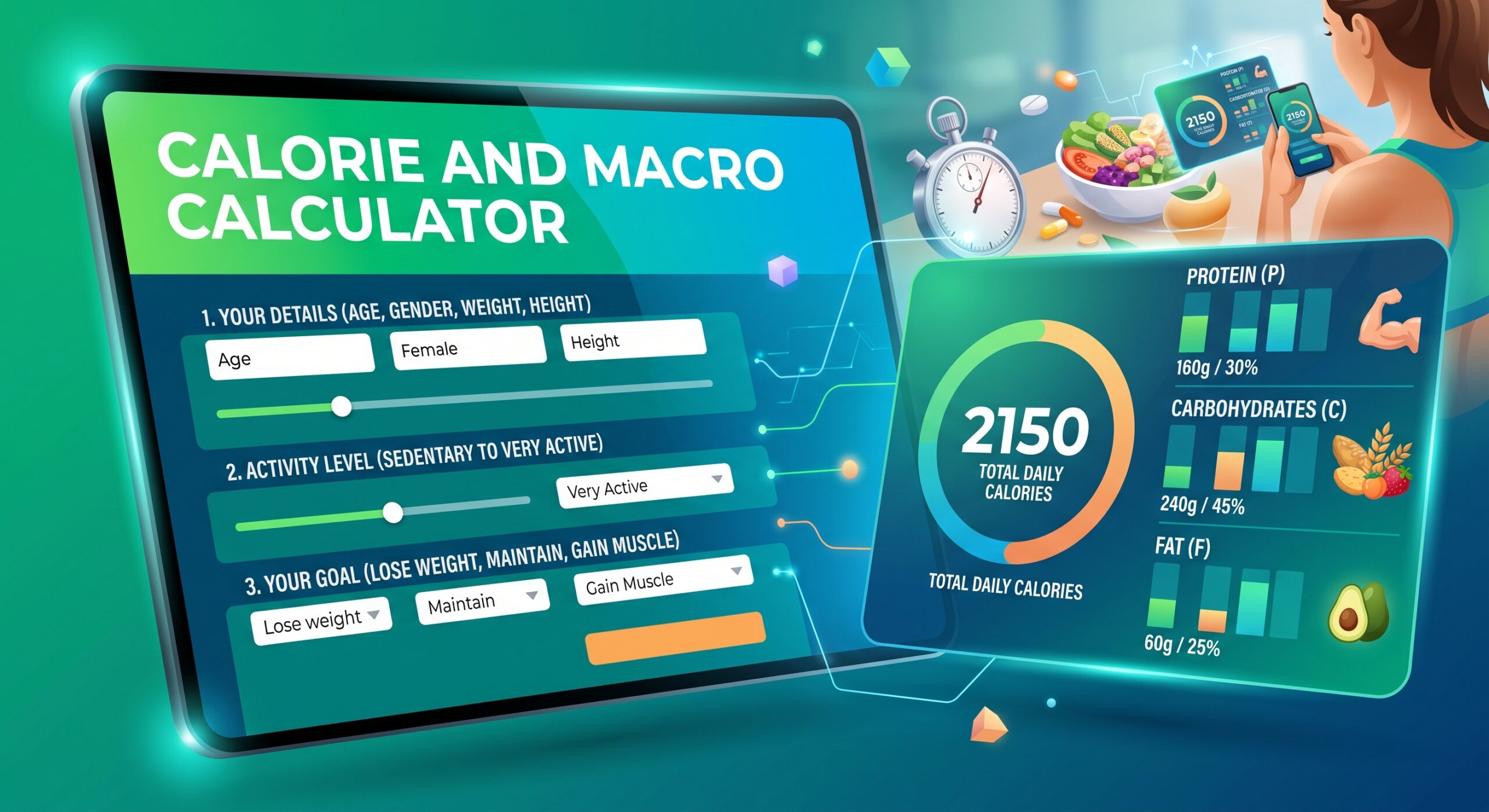
Setting up an effective calorie and macro calculator requires dialing in your baseline energy before adjusting a single macronutrient slider. I start every client with the Mifflin-St Jeor formula to estimate Resting Metabolic Rate, apply an activity multiplier between 1.2 and 1.75, and set protein between 1.6 to 2.2 grams per kilogram of body weight depending on training volume. Balancing overall energy intake with precise amino acid availability prevents muscle loss during a deficit while keeping metabolic rate stable.
Energy Benchmarks and Macro Distributions Across Different Fitness Targets
Every gram of macronutrient carries a distinct energetic value: protein and carbohydrates supply roughly 4 calories per gram, while dietary fats supply 9 calories per gram. Determining the correct distribution depends on your total daily energy expenditure (TDEE), physical activity levels, and cellular energy demands.
A standard macro split for fat loss prioritizes elevated protein intake to preserve lean tissue, alongside moderate fat for hormone production and carbohydrates tailored to training volume. The table below outlines standard metabolic benchmarks across common athletic objectives.
| Fitness Goal | Daily Calorie Benchmark | Macro Split (P / F / C) | Physiological Objective |
|---|---|---|---|
| Aggressive Cut | TDEE minus 20% to 25% | 40% P / 25% F / 35% C | Maximize fat loss; protect muscle mass |
| Moderate Deficit | TDEE minus 10% to 15% | 30% P / 30% F / 40% C | Sustainable fat reduction; preserve strength |
| Metabolic Maintenance | 100% of calculated TDEE | 25% P / 30% F / 45% C | Maintain weight; optimize recovery |
| Lean Muscle Gain | TDEE plus 5% to 10% | 25% P / 20% F / 55% C | Fuel muscle protein synthesis; replenish glycogen |
Target Recommendations by Goal
| Primary Goal | Core Recommendation |
|---|---|
| Fat Loss | High protein (2.0–2.2g/kg), moderate deficit |
| Recomposition | Maintenance calories, heavy resistance training |
| Hypertrophy | Small surplus (+250 kcal), high carb intake |
| Endurance Performance | Moderate protein (1.4–1.6g/kg), high carb (5–8g/kg) |
How Calorie and Macro Adjustments Shift Your Internal Physiology
Modifying your daily caloric intake and macronutrient ratios triggers immediate shifts in metabolic rate, digestion costs, and hormonal signaling pathways. Understanding these physiological adaptations helps you anticipate hunger patterns and maintain lean tissue during periods of energy restriction.
Thermic Effect of Food and Digestible Energy Costs
The energy required to digest, absorb, and metabolize nutrients is known as the thermic effect of food (TEF). TEF accounts for approximately 10% of total daily energy expenditure, but the cost varies significantly across macronutrient categories:
- Dietary Protein: Requires 20% to 30% of its gross energy for breakdown and processing.
- Carbohydrates: Require 5% to 10% of their energy for digestion and glycogen conversion.
- Dietary Fats: Require 0% to 3% of consumed energy, making them the most metabolically efficient macronutrient to store.
When you increase daily protein intake from 15% to 30% of total calories within a 2,000-calorie diet, you burn an extra 60 to 90 calories per day purely through digestive thermogenesis. This digestive overhead provides a distinct advantage during fat loss phases.
Satiety Signaling via GLP-1, PYY, and Cholecystokinin
Energy balance is regulated by endocrine signals produced in the gastrointestinal tract. Protein and viscous dietary fibers trigger enteroendocrine L-cells in the distal gut to release satiety hormones:
- GLP-1 (Glucagon-Like Peptide-1): Delays gastric emptying and reduces brain reward responses to food.
- PYY (Peptide YY): Suppresses appetite and lowers circulating levels of the hunger hormone ghrelin.
- CCK (Cholecystokinin): Released in response to dietary fats and proteins to signal fullness to the vagus nerve.
Replacing 30 grams of morning fast-digesting carbohydrates with whole eggs and turkey sausage reduces late-afternoon hunger ratings by roughly 40%. Slowing down gastric motility stabilizes blood glucose levels and prevents energy crashes.
Muscle Protein Synthesis and Nitrogen Balance Control
To maintain skeletal muscle while eating in a deficit, the body must maintain a positive net nitrogen balance. Muscle protein synthesis (MPS) relies on the presence of essential amino acids, particularly leucine, which activates the intracellular mTORC1 signaling pathway.
Consuming 2.5 to 3.0 grams of leucine per meal—found in roughly 30 grams of whey protein or 120 grams of lean chicken breast—triggers maximal MPS. Distributing protein evenly across 3 to 5 meals per day maintains elevated rates of protein synthesis compared to eating the same total protein amount in a single evening meal.
Glycogen Depletion, Thyroid Downregulation, and Leptin Dynamics
Extended caloric deficits alter hormone production and metabolic efficiency. As adipose tissue decreases, circulating leptin drops, which signals the hypothalamus to increase hunger and conserve energy.
At the same time, low carbohydrate intake decreases hepatic glycogen stores, reducing the conversion of inactive thyroid hormone (T4) into active triiodothyronine (T3). Incorporating periodic carbohydrate refeeds elevates circulating T3, restores liver glycogen, and temporarily increases leptin levels to maintain metabolic output.
Real-World Tracking Traps, Cooked-Weight Errors, and Daily Meal Timing
Small measuring mistakes can accumulate quickly, turning an intended 500-calorie deficit into maintenance or an unintended surplus. Consistently logging food state and accounting for preparation methods ensures your calculated targets match your actual intake.
Raw Versus Cooked Weight Discrepancies and Hidden Lipid Traps
Food items gain or lose water weight during cooking, which dramatically alters their energy density per gram:
- Meat and Poultry: Lose roughly 20% to 25% of their weight as water during cooking. A 100g raw chicken breast (110 kcal, 23g protein) becomes roughly 75g when cooked. If you log 100g of cooked chicken using a raw entry, you underestimate intake by nearly 35%.
- Grains and Starch: Absorb water, expanding to roughly 2.5 to 3 times their dry weight. A 100g serving of dry jasmine rice contains ~350 kcal, but 100g of cooked rice contains only ~130 kcal. Logging cooked rice with a dry entry leads to drastic over-counting.
- Added Cooking Oils: A single tablespoon of unmeasured olive oil or butter adds 120 calories and 14 grams of fat. Failing to weigh cooking fats is one of the most common tracking errors.
From an economic perspective, buying dry staples (like bulk oats, dry beans, and raw rice) and family-pack raw proteins provides a lower cost per gram of protein and carbohydrate than pre-cooked convenience items, while giving you complete control over raw tracking accuracy.
A Four-Week Deficit Realignment Case Study
A client, Marcus (34 years old, 185 lbs, targeting fat loss), stalled at his starting weight for three consecutive weeks despite tracking a calculated 1,900-calorie budget. A review of his tracking logs revealed two primary errors: he was recording cooked white rice using raw food database entries and cooking his evening meals with unmeasured skillet oil spray.
Correcting his entries revealed his actual intake was averaging 2,380 calories per day—completely eliminating his intended 500-calorie deficit. After switching to weighing all grains raw and measuring cooking oils with a teaspoon, his intake dropped to the target 1,900 calories. Over the following 14 days, he dropped 3.2 pounds of scale weight without changing his exercise routine.
Managing the Week Two Hunger Spike and Water Weight Shifts
Entering a caloric deficit triggers predictable biological challenges. Around day 10 to 14, initial glycogen depletion slows down, water weight loss levels off, and circulating ghrelin peaks. This combination often causes physical fatigue and increased hunger cravings.
During this period, temporary water retention caused by elevated cortisol can mask actual fat loss on the scale for up to two weeks. Staying consistent with your calculated targets rather than dropping calories further prevents metabolic fatigue and preserves training intensity.
Step-by-Step TDEE and Macro Calculation Protocol
Use this manual calculation process to establish and verify your daily targets:
- Calculate RMR (Mifflin-St Jeor):Males: RMR = (10 × weight in kg) + (6.25 × height in cm) – (5 × age in yrs) + 5Females: RMR = (10 × weight in kg) + (6.25 × height in cm) – (5 × age in yrs) – 161
- Determine TDEE: Multiply RMR by an activity factor (1.2 for sedentary, 1.375 for light activity, 1.55 for moderate activity, 1.725 for heavy training).
- Apply Goal Adjustment: Subtract 15% to 20% for fat loss; add 10% for muscle gain.
- Set Protein Target: Multiply total body weight in kilograms by 1.8 to 2.2g. Multiply these grams by 4 to find total protein calories.
- Set Dietary Fat Target: Allocate 20% to 30% of total target calories to fats. Divide fat calories by 9 to get target grams.
- Allocate Remaining Calories to Carbohydrates: Subtract protein and fat calories from your total calorie target. Divide the remaining calories by 4 to determine carbohydrate grams.
Macro Adjustment Cheat Sheet
| Tracking Scenario | Root Cause | Actionable Correction |
|---|---|---|
| Scale stalled for 3+ weeks | Uncounted calories or hidden fats | Audit cooking oils; switch to weighing all foods raw |
| Extreme fatigue during workouts | Insufficient glycogen or low total carbs | Shift 40% of daily carbs into pre/post-workout meals |
| Constant hunger between meals | Low protein density or low fiber intake | Increase protein to 2.2g/kg; target 14g fiber per 1,000 kcal |
| Rapid early weight loss stops | Glycogen water weight loss leveling off | Maintain current targets; evaluate over a 14-day window |
Calorie & Macro Optimization: Answers from the Field
How do I recalculate macros when my weight loss stalls for more than two weeks?
Verify that your tracking accuracy is 100% precise by weighing all food raw and accounting for cooking oils. If tracking is accurate and your body weight has remained stable for 21 days, reduce daily carbohydrate intake by 25 to 30 grams or lower fat intake by 8 to 10 grams. This re-establishes a moderate energy deficit without compromising your daily protein target.
Should I track macros using raw or cooked food weights in my calculator?
Weighing food raw is significantly more accurate because cooking time, temperature, and moisture loss vary widely. A raw food entry in a tracking database accounts for exact, unadjusted nutrient density. If you must weigh food cooked, ensure you select a database entry that explicitly states “cooked” or “grilled” to avoid major calorie miscalculations.
How does the thermic effect of food impact my net calorie balance?
The thermic effect of food reduces the net energy absorbed from what you eat. While carbohydrates yield 4 calories per gram gross, your body uses roughly 5% to 10% of that energy during digestion. Protein requires up to 30% of its caloric value for digestive breakdown, meaning a high-protein intake yields a lower net caloric availability compared to an equivalent intake of fats or refined carbohydrates.
Is a high-protein macro split safe for individuals without kidney conditions?
In individuals with normal, healthy renal function, high-protein diets up to 2.8 grams per kilogram of body weight have been shown to be safe in clinical trials. The kidneys adapt to increased protein intake by increasing glomerular filtration rate without causing damage. However, individuals with pre-existing chronic kidney disease or impaired renal clearance should consult a nephrologist before increasing protein intake.
How do I adjust my TDEE calculator settings if I work a desk job but train heavily?
Set your baseline activity multiplier to “Sedentary” (1.2) to reflect your 8 hours at a desk, then manually add the energy cost of your workouts. Alternatively, select “Lightly Active” (1.375) rather than “Very Active”. Most automated calculators overestimate non-exercise activity thermogenesis (NEAT) for sedentary workers who train for an hour a day.
This content is based on nutritional physiology and energy metabolism research. It is for informational purposes only and does not constitute medical advice. Consult a qualified healthcare professional before making significant alterations to your caloric or macronutrient intake.