
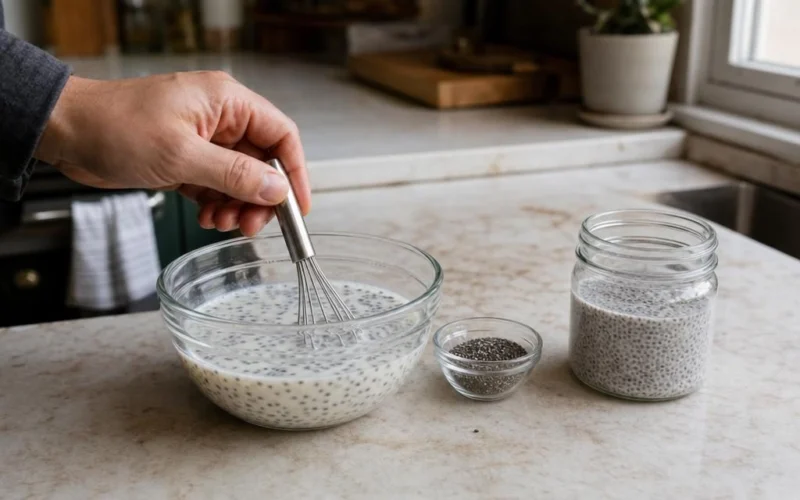
To prevent clumps, whisk chia seeds thoroughly into the liquid, wait 5–10 minutes, then stir again while scraping the bottom and sides. Refrigerate for at least 2 hours, preferably overnight, and stir before serving. A wide bowl is easiest to mix; a jar works if it can be shaken and opened for the second stir.
Start With the Right Ratio and Mixing Setup
Chia pudding ratios are volume measurements, not weight measurements. There is no single universally correct ratio: use less chia for a softer set and more for a thicker pudding.
| Chia seeds per 1 cup liquid | Expected texture | Best use |
|---|---|---|
| 3 tablespoons | Softer and looser | Spoonable pudding with a lighter set |
| 1/4 cup | Thicker | Firm pudding or a make-ahead breakfast |
Both ratios are reasonable preferences, not contradictory rules. A 1/4-cup-to-1-cup format appears in recipe guidance from Harvard T.H. Chan School of Public Health and institutional recipes from Alberta Health Services. Recipe sources also commonly use about 3 tablespoons per cup for a softer texture.
You can use dairy milk, plant milk, or another pourable liquid. Yogurt mixtures, protein powder, fruit purée, and thick coconut milk can make the base harder to disperse, so they may need extra whisking or a little additional liquid.
For the most even mixing, use a wide, shallow bowl. It gives you room to whisk and makes it easy to reach the bottom and sides. A wide-mouth jar is convenient for a small batch, but a narrow jar can hide settled seeds and make a thick mixture difficult to stir.
You will need chia seeds, liquid, a whisk or fork, and a bowl or jar. Sweetener, vanilla, cocoa, spices, and fruit are optional. Mix thick flavorings into the liquid as thoroughly as possible before adding the seeds.
Use a Two-Stir Schedule
The mixing order matters. Combine the liquid with any sweetener or flavorings first, then add the chia seeds and whisk immediately. As the seeds hydrate, they begin forming a gel around themselves and may settle while the liquid remains above them. That early separation can create clumps at the bottom.
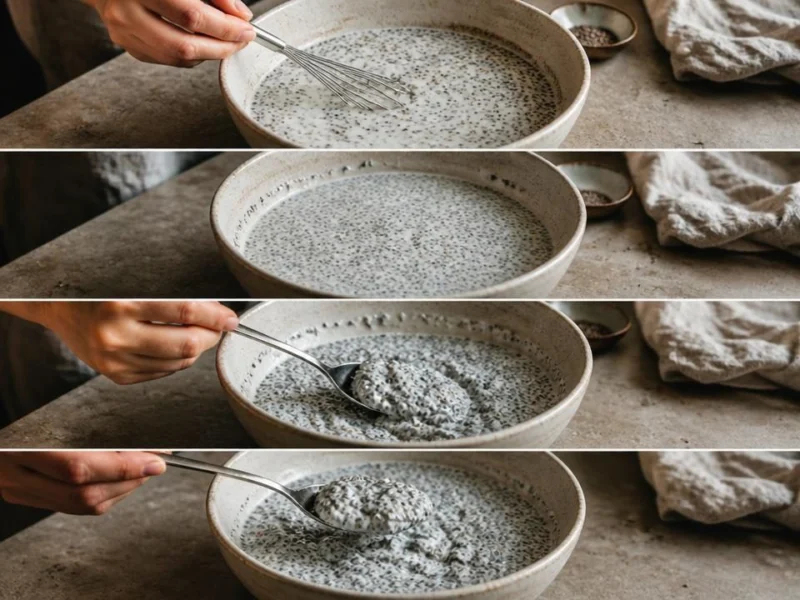
- Immediately: Whisk thoroughly, breaking up seeds on the bottom and sides.
- After 5–10 minutes: Stir again, scraping the bottom and sides so partially hydrated seeds are redistributed.
- After at least 2 hours: Stir before serving and adjust the consistency if necessary.
This second stir is recurring culinary guidance from recipe sources, not a formally established universal timing rule. Five to 10 minutes is a practical starting point because the seeds have begun to hydrate while the mixture is still easy to stir.
Shaking a jar once may not fully redistribute every seed, particularly in a narrow container. Open the jar for the second stir so you can reach the settled layer directly.
Refrigerate, Then Adjust the Texture
Chia pudding needs at least 2 hours in the refrigerator to set. Overnight chilling is common and convenient, but it is not required for every batch. The pudding may continue to thicken as it chills.
Before serving, stir from the bottom and check the consistency. If it is too thick, add a small splash of milk or another compatible liquid and stir. Add liquid gradually; a large pour can make the pudding watery.
Blending is useful when you want a smoother, less seed-like texture. It breaks up the visible seed structure and can help disperse small lumps, but it changes the character of the pudding. Blended chia pudding is not the same as preventing clumps in a whole-seed mixture.
Rescue Chia Pudding That Is Already Clumpy
A clumpy batch is usually workable, especially if the lumps are simply seeds that settled and gelled together.
- Stir vigorously with a whisk or fork.
- Press compact clumps against the side of the bowl to separate them.
- Add a small splash of liquid if the mixture is too thick to work easily.
- Let it rest briefly, then stir again.
- Blend it if you prefer a smooth, less seed-like texture.
A watery layer on top can usually be reincorporated by stirring thoroughly. If the mixture remains loose, continue chilling before adding more chia. Adding a large amount of seeds immediately can create a second round of dense lumps. If you do need to thicken it later, add a small amount, mix well, and repeat the early stirring process.
Some gel around individual seeds is normal chia pudding texture. True clumps are compact masses that remain together instead of separating when stirred.
Troubleshoot the Texture You Got
| Symptom | Likely explanation | Next action |
|---|---|---|
| Clumps at the bottom | Seeds settled during early hydration | Scrape the bottom and repeat the second stir |
| Watery layer on top | The mixture was not fully redistributed or hydrated | Stir thoroughly and continue chilling |
| Too thick | The ratio or ingredients produced a firm set | Add liquid a little at a time and stir |
| Too thin | The seeds have not finished hydrating or the mixture has relatively more liquid | Chill longer first; if still thin, add a small amount of chia and repeat the early stirring process |
| Seed-like or uneven texture | The seeds did not hydrate evenly | Stir again or blend for a smoother result |
| Clumps after adding yogurt, protein powder, fruit purée, or thick coconut milk | The thicker base made the seeds harder to disperse | Thin the mixture slightly and whisk more thoroughly |
Choose the Best Method for Your Container and Ingredients
- Wide bowl: Best for large batches and for scraping the base and sides when mixing.
- Wide-mouth jar: Convenient for small batches if you can open it for the second stir.
- Narrow jar: Usable, but shaking may leave settled clumps. Transfer the mixture to a bowl if thorough stirring is difficult.
- Thick add-ins: Mix or thin yogurt, protein powder, fruit purée, or thick coconut milk into the liquid before adding chia when practical.
Different brands, seed sizes, or seed freshness may contribute to texture variation, but they are not guaranteed causes of failure. If a batch behaves differently from one you have made before, adjust the liquid gradually and focus on thorough mixing rather than assuming the ratio is wrong.