
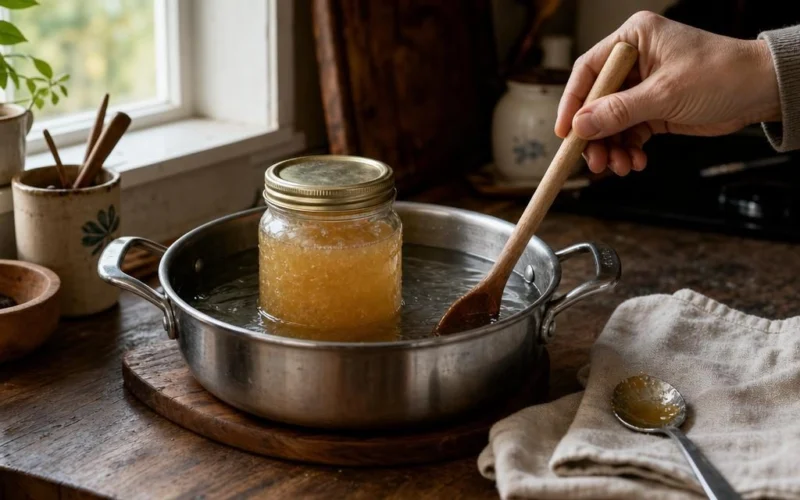
The most dependable way to soften crystallized honey is a warm-water bath. Loosen the lid, place the container in warm water—about 100–120°F (38–49°C)—and stir occasionally until the honey reaches the texture you want. Use warm, not boiling, water: hotter is not necessarily better and can increase the risk of uneven heating, darkening, or flavor changes.
How to Soften Crystallized Honey in a Warm-Water Bath
Choose the container first: use this bath only with a container that is clearly heat-safe. If the original container is not clearly heat-safe, transfer the honey to heat-safe glass before warming it, or do not heat the container. This 100–120°F (38–49°C) range is a gentle household working range, not a universal scientific requirement.
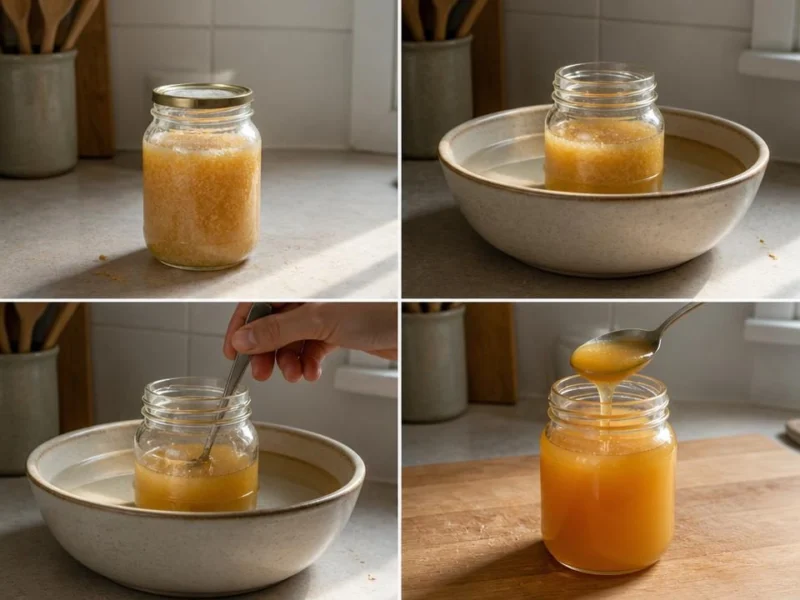
Materials: crystallized honey in a heat-safe container, a bowl or saucepan larger than the container, warm water, a spoon or clean stirrer, and a towel for drying the container.
- Loosen the lid. Do not seal the container tightly while warming it.
- Set the container in warm water. Place it in a bowl or saucepan of 100–120°F (38–49°C) water. Keep the water below the lid and, where practical, near the level of the honey.
- Stir periodically. Every few minutes, stir the honey so warmer and cooler portions mix.
- Refresh the water as needed. If the water cools before the honey is ready, replace it with fresh warm water rather than using boiling water or stronger direct heat.
- Stop at the texture you need. Remove the container when the honey is soft enough to use, pourable, or fully smooth. Do not continue heating once the desired texture returns.
- Dry and close the container. Wipe the outside dry, allow the container to cool slightly if it is hot to the touch, and close the lid.
A small amount may soften in several minutes, while a large jar of very firm honey may need repeated warm-water cycles. The timing varies with the container size, honey volume, and firmness of the crystals, so no single schedule applies to every batch.
Choose the stopping point you need
- Soft enough to scoop: remove the container when a spoon can move through the honey comfortably.
- Pourable: continue gentle warming and stirring until the honey flows more easily.
- Fully reliquefied: continue only until visible crystals dissolve, then stop. Prolonged heating is unnecessary.
What to Do With Honey in a Plastic Squeeze Bottle
Check the package instructions before putting a squeeze bottle in warm water or a microwave. Ordinary plastic packaging should not be assumed to be heat-safe.
If the bottle is not explicitly approved for warm-water heating, transfer the honey to a heat-safe glass container before warming it. Keep the cap out of the water and make sure water cannot enter the bottle. Never microwave plastic packaging unless the manufacturer specifically permits it for that use.
If the crystallized honey cannot be transferred without making a mess or damaging the bottle, scoop out only the portion you need and soften it in a small heat-safe container. You can also use it crystallized if the recipe or food allows for a thicker texture.
Warm-Water Bath vs. Microwave
| Criteria | Warm-water bath | Microwave |
|---|---|---|
| Control over heating | Gradual, surrounding heat; easier to monitor | Rapid heating with less even control |
| Risk of hot spots | Lower when the honey is stirred | Higher; some areas may overheat while crystals remain |
| Container requirements | Heat-safe container; keep the lid and water level in mind | Clearly microwave-safe, nonmetal container with no unsuitable lid |
| Best use | A whole jar or a gentle, even softening | A small amount when speed matters and the container is suitable |
| Main drawback | Takes longer and may require refreshed water | Uneven heating makes overheating easier |
For a whole jar, the warm-water bath is the better default. A microwave can work for a small amount, but use a microwave-safe, nonmetal container, heat in brief intervals, stir between intervals, and stop early. Do not use a universal microwave time: power level, quantity, container shape, and honey composition all affect the result. USDA research on microwave liquefaction found that heating can be uneven, so a microwave is less forgiving than indirect water-bath heating.
Why Honey Crystallizes—and Whether It Has Gone Bad
Honey is a concentrated sugar solution. Over time, glucose can separate from the liquid portion and form crystals. The rate varies with the honey’s type, water content, storage conditions, and the presence of tiny particles such as pollen that can act as starting points for crystals.
Crystallization changes the texture, but it does not automatically mean the honey has spoiled. Utah State University Extension explains that crystallized honey remains usable and can be returned to a liquid texture with gentle warming. The National Honey Board also describes crystallization as a natural process.
Not every thick honey needs to be liquefied. Creamed honey is intentionally crystallized into a fine, spreadable texture and may be designed to remain thick.
Do not treat obvious mold, a fermented smell, or signs of contamination as ordinary crystallization. Those are separate freshness concerns, and reheating is not a reliable way to correct them.
Troubleshooting a Hard or Uneven Batch
| What you notice | What to do |
|---|---|
| Crystals remain after one cycle | Stir the honey, refresh the bath with warm water, and repeat the warming briefly. |
| The outside is hot but the center is hard | Use a larger water bath, stir more often, and avoid stronger direct heat. Uneven heating can leave the center crystallized while the outside overheats. |
| The water cooled quickly | Replace it with fresh warm water, keeping the water below the lid and the honey line where practical. |
| The honey is in unsuitable plastic | Transfer the honey to heat-safe glass before warming, or use it crystallized if it cannot be transferred safely. |
| The honey became darker or tastes different | Stop heating. Further high heat may cause additional color or flavor changes. |
| Water touched a closed container | Dry the outside and check that the lid is secure. If no water entered, the honey can remain in the container. |
| Water or contamination entered an open container | Do not return it to casual room-temperature storage. If contamination is suspected, discard the honey rather than treating it as ordinary crystallization. |
| You need only one serving | Scoop out that amount and warm it gently in a small heat-safe container, or warm a spoonful over warm water instead of reheating the whole jar. |
Use a warm-water bath, repeat gently if necessary, and remove the honey as soon as the desired texture returns. Dry the container and store it at room temperature.