
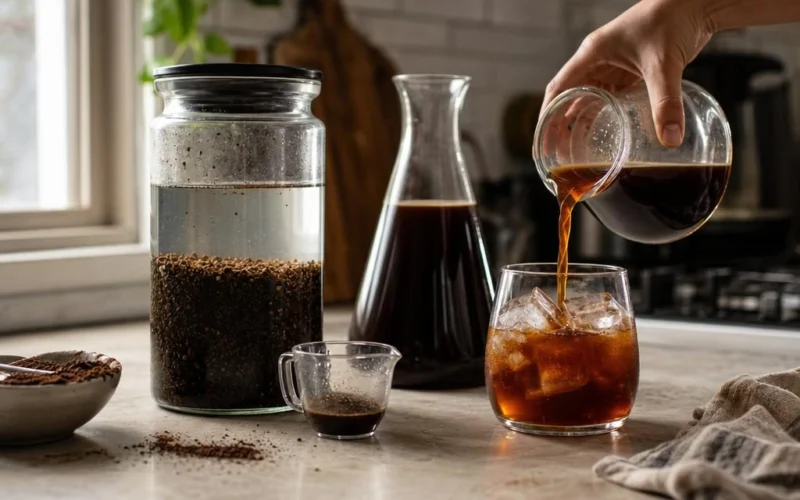
If your cold brew is still steeping and already tastes bitter, strain it now—leaving the grounds in longer is unlikely to improve it. If it is already strained, add water a little at a time and taste between additions; this lowers intensity, but it cannot fully remove harsh over-extracted or smoky roast flavors. For the next batch, shorten the steep or use a coarser, more even grind before changing the coffee-to-water ratio.
Rescue a Bitter Cold Brew Without Making It Weak
If the coffee is still steeping
Strain it immediately through your intended filter. If you use a reusable metal filter, a second pass through a paper filter can remove more fine sediment, which may help if the coffee tastes muddy or gritty.
Do not squeeze, press, or aggressively wring out the grounds. This can push fine particles into the brew and make an already harsh batch taste heavier. Taste a small sample before adding ice, water, or milk.
If the batch is already strained
Dilute gradually instead of filling the glass with water all at once. For one glass of cold brew, add 1 tablespoon of water at a time, stir, and taste. For a larger batch of concentrate, start with about 10% more water, then reassess.
- Add a small amount of cold water.
- Stir thoroughly and taste before adding ice.
- Stop when the harshness softens but the coffee still tastes full.
Taste the strained batch as a concentrate, then dilute a small portion to drinking strength; do not judge the baseline concentrate as a ready-to-drink serving.
Water reduces strength and perceived bitterness, but it cannot reliably erase burnt, ashy, woody, or aggressively over-extracted flavors. If the drink becomes thin before it becomes pleasant, stop diluting. Use the batch in a milk-based drink, blended coffee drink, or baking recipe, or remake it with better extraction control.
Diagnose What Made the Cold Brew Bitter
“Bitter” can describe several different problems. Extraction is how much soluble material moves from the coffee into the water. Strength is how concentrated the finished drink tastes. Roast character comes from the coffee itself and can taste dark, smoky, or ashy even when the brewing time was reasonable.
| Symptom | Likely cause | Immediate fix | Next-batch adjustment |
|---|---|---|---|
| Bitter and still steeping | Contact time is already too long for this coffee and setup | Strain now | Shorten the steep first |
| Bitter after a long steep | Too much extraction for the grind, temperature, or coffee | Dilute modestly or use with milk | Reduce steep time |
| Strong, muddy, or gritty | Too many fine particles or incomplete filtration | Filter again without pressing grounds | Use a coarser, more even grind |
| Dark, smoky, or ashy despite reasonable timing | Roast character may be the issue | Try it with milk if desired | Test a medium roast |
| Bitter but watery after dilution | Too much water added to a harsh brew | Stop diluting | Make a stronger concentrate with a shorter, controlled steep |
| Harsh flavor with regular drip-ground coffee | Smaller particles and fines extract differently and leave more sediment | Strain carefully | Use a shorter steep or switch to coarser grounds |
| Flat or unpleasant flavor despite recipe changes | Coffee quality, staleness, or water flavor | Check the water and coffee aroma | Try fresher coffee, different beans, or better-tasting water |
Cold brew is not automatically immune to over-extraction. Research shows that grinding, extraction time, and coffee type can change both the chemistry and sensory characteristics of cold brew. In one tested setup, coarser grinding and a shorter extraction produced higher sensory scores, but that does not create one universal recipe for every coffee or brewer. The Scientific Reports study is useful evidence for testing these variables deliberately rather than assuming more time will always improve the brew.
Adjust the Variables in the Right Order
There is no single official cold-brew recipe. Home methods vary widely in coffee type, water temperature, grind, ratio, filtration, and steep time, so the goal is a controlled test rather than chasing one supposedly perfect number. A pilot study of cold brew methods also found that the category lacks a uniform definition and standardized consumer recipe.
First check steep time
If your cold brew is harsh, shorten the next steep before making a major ratio change. A useful refrigerator starting range is 12 to 16 hours. That is a test range, not a guarantee: the coffee, grind, brewing vessel, and filter all affect the result.
Room-temperature brewing generally extracts faster than refrigerator brewing because warmer water encourages faster extraction. If you brew on the counter, begin with less contact time than you would use in the refrigerator and taste before committing to a longer steep.
Do not try to rescue a bitter batch by steeping it longer. Once the brew tastes harsh, extra contact time is more likely to add unwanted flavor than restore balance.
Then check grind size and particle consistency
For immersion cold brew, aim for coarse, fairly even grounds that resemble coarse sea salt. They should look distinctly larger than standard drip grounds, without a large amount of visible powder at the bottom of the bag or grinder.
Fine particles, often called fines, can make filtration harder and may contribute to sediment, muddiness, and harsh sensory results. That does not mean fine grounds always make cold brew bitter; the effect depends on the recipe and brewing method. But if your coffee tastes gritty or heavily extracted, a coarser and more consistent grind is a sensible next test.
Regular pre-ground drip coffee is usually finer than ideal for cold brew. You can still use it, but shorten the steep, expect more sediment, and filter carefully. Treat it as a different setup rather than assuming it will behave exactly like a coarse cold-brew grind.
Evaluate the coffee and water
If the cold brew tastes smoky, charred, or ashy, timing may not be the main problem. Dark roasts can bring strong roasty flavors that some people enjoy and others read as burnt or bitter. Dark roast is not automatically more bitter than every medium roast, but a medium roast is often an easier starting point when your goal is a smoother, less smoky cup.
Water matters because it becomes most of the finished drink. Use fresh water that tastes good on its own. If your tap water has obvious chlorine, mineral, or off-flavors, filtered water may produce a cleaner-tasting brew. It will not, however, correct a batch that was steeped too long or made with overly fine grounds.
Use a Stronger Concentrate Instead of Making a Weak Batch
Separate the strength of the brewed concentrate from the strength of the drink in your glass. Brew a relatively strong concentrate, then dilute a small portion with water or milk to your preferred drinking strength. Do not judge the undiluted concentrate as though it were a ready-to-drink serving.
Weight is more reliable than measuring grounds by cups because coffee volume varies with bean density and grind size. The ratio is a practical starting point, not a universal formula.
Using more coffee relative to water generally produces a stronger concentrate. Steep time, particle size, and brewing temperature affect extraction and flavor instead: they influence how much material is drawn from the grounds and can change whether the coffee tastes balanced, harsh, muddy, or roasty. A strong concentrate can be clean and balanced, while a weak drink can still taste bitter because of poor extraction or roast character.
Change only one variable per batch and record the result. If you alter the steep time, roast, grind, and ratio together, you will not know which adjustment improved—or worsened—the coffee.
A Repeatable Next-Batch Method
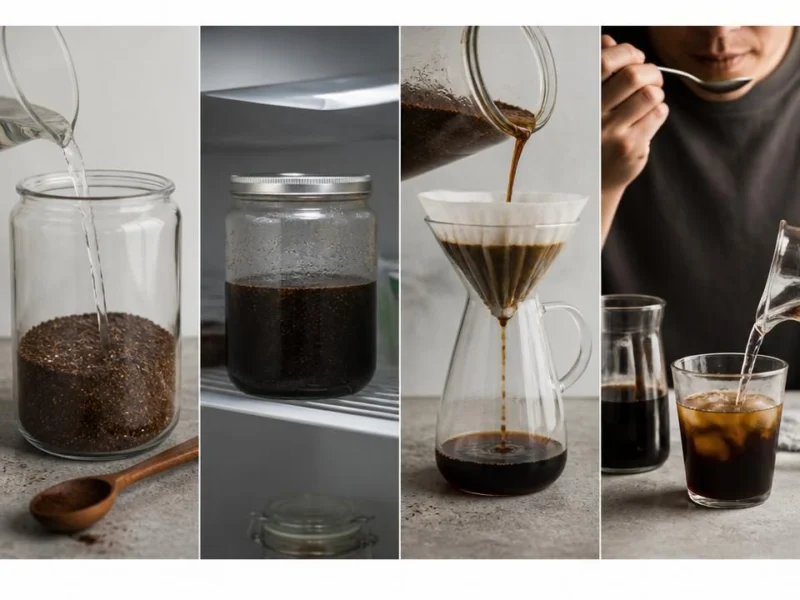
- Choose a medium roast, or another coffee that does not already smell strongly smoky or ashy.
- Grind it coarsely and as evenly as your grinder allows, roughly like coarse sea salt.
- Weigh coffee and water using a 1:8 to 1:10 coffee-to-water ratio.
- Steep in the refrigerator for 12 to 16 hours as your first test.
- Strain thoroughly without squeezing or pressing the grounds.
- Taste the concentrate before adding lots of ice or water, then dilute gradually to your preferred drinking strength.
- For the next batch, change only one factor: steep time, grind, roast, or ratio.
Use the result to guide the next adjustment. If it is still bitter and harsh, shorten the steep first. If it is muddy or gritty, improve grind consistency and filtration. If it is smoky or ashy, test a different roast. If it tastes pleasant but weak, use less dilution or make a stronger concentrate next time. If it is bitter and watery, stop diluting and remake it with controlled extraction.
If the coffee is still harsh after a shorter, controlled steep and better filtration, change the roast or coffee rather than continuing to add water.