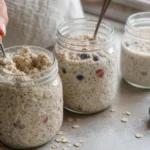
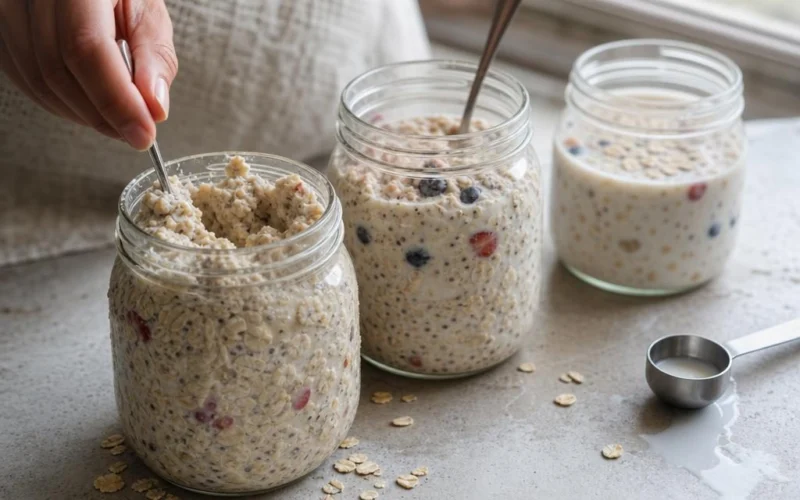
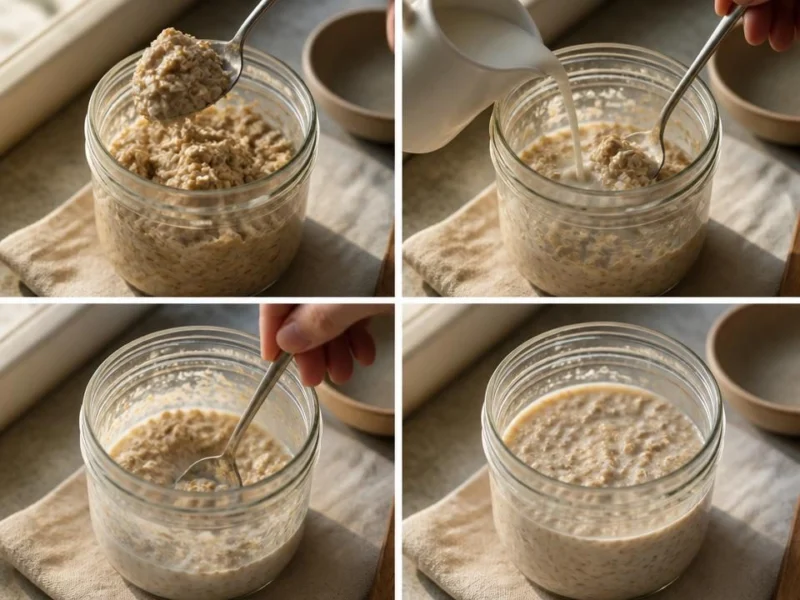
If your overnight oats are too thick, stir in 1 tablespoon of milk at a time, waiting 2–5 minutes between additions. If they are too runny, mix in 1 tablespoon of rolled oats or 1–2 tablespoons of Greek yogurt, then rest them for 20–30 minutes. If liquid is pooling around the edges, stir thoroughly first; add 1 teaspoon of chia only if the mixture remains loose, then allow 10–30 minutes for it to hydrate. These are starting adjustments, since oat type, yogurt, fruit, chia, and protein powder can all change the final texture.
Start With Your Texture Target
Before fixing the batch, decide what you actually want it to feel like. Thick overnight oats are not inherently better than loose ones; the right consistency depends on whether you want a breakfast you can scoop, stir, or drink.
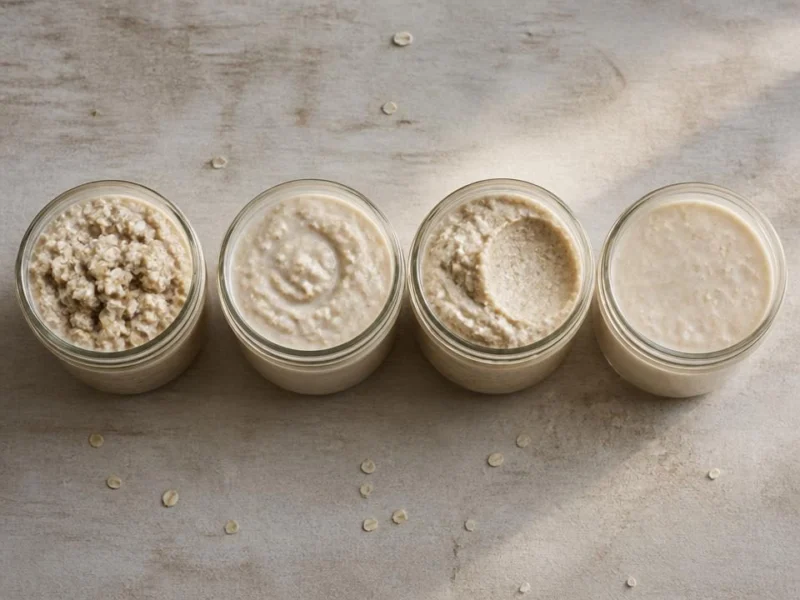
| Texture target | What it looks like | Typical use |
|---|---|---|
| Spoonable | Holds its shape briefly, then settles when stirred | An everyday bowl or jar of oats |
| Creamy | Soft and fluid, with no pool of liquid around the edges | Oats with yogurt, fruit, or nut butter |
| Pudding-thick | Dense, scoopable, and slow to move in the container | A chia-heavy or high-protein style |
| Drinkable | Loose enough to pour or sip from a jar | A smoothie-like breakfast |
A mixture can be loose and still be pleasantly creamy. “Watery” is different: it usually means you see separated liquid around the sides or bottom, often after fruit has released juice or ingredients were not fully mixed.
Use This One-Serving Starting Ratio
For a dependable spoonable-to-creamy base, start with:
- 1/2 cup rolled oats
- 1/2 cup milk
- 1/4 cup yogurt
- 1 teaspoon chia seeds, optional
Mix thoroughly, cover, and refrigerate for at least 4 hours. A chilling window of roughly 2–8 hours can work depending on the ingredients and the texture you prefer; overnight oats do not need exactly eight hours. The University of Iowa’s overnight oats recipe, for example, calls for refrigerating the mixture for at least four hours.
This formula is a useful starting point, not a universal rule. Recipes vary because some use more milk, no yogurt, extra chia, fruit, or powders that soak up liquid. Both the University of Illinois Extension and the Colorado State University Kendall Reagan Nutrition Center use related oat-and-milk combinations, with optional ingredients changing the amount of liquid needed.
- If you skip yogurt: begin with a little more milk if you want a creamy result.
- If you add chia, protein powder, mashed banana, or nut butter: hold back or reserve a small amount of extra milk for later.
- If you prefer looser oats: increase milk gradually instead of making a large change before chilling.
Why the Texture Changed
| Ingredient or variable | Usual effect on texture | Next-batch consideration |
|---|---|---|
| Rolled oats | Predictably tender and spoonable | Best default for consistent results |
| Quick oats | Soften rapidly and can become mushy | Expect a softer texture |
| Steel-cut oats | Remain firmer and chewier | Use a steel-cut-specific method |
| Chia seeds | Absorb liquid and thicken as they hydrate | Use conservatively |
| Yogurt | Adds creaminess and thickness | Account for its added solids |
| Protein powder | May thicken or turn pasty, depending on the formula | Reserve extra liquid |
| Banana or nut butter | Adds body and density | Plan for additional milk |
| Fresh or frozen fruit | Can release juice during chilling | Add especially juicy fruit later |
| Soaking time and mixing | Changes hydration and texture evenness | Mix fully and allow adequate chilling time |
Rolled, Quick, and Steel-Cut Oats
Rolled oats are the most predictable choice for standard overnight oats because they soften without usually becoming pasty. They are the oat type used in many university recipe versions, including North Carolina State University’s berry overnight oats.
Quick or instant oats absorb liquid faster, so they can work but tend to produce a softer, mushier bowl. Steel-cut oats behave differently: they generally stay chewy and need a different preparation approach, so they are not a one-for-one substitute for rolled oats. Absorption can also vary by brand and oat cut.
Chia Seeds
Chia thickens the mixture as it hydrates, but too much can create a gel-like or gummy texture. Chia is not a guaranteed answer to liquid around the edges, which may instead be fruit juice or uneven mixing.
If chia is added to an already mixed serving, give it 10–30 minutes to hydrate before reassessing the texture. Treat any amount as a starting adjustment rather than a fixed rule, since yogurt, fruit, protein powder, and oat type also affect absorption.
Yogurt, Protein Powder, and Nut Butter
Greek yogurt adds solids and creaminess, so it often makes oats thicker than milk alone. Protein powders vary substantially: some absorb a great deal of liquid and create a pasty texture, while others have less effect.
Nut butter and mashed banana also add body. A batch containing several thickening ingredients can become dense even when its oats-to-milk ratio initially looks reasonable. When troubleshooting a repeat recipe, change one ingredient or variable at a time so the cause is clear.
Fruit and Other Watery Ingredients
Fresh fruit can release liquid during chilling, especially juicy berries, melon, citrus segments, and thawed frozen fruit. Liquid around the edges does not necessarily mean the oat ratio was wrong; it may be separated fruit juice or ingredients that were not fully mixed.
Add especially juicy fresh fruit just before serving if separation is a recurring problem. Berries can be mixed in earlier, although they will soften, and frozen fruit may contribute additional moisture as it thaws.
Soaking Time and Mixing
Short soaking can leave oats dry in some areas and loose in others because the ingredients have not hydrated evenly. Longer soaking generally softens the oats further, but it does not guarantee a particular thickness.
Scrape the bottom and sides of the container and stir thoroughly so the chia, yogurt, and liquid are evenly distributed. Overnight oats do not require exactly eight hours: approximately 2–8 hours can work depending on the ingredients and the texture you want, while many recipes use at least 4 hours as a practical minimum.
Prevent the Same Texture Problem Next Time
- Measure the oats and liquid instead of estimating by eye.
- Choose rolled oats when you want the most consistent overnight oats texture.
- Mix wet and dry ingredients thoroughly before chilling.
- Add chia conservatively when yogurt, banana, nut butter, or protein powder is already in the jar.
- Hold back a small amount of milk and add it after chilling if the oats need loosening.
- Add very juicy fruit at serving time if separation is a recurring problem.
- Write down the combination that gives you your preferred texture, including the oat brand and additions.
Frequently Asked Questions
Can I fix overnight oats that are already too thick in the morning?
Yes. Stir in milk 1 tablespoon at a time, waiting 2–5 minutes after each addition. Stop when the oats reach your preferred consistency. Yogurt can make the mixture thicker, so milk is the more direct first adjustment for a stiff jar.
Why did my oats turn watery after I added fruit?
Juicy fresh fruit and thawed frozen fruit can release liquid while the oats chill. Stir thoroughly first, since the liquid may simply have separated. If the oats are still loose, add a small amount of rolled oats or Greek yogurt; for a recurring issue, add very juicy fruit just before serving.
Are quick oats or steel-cut oats suitable for overnight oats?
Quick oats can work, but they usually become softer and may turn mushier than rolled oats. Steel-cut oats stay chewier and generally need a different recipe or preparation method. For the most predictable result, use rolled oats.
Adjust finished oats in small increments, give the added ingredient time to hydrate, and change only one variable in the next batch so the successful ratio is easy to repeat.