
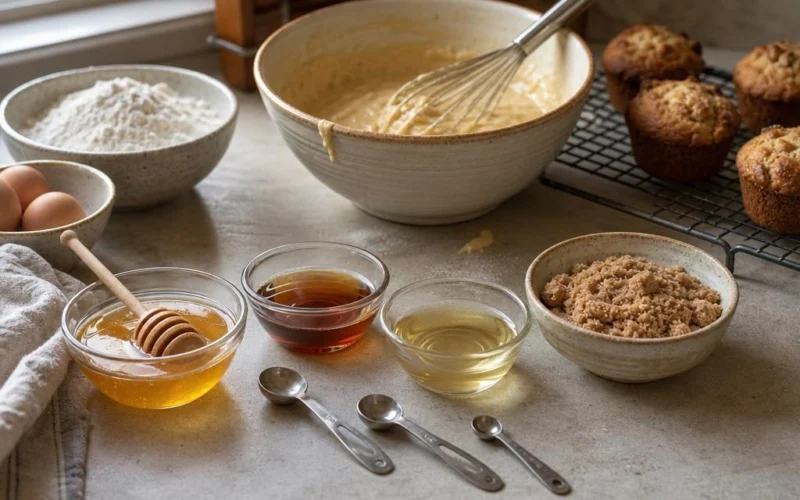
For most cakes, muffins, quick breads, and granola, replace honey with maple syrup or agave at roughly 1:1 by volume. Because these syrups are usually thinner than honey, reduce another liquid by 1–2 tablespoons per cup of honey if the batter looks loose. For a dry substitute, use about 1¼ cups granulated sugar plus ¼ cup additional liquid for each 1 cup honey, but expect a drier, less chewy result.
These are starting ratios, not formula-equivalent swaps. The best honey replacement in baking depends on whether honey mainly supplies sweetness, moisture, a glaze-like texture, or sticky binding.
Honey Substitution Ratios at a Glance
Published substitution charts vary because they may prioritize sweetness, total liquid, or final texture differently. The amounts below are practical starting estimates for replacing honey in ordinary baked goods, not precision formulas for candy, yeast dough, or other specialty recipes.
| Honey in recipe | Maple syrup or agave | Golden syrup or light corn syrup | Granulated sugar | Extra liquid with sugar | Main expected change |
|---|---|---|---|---|---|
| 1 tablespoon | 1 tablespoon | 1 tablespoon | About 1¼ tablespoons | About 1 teaspoon | Sugar gives less stickiness and moisture |
| ¼ cup | ¼ cup | ¼ cup | About 5 tablespoons | 1 tablespoon | Liquid syrups may make batter looser |
| ½ cup | ½ cup | ½ cup | ¾ cup plus 2 tablespoons | 2 tablespoons | Sugar produces less chew and cohesion |
| 1 cup | 1 cup | 1 cup | 1¼ cups | ¼ cup | Expect a more substantial, potentially crisper texture with sugar |
Choose the Substitute by What the Recipe Needs
For cakes, muffins, and quick breads
Use pure maple syrup or agave at about 1:1 by volume. Both retain the recipe’s liquid-sweetener format, making them practical choices for muffins, snack cakes, banana bread, and similar batters.
Maple syrup adds a recognizable maple note; agave is milder. Because both are generally thinner than honey, the batter may be looser than expected.
For granola bars, chewy cookies, and other binders
When cohesion and chew are the priority, start with golden syrup or light corn syrup at 1:1 by volume. These are the preferred replacements for recipes in which honey holds together oats, seeds, nuts, dried fruit, or other mix-ins.
Choose golden syrup if its caramel-like flavor suits the recipe; choose light corn syrup for a more neutral flavor. Maple syrup can work in some granola formulas, but it may provide less binding than a thicker syrup.
For a milder flavor
Choose agave when you want sweetness without maple’s distinct flavor or golden syrup’s caramel-like notes. It remains a liquid sweetener, so the finished batter may be softer or looser than one made with honey.
For a drier or crisper result
Use granulated sugar with the added liquid specified in the ratio table. This is a practical pantry option for many cookies and simple cakes, but it will not reproduce honey’s viscosity, moisture retention, or chew. Expect a less sticky, potentially crisper or more crumbly result.
For deeper flavor
Brown sugar can replace honey at roughly 1¼ cups per 1 cup of honey, with liquid adjusted cautiously as needed. It adds molasses flavor and deeper color, but its crystals create a more granular texture than honey. Use it when a rustic, caramel-like result fits the recipe.
How the Swap Changes Moisture, Browning, and Texture
Honey does more than sweeten. It contributes water, thickness, mild acidity, and browning potential. Those properties help explain why two substitutes with similar sweetness can behave differently in the oven. King Arthur Baking’s guidance on liquid sweeteners notes that different syrups affect moisture, acidity, and browning in different ways.
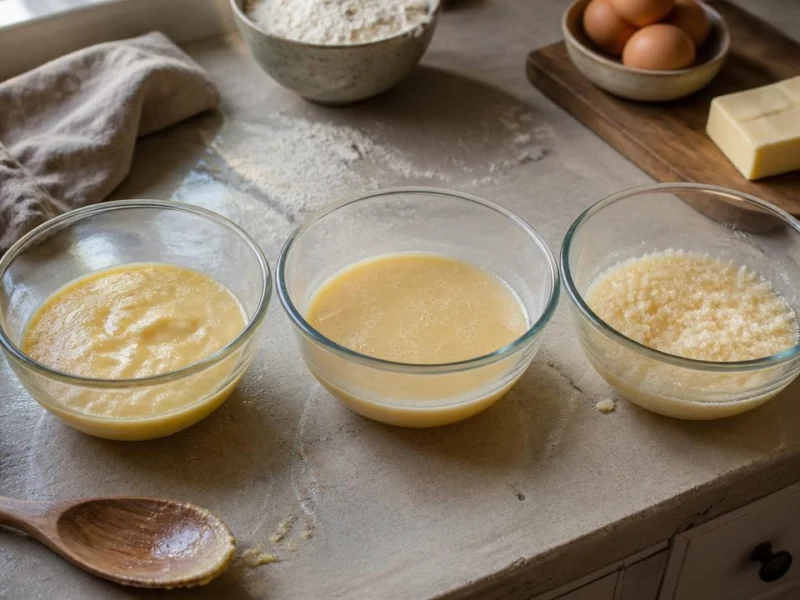
Liquid-for-liquid swaps—honey replaced with maple syrup, agave, golden syrup, or light corn syrup—usually preserve the general format of the recipe. Still, thinner syrups can produce a looser batter, and the finished bake may spread, rise, brown, or keep differently.
Liquid-to-dry swaps require deliberate liquid replacement. Granulated or brown sugar adds sweetness but does not provide the same syrupy moisture or flow. The result may be drier, less chewy, paler, or crisper, depending on the recipe and baking time.
Golden syrup and light corn syrup are especially useful where viscosity matters. They can help with chew and binding, though they will not duplicate honey’s floral flavor. Browning also depends on the substitute, oven temperature, pan color, recipe acidity, and bake time, so no substitute guarantees the same surface color.
Adjust the Recipe Without Overcorrecting
Begin with the stated ratio, then make only the smallest adjustment the batter needs. Overcorrecting with flour, leavening, or a lower oven temperature can create a larger problem than the substitution itself.
- For maple syrup or agave, use the same volume as honey first.
- If the batter is visibly thinner, hold back or reduce 1–2 tablespoons of another liquid per cup of honey replaced, provided the recipe contains enough liquid to adjust.
- Do not add flour automatically. If the batter is clearly too loose and the recipe has a sturdy structure, a small flour correction may help, but large additions can make the finished product tough.
- When using sugar, add the replacement liquid gradually instead of assuming every recipe needs the full amount at once.
Do not add baking soda simply because honey is leaving the recipe. Baking soda interacts with acidic ingredients and the recipe’s existing leavening balance; unnecessary soda can affect flavor, color, and rise. Likewise, keep the original oven temperature for a honey-to-syrup swap unless the first batch shows a clear browning problem.
Honey, maple syrup, and agave are sometimes marketed as “natural” sweeteners, but that does not make a baked good automatically nutritionally superior. They still contribute sugars and calories; the most predictable difference here is baking performance. The FDA treats honey and maple syrup as single-ingredient sugars or syrups for added-sugars labeling purposes in relevant packaged-food contexts.
Troubleshoot the First Batch
| Symptom | Likely cause | Next adjustment |
|---|---|---|
| Too-thin batter | The new syrup is thinner than honey, or all other liquid was retained | Hold back or reduce another liquid slightly on the next batch; avoid large flour additions |
| Excessive browning | The substitute browns differently, or the oven and pan produce strong surface color | Check earlier, tent loosely when suitable, then consider a modest temperature change only after observation |
| Less chew or weak binding | A dry sweetener replaced a viscous binder | Use golden syrup or light corn syrup in the next batch |
| Unexpected flavor | The substitute has a stronger or different flavor profile | Choose agave for mildness, maple for a maple note, or golden syrup for a syrupy caramel-like profile |
When using maple syrup, confirm that the bottle says pure maple syrup. Pancake syrup or maple-flavored syrup may contain other sweeteners and flavorings, with a different thickness and taste. The same label-reading principle applies to honey products: FDA guidance distinguishes pure honey from products blended with other sweeteners.
When Not to Use a Casual Honey-Swap Ratio
Some recipes depend on precise sugar concentration, viscosity, or fermentation behavior. In these cases, the table is not enough.
- Yeast breads: Honey contributes both sweetness and dough moisture. Sugar can work, but the dough’s hydration, handling, and fermentation behavior may change.
- Caramel, candy, and preserves: Do not use these general ratios. Setting behavior depends on carefully controlled sugar concentration and cooking stages.
- Glazes and no-bake bars: Viscosity may matter more than sweetness. Use a syrup with a similar flow and stickiness, especially when the mixture must coat or bind ingredients.
- Recipes with a large amount of honey: If honey is a major structural ingredient rather than a small sweetener, expect a larger texture shift and test the formula rather than assuming equivalence.
- Vegan baking: Maple syrup and agave are common plant-based choices. Check labels on packaged syrups and blends if strict vegan ingredients matter.
- Allergy or labeling concerns: Read the ingredient list instead of relying on front-label wording such as “maple flavored” or “honey blend.”
Frequently Asked Questions
Can I use pancake syrup instead of honey?
It can work as a syrup substitute in some recipes, but pancake syrup is not necessarily pure maple syrup. Check the ingredient list: corn-syrup-based or maple-flavored products can differ in flavor and viscosity.
Should I lower the oven temperature when replacing honey?
Not automatically. Follow the original recipe’s temperature and monitor browning. A temperature reduction is more relevant to some dry-sugar-to-syrup substitutions than to a routine honey-to-syrup swap.
Can I replace honey in yeast bread?
Usually, but the substitute can change the dough’s sweetness, hydration, and fermentation behavior. Judge the dough by its texture and handling rather than applying a cake or muffin ratio blindly.
Can I replace honey in caramel or candy?
Do not use general baking ratios for caramel or candy. These recipes depend on precise sugar concentration and setting behavior, so a casual honey replacement is unreliable.