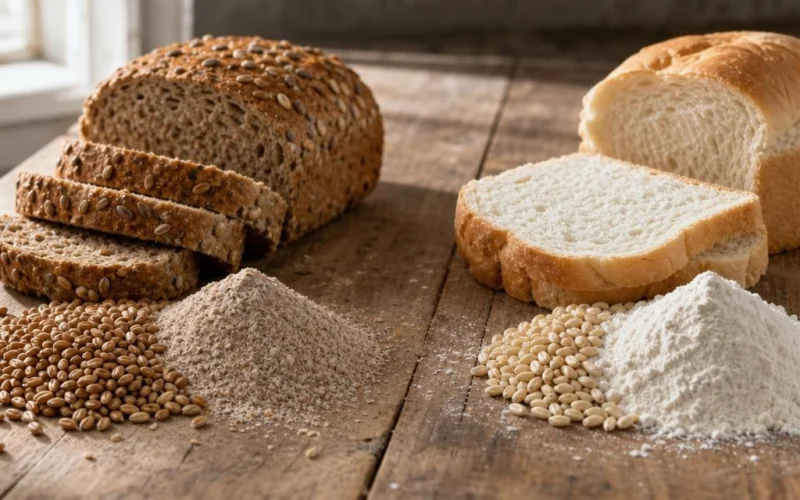
Whole grains retain all three parts of the grain kernel: the bran, germ, and endosperm. Refined grains are milled to remove the bran and germ, leaving mostly the starchy endosperm. For everyday eating, choose whole-grain foods more often, while recognizing that refined grains can still fit into balanced meals.
How whole grains and refined grains differ
Whole grains retain all three parts of the kernel—bran, germ, and endosperm—while refined grains are made mainly from the starchy endosperm after the bran and germ are removed. This changes the grain’s structure as well as its nutrient profile.
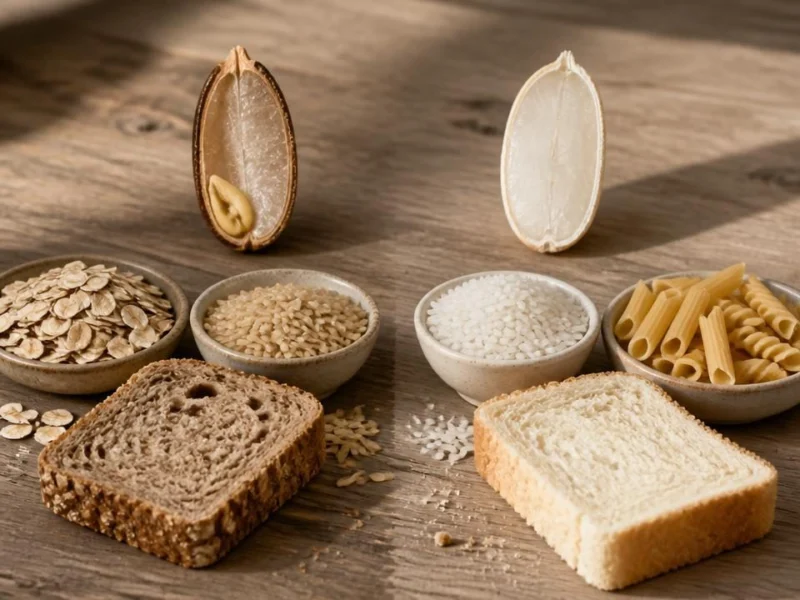
| Whole grains | Refined grains | |
|---|---|---|
| Kernel parts | Bran, germ, and endosperm retained | Mainly endosperm |
| Typical nutrients | Usually more fiber and naturally occurring micronutrients | Usually less fiber; some products are enriched |
| Examples | Oats, brown rice, quinoa, popcorn, whole-wheat flour | White rice, white flour, regular pasta, white bread |
The bran supplies much of a grain’s fiber and plant compounds; the germ contains oils, vitamin E, and minerals; and the endosperm is mostly starch and protein. Enriched white flour may have iron, thiamin, riboflavin, niacin, and folic acid added back, but enrichment does not restore the bran, germ, fiber, vitamin E, or original grain structure.
Processing does not always turn a grain into a refined grain. Rolled and quick oats can remain whole grains because their kernel components are retained. FDA whole-grain guidance distinguishes dehulled barley from pearled barley, which has had some bran removed.
Whole-grain foods and refined-grain foods
Common whole grains include oats, brown rice, wild rice, quinoa, popcorn, bulgur, millet, corn, buckwheat, whole-wheat pasta, and hulled or dehulled barley. Common refined-grain foods include white rice, white bread, regular pasta, ordinary wheat flour, flour tortillas, many pretzels, and many breakfast cereals.
| Goal | Practical choice | Why |
|---|---|---|
| More fiber | Intact or minimally processed whole grains, such as oats, brown rice, or bulgur | They retain more of the bran. |
| Easier digestion | Refined grains temporarily, if tolerated better | They are typically lower in fiber. |
| Gluten-free | Quinoa, rice, corn, buckwheat, millet, or certified gluten-free oats | These can be whole grains without containing gluten. |
| Fast cooking | Rolled oats, bulgur, or parboiled grains | They need relatively little preparation. |
Why whole grains may feel more filling and digest differently
Whole-grain nutrition is partly about fiber, but the grain’s structure matters too. Intact or coarsely cut grains take longer to chew and digest than finely milled flour. Steel-cut oats, for example, are less physically broken down than instant oats, even though both can be whole grain.
The bran contains fibers that are not fully digested in the small intestine. Some of these carbohydrates reach the large intestine, where gut microbes can ferment them into short-chain fatty acids. This is a well-established mechanism, although individual digestive responses vary and more fermentation can also mean more gas for some people.
Grain processing changes the speed of digestion. A dense 100% whole-wheat bread, an airy whole-grain cereal, and intact cooked barley should not be expected to affect blood sugar in the same way simply because each contains whole-grain ingredients. Particle size, cooking time, added sugar, fat, protein, and the rest of the meal all matter.
Cooling cooked grains may slightly increase resistant starch as starch molecules reorganize during refrigeration. Reheating does not erase all of that change, but it should not be treated as a guaranteed metabolic strategy. The more reliable food-safety step is to refrigerate cooked rice, pasta, or grains promptly and reheat leftovers thoroughly.
What the research can and cannot say
The compositional advantage of whole grains is clear: they retain more fiber and more of the original grain components. Long-term population studies also link higher whole-grain intake with lower risk of several cardiometabolic outcomes, but those studies cannot prove that whole grains alone caused the difference. People who eat more whole grains may also differ in many other diet and lifestyle habits.
Randomized trials offer a more controlled test. A systematic review of trials found that replacing refined grains with whole grains may improve some cardiovascular risk markers, though effects are generally modest and results are not identical across every outcome. The randomized-trial evidence supports a practical swap, not a promise that one bowl of oatmeal will prevent disease or cause weight loss.
Current public-health guidance commonly encourages making at least half of grain choices whole grains. USDA MyPlate materials offer familiar swaps such as oatmeal for sugary cereal and brown rice or whole-wheat pasta in place of refined versions.
How to spot a real whole-grain product at the store
Do not rely on color or front-label terms such as “wheat,” “multigrain,” “seven grain,” or “stone-ground.” Dark bread may contain molasses or caramel coloring, and multigrain simply means that more than one grain may be present.
Use this three-question label test:
- Is a whole grain named clearly? Look for terms such as “100% whole wheat,” “whole oats,” “whole-grain corn,” or “whole rye.”
- Is the whole grain first on the ingredient list? Ingredients are generally listed by weight, so a named whole grain near the beginning matters more than one listed after refined flour.
- Does the rest of the label fit your goal? Compare fiber per serving, then check added sugar and sodium. A product can contain whole grain and still be high in added sugar or sodium.
For example, if two breads both say “made with whole grains,” choose the one that lists whole-wheat flour first and has more fiber per serving, while keeping added sugar and sodium modest. “Contains whole grains” confirms that a whole-grain ingredient is present, not that the product is mostly whole grain.
Fiber increases, bloating, gluten, and other situations to consider
The most common difficulty with switching to whole grains is increasing fiber too quickly. Someone who replaces white toast, white rice, regular pasta, and low-fiber cereal all at once may notice gas, bloating, cramping, or changes in bowel habits within a few days.
A gentler transition is to start with one whole-grain serving per day for several days, then add another choice as tolerated. Plain oatmeal at breakfast, brown rice with dinner, or a slice of 100% whole-wheat bread are manageable starting points. Drinking enough fluids also helps fiber move through the digestive tract.
People with irritable bowel syndrome may tolerate some grains better than others, depending on their personal triggers and the amount eaten. Oats, rice, quinoa, and sourdough-style breads may be easier for some people, while wheat-based foods can be troublesome for others. A registered dietitian can help people who need a structured low-FODMAP approach rather than broad food avoidance.
Whole grain does not mean gluten-free
Wheat, rye, and barley contain gluten whether they are whole or refined. Brown rice, corn, quinoa, millet, buckwheat, and wild rice are naturally gluten-free. Oats are naturally gluten-free in principle but can be contaminated with wheat, rye, or barley during growing and processing.
For celiac disease, choose products specifically labeled gluten-free and discuss oats with a qualified healthcare professional if needed. The Celiac Disease Foundation notes that gluten safety depends on both the grain and cross-contact risk.
Phytate is not a reason to avoid whole grains
Whole grains contain phytic acid, often called phytate. Phytate can bind minerals such as iron, zinc, and calcium in the digestive tract, which can reduce absorption under some circumstances. That mechanism is real, but it does not mean whole grains are unhealthy or that most people need to avoid them.
Soaking, sprouting, fermentation, and leavening can reduce phytate to varying degrees. Sourdough fermentation, for example, may lower phytate more than quick-yeast bread, though it does not turn every bread into a nutritionally superior product. Evidence reviews do not support abandoning whole grains because of phytate alone. Research on phytate and whole grains describes why overall dietary pattern, mineral status, and preparation method all matter.
Easy ways to use more whole grains without rebuilding every meal
Replacing every refined grain at once is unnecessary. A mixed approach can make the taste and texture transition easier, especially for families or people accustomed to soft white bread and white rice.
| Food | Practical pairing or prep | Why it helps |
|---|---|---|
| Plain oats | Add yogurt and berries | Protein plus flavor |
| Brown rice | Mix with white rice | Gentler texture change |
| Whole-wheat pasta | Use tomato-lentil sauce | More satisfying meal |
| Popcorn | Season with herbs | Avoid excess butter |
| Whole-grain toast | Top with egg | Balances carbohydrate |
For a gradual rice transition, cook half brown rice and half white rice together only if their cooking times are compatible; otherwise cook them separately and combine them before serving. Brown rice often needs more water and a longer cooking time, while white rice can become mushy if treated the same way.
Bulgur is useful for busy meals because it cooks quickly and has a mild chewy texture. Rolled oats work in savory bowls as well as sweet breakfasts: cook them with water or broth, then add an egg, sautéed vegetables, beans, or herbs.
Refined grains also have practical uses. White rice, plain pasta, or white toast may be easier to tolerate during a short-term digestive upset, before intense athletic activity, or when a softer texture is needed. The useful question is not whether refined grains are forbidden; it is whether they are crowding out fiber-rich foods across most meals.
Questions people ask while choosing whole grains
Are whole grains always healthier than refined grains?
Whole grains are usually the more nutrient-dense default because they retain fiber and more of the original kernel. The overall food still matters. A sugary whole-grain cereal may be less useful as an everyday choice than plain oats, and refined grains can fit into balanced meals.
Is instant oatmeal a whole grain?
Plain instant oatmeal can be whole grain because it is made from oats that have been rolled, cut, or partially cooked. Check the ingredient list and flavor packet: many instant oat products contain added sugar and sodium, while plain instant oats do not.
Does multigrain mean whole grain?
No. “Multigrain” means a product contains more than one grain, but those grains may be refined. Look for a named whole grain in the ingredient list, ideally as the first ingredient.
Does enriched white flour replace what refining removes?
Enrichment adds back selected nutrients, commonly certain B vitamins and iron. It does not rebuild the bran and germ or restore the original fiber, vitamin E, oils, and full grain matrix.
Can brown rice and white rice have similar calories?
Yes. Their calories per cooked serving can be close because both contain substantial starch. Brown rice generally has more fiber and retains more of the grain kernel, which is a more useful distinction than assuming it is dramatically lower in calories.
This content is based on food chemistry and clinical nutrition research. It is for informational purposes only and does not constitute medical advice. Consult a qualified healthcare professional before making significant changes to your dietary routine.