
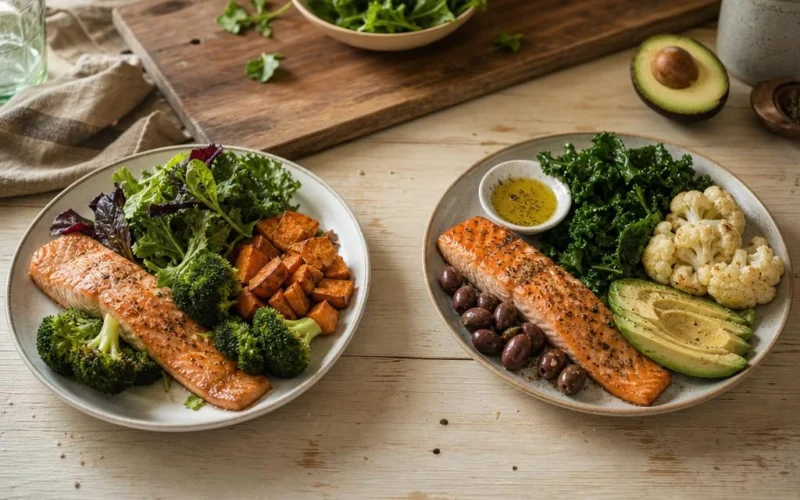
Keto is a strict type of low-carbohydrate diet designed to produce nutritional ketosis, usually by limiting carbohydrates to about 20–50 grams per day. A flexible low-carb diet commonly provides about 50–130 grams, although “low carb” has no universal definition. For most adults seeking sustainable weight management, flexible low-carb eating is the stronger starting point; keto is a specialized option for people who specifically want ketosis and can manage its restrictions safely.
Low carb vs keto: carb limits, macros, and food flexibility
The central difference in a keto diet vs low-carb diet is the intended metabolic state. Low-carb eating reduces carbohydrate intake without requiring ketosis. Keto restricts carbohydrates enough that the liver increases its production of ketones, which the body can use as an alternative fuel.
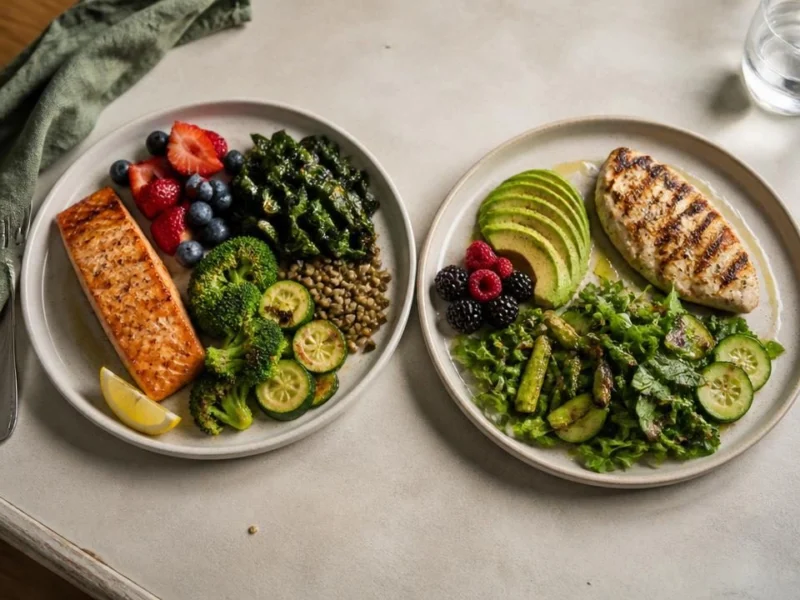
Published definitions vary. A useful working range is 50–130 grams daily for nonketogenic low carb and 20–50 grams—or less than 10% of calories—for keto. These are planning ranges, not thresholds that guarantee the same result for everyone. The broader clinical literature reflects this variation, as summarized in the NCBI overview of low-carbohydrate diets.
| Feature | Flexible low carb | Keto |
|---|---|---|
| Daily carbohydrates | Often 50–130 g | Usually 20–50 g |
| Main goal | Reduce carbohydrate intake | Maintain nutritional ketosis |
| Protein | Moderate to high | Usually moderate |
| Fat | Flexible | Usually high |
| Fruit | Several choices fit | Mostly small berry portions |
| Beans | Often fit | Usually heavily limited |
| Whole grains | Small portions may fit | Usually excluded |
| Tracking burden | Low to moderate | Moderate to high |
| Social flexibility | Generally easier | Often more difficult |
Neither approach requires a menu dominated by bacon, butter, or processed “keto” snacks. Salmon, tofu, eggs, poultry, olive oil, nuts, avocado, plain Greek yogurt, and nonstarchy vegetables can form the base of either pattern. Flexible low-carb plans have more room for beans, fruit, and modest servings of minimally processed grains.
Which approach fits your goal?
| Goal or situation | Better starting route |
|---|---|
| Sustainable weight management | Flexible low carb |
| Specific ketosis goal | Planned keto |
| Intense athletic training | Flexible low carb |
| Diabetes medication use | Clinician-led plan |
Stricter does not mean better. Carbohydrate restriction can support short-term weight loss for some people, but a systematic review of 110 randomized trials found that effects beyond 12 months were less clear. The diet still needs to create an energy deficit for body-fat loss; ketosis does not override calorie intake.
What changes in your body when carbohydrates drop?
Three concepts are often blended together even though they describe different processes: a lower insulin response after a meal, nutritional ketosis, and diabetic ketoacidosis.
Lower insulin after a meal is not the same as ketosis
A meal containing less digestible carbohydrate usually produces a smaller rise in blood glucose and therefore requires less insulin than a carbohydrate-rich meal. That response can occur after one low-carb meal without putting the body into sustained ketosis.
Ketosis develops when carbohydrate availability stays low enough for the liver to convert fatty acids into ketones. The exact carbohydrate level and timing vary with total intake, physical activity, glycogen stores, and individual metabolism. Eating 50 grams does not guarantee ketosis, just as exceeding 20 grams does not prove that every person has left it.
Why the scale may drop quickly in week one
The body stores carbohydrate as glycogen in the liver and muscles. Glycogen is stored with water, so reducing those reserves can cause a noticeable release of water during the first several days of a strict keto diet. That early scale movement is not equivalent to the same amount of body-fat loss.
Consider a hypothetical adult who switches abruptly from a high-carbohydrate diet to 25 grams daily. The scale may fall sharply during days three through seven while gym performance feels flat and thirst changes. By weeks two to four, the rate commonly slows as the initial water shift ends. Subsequent fat loss depends on energy intake, adherence, activity, and individual response.
Nutritional ketosis is not diabetic ketoacidosis
Nutritional ketosis is a regulated state in which ketones rise while the body still controls acid-base balance. Diabetic ketoacidosis, or DKA, is a dangerous state involving excessive ketone production, metabolic acidosis, and usually severe insulin deficiency. DKA requires urgent medical care.
Persistent vomiting, confusion, abdominal pain, severe weakness, difficulty breathing, or an inability to stay hydrated should never be dismissed as “keto flu.” People with diabetes should follow their established sick-day and ketone-testing instructions and seek medical help when directed.
Who should not start keto without clinical guidance?
Carbohydrate reduction can change glucose levels quickly enough that some diabetes medications may need professional adjustment. SGLT2 inhibitors deserve particular caution because DKA can occur even when blood glucose is not extremely high. The American Diabetes Association’s 2026 guidance discourages ketogenic patterns in people at DKA risk who take these medicines.
Keto is also inappropriate as a casual self-directed experiment for:
- Pregnancy or breastfeeding: Very-low-carbohydrate patterns may not meet increased nutrient and carbohydrate requirements. ADA pregnancy guidance lists a carbohydrate reference intake of 175 grams per day.
- Type 1 diabetes: Ketone management and insulin requirements make unsupervised keto particularly risky.
- Kidney disease: Protein, minerals, fluid balance, and medications require individualized review.
- Disordered-eating history or risk: Rigid tracking and food exclusion may aggravate restrictive behavior.
- Significant gastrointestinal conditions: Abrupt changes in fiber and fat can worsen symptoms for some people.
- Children and adolescents: Therapeutic ketogenic diets require specialized clinical supervision.
The ADA’s 2026 nutrition and behavioral guidance does not recommend very-low-carbohydrate plans for several of these groups. Strict calorie or carbohydrate restriction can also contribute to menstrual changes when it results in inadequate energy availability. A missed or persistently altered cycle, declining training performance, or ongoing fatigue warrants medical and nutritional review.
LDL cholesterol can respond differently from triglycerides
Keto does not produce one universal cholesterol pattern. A 2026 review of randomized keto trials found lower triglycerides and higher HDL cholesterol on average, alongside increases in LDL and total cholesterol. Long-term cardiovascular-outcome evidence remains uncertain.
A substantial LDL rise should not be ignored because triglycerides improved. Food selection may matter: replacing some butter, coconut oil, fatty processed meats, and cream with olive oil, avocado, nuts, seeds, and fish can reduce saturated fat without raising carbohydrate intake substantially. A clinician can decide whether repeat testing or a broader cardiovascular assessment is appropriate.
A seven-day transition without crashing to 20 grams
You do not need to move from a typical diet to strict keto overnight. Use the first week to remove the largest carbohydrate sources, build complete meals, and then choose either a flexible 75–130 gram low-carb range or a clinician-reviewed keto target, commonly 20–50 grams per day. These are working ranges, not guarantees that a particular intake will produce ketosis.
Days 1–2: Remove the easiest sources
- Replace sugary drinks with water, sparkling water, or unsweetened tea or coffee.
- Set aside candy, pastries, and refined snack foods rather than trying to reduce every carbohydrate at once.
- Build meals around protein and vegetables: eggs with spinach, plain Greek yogurt with berries, a chicken salad, tofu with vegetables, or fish with roasted broccoli.
- Keep your usual starch portion for now, but measure it so you know what you are reducing.
Days 3–4: Choose your route
| Route | Meal structure | Carbohydrate foods that may fit |
|---|---|---|
| Flexible low carb | Protein, nonstarchy vegetables, unsaturated fat, and a measured high-fiber carbohydrate | Fruit, plain yogurt, beans, lentils, oats, quinoa, or a small whole-grain portion |
| Keto | Protein, nonstarchy vegetables, and enough fat to make the meal satisfying | Small berry portions, nuts, seeds, avocado, and unsweetened dairy if they fit the chosen limit |
For the low-carb route, halve oversized servings of rice, pasta, bread, or potatoes and add vegetables, protein, or beans. For keto, replace those starches with options such as cauliflower, zucchini, leafy greens, mushrooms, or broccoli. Oils, cheese, nuts, nut butter, and cream are low in carbohydrate but energy-dense, so portions still matter.
Days 5–7: Repeat simple meals and assess tolerance
Choose two breakfasts, two lunches, and two dinners that you can repeat rather than creating a new menu every day.
- Low-carb breakfasts: Plain Greek yogurt with berries and walnuts; eggs with vegetables and a piece of whole fruit.
- Keto breakfasts: Eggs with spinach and avocado; unsweetened yogurt with chia seeds and a small berry portion.
- Low-carb lunches: Chicken-and-bean salad; tofu and vegetables with a measured portion of quinoa.
- Keto lunches: Chicken-avocado salad with olive-oil dressing; tuna in a lettuce wrap with raw vegetables.
- Low-carb dinners: Salmon, roasted vegetables, and lentils; chicken stir-fry with a small serving of brown rice.
- Keto dinners: Salmon with broccoli and olive oil; tofu or chicken stir-fry over cauliflower rice.
People doing intense training may find the flexible route easier because fruit, yogurt, beans, or a measured grain portion can be placed near a workout. Shift workers can use the same meal sequence after waking rather than tying it to conventional meal times.
Concise grocery list
- Protein: Eggs, chicken, canned tuna, tofu, plain yogurt, and fresh or frozen fish.
- Vegetables: Salad greens, broccoli, spinach, cauliflower, zucchini, peppers, and frozen vegetable mixes without added sauce.
- Unsaturated fats: Olive oil, avocado, nuts, seeds, and natural peanut butter.
- For flexible low carb: Berries, apples, beans, lentils, oats, quinoa, or brown rice.
- Flavor: Herbs, spices, mustard, vinegar, lemon, and salsa without added sugar.
Cook one or two proteins and a tray of vegetables ahead of time, then add the route-specific carbohydrate or fat when assembling each meal. This is usually simpler than relying on specialty “keto” products.
What to expect during the first week
Headache, fatigue, cravings, constipation, or reduced exercise capacity can occur during the first several days of a large carbohydrate reduction. Evidence on the causes and best remedies remains mixed, according to a 2025 scoping review. These symptoms are not proof that the diet is working.
- Reduce carbohydrates more gradually if the change disrupts work, sleep, or training.
- Eat complete meals containing protein, vegetables, and an appropriate fat source.
- Drink according to thirst while accounting for heat and exercise.
- Include vegetables, seeds, nuts, berries, or legumes where the carbohydrate budget permits.
- Seek medical care for persistent vomiting, confusion, severe weakness, inability to stay hydrated, or diabetes-related ketone symptoms.
Adult fiber needs are commonly about 22–34 grams per day, according to the National Institute of Diabetes and Digestive and Kidney Diseases. Increase fiber progressively and drink enough fluid; a sudden increase can worsen bloating or constipation.
Check safety before making a large reduction
A lower-carbohydrate meal will often produce a lower post-meal glucose and insulin response than a higher-carbohydrate meal, but the effect varies and is not guaranteed to be clinically meaningful for every person. If you use insulin, sulfonylureas, blood-pressure medication, or an SGLT2 inhibitor, involve your prescriber before making a substantial change. Do not adjust medication on your own; ketogenic eating can be particularly dangerous for people at risk of diabetic ketoacidosis while using SGLT2 inhibitors.
Ketogenic and severely restrictive eating patterns should be avoided during pregnancy; the pregnancy carbohydrate reference intake is 175 grams per day. Very-low-carbohydrate plans are also not currently recommended during breastfeeding, but the pregnancy reference intake should not be assumed to be a lactation target. People with type 1 diabetes, kidney disease, or a history of or risk for disordered eating should seek qualified guidance before attempting keto.
Review the plan after two to four weeks
- Adherence: Did your average intake match the intended range?
- Digestion: Are constipation, diarrhea, or bloating persistent?
- Hunger and enjoyment: Are meals satisfying, practical, and socially manageable?
- Training: Has energy stabilized or continued to decline?
- Clinical measures: When relevant, review glucose, blood pressure, medications, and lipids with a clinician.
Persistent fatigue, poor recovery, menstrual disruption, worsening gastrointestinal symptoms, or repeated loss-of-control eating are reasons to loosen the restriction and seek qualified guidance. Moving from keto to a moderate low-carb range is a practical adjustment, not a failure.
Questions that come up when choosing between the two
Should I count total carbs or net carbs?
Nutrition Facts labels list total carbohydrate. “Net carbs” is a common planning convention—typically total carbohydrate minus fiber and sometimes certain sugar alcohols—not a standardized FDA nutrient category. Use one method consistently, check which method your chosen carb target uses, and do not assume all sugar alcohols affect digestion or blood glucose identically.
Can fruit, beans, and whole grains fit a low-carb diet?
Usually, depending on your carb target and portions. A flexible low-carb plan can accommodate fruit, legumes, yogurt, and modest servings of whole grains; strict keto leaves much less room and commonly limits beans, grains, and higher-carbohydrate fruits. Refer to the carb-range and food-flexibility comparison above when planning portions.
Why might LDL cholesterol rise on keto?
Responses vary, but ketogenic diets can raise LDL cholesterol in some people even when triglycerides fall and HDL cholesterol rises. This does not by itself establish the long-term cardiovascular effect. Follow the food-quality guidance above, favor unsaturated fats over a butter- or processed-meat-heavy pattern, and review a meaningful LDL increase with a clinician rather than interpreting one marker in isolation.
This information is educational and does not replace individualized medical advice. Consult a qualified healthcare professional before making a major dietary change, particularly if you have a medical condition or take medication.