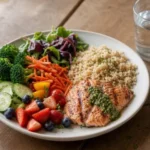
Use 14 grams of fiber per 1,000 calories as a practical daily target: divide your daily calories by 1,000, then multiply by 14. I’d aim for that number over time rather than forcing a large increase in one week.
Your fiber target and the foods that make it achievable
The calorie-based formula adjusts daily fiber intake to the amount of food you eat. A person eating 1,500 calories has less room for fiber-rich foods than someone eating 2,800 calories, so one fixed target does not fit every diet.
| Daily calories | Calculation | Fiber target |
|---|---|---|
| 1,500 | 1.5 × 14 | 21 g |
| 1,800 | 1.8 × 14 | 25 g |
| 2,000 | 2 × 14 | 28 g |
| 2,400 | 2.4 × 14 | 34 g |
| 2,800 | 2.8 × 14 | 39 g |
This formula, the federal Daily Value, and age- and sex-based recommendations answer slightly different questions:
- Calorie-scaled target: The established benchmark is 14 grams per 1,000 calories.
- Nutrition Facts Daily Value: The FDA uses 28 grams to calculate the percentages printed on labels.
- Adequate Intake: The National Academies’ reference values are 25 grams for women and 38 grams for men through age 50, then 21 and 30 grams, respectively, after age 50.
These are reference points, not competing rules. The 28-gram Daily Value is especially useful for comparing products, while the calorie formula is usually more useful for planning an individual diet.
The following estimates are based on standard entries in USDA FoodData Central. Values can differ by variety, brand, cooking method, and drained weight.
| Food per 100 g | Calories; protein | Fiber | Best feature |
|---|---|---|---|
| Lentils, cooked | 116; 9 g | 7.9 g | Budget protein anchor |
| Black beans, cooked | 132; 9 g | 8.7 g | Fiber-protein combination |
| Rolled oats, dry | 379; 13 g | 10.1 g | Viscous beta-glucan |
| Raspberries, raw | 52; 1 g | 6.5 g | High fiber density |
| Pear with skin | 57; 0.4 g | 3.1 g | Portable whole fruit |
| Broccoli, cooked | 35; 2 g | 3.3 g | Low calorie density |
| Almonds, raw | 579; 21 g | 12.5 g | Fiber with fats |
| Chia seeds, dry | 486; 17 g | 34.4 g | Concentrated small serving |
The 100-gram comparison exposes an important trade-off. Nuts and seeds contain substantial fiber, but they are calorie-dense; berries and vegetables supply fewer calories but require more volume. Beans and lentils are often the best compromise among fiber, protein, price, and meal usefulness.
| Goal | Useful starting foods |
|---|---|
| Lower-calorie meals | Berries, pears, vegetables |
| Low-cost eating | Lentils, beans, oats |
| Higher-protein diet | Beans, lentils, chia |
| Sensitive digestion | Oats, tolerated produce |
What different fibers do inside your digestive tract
“Soluble” and “insoluble” are useful labels, but they do not reliably predict digestive tolerance. How a fiber feels depends more on its viscosity, fermentability, serving size, food form, and your individual response.
Viscous fibers, such as beta-glucan in oats and psyllium, absorb water and form a gel. Fermentable fibers are broken down by gut microbes, which can produce beneficial compounds as well as gas. Because fibers differ in these properties, a food that supports comfortable bowel habits for one person may cause bloating or discomfort for another, particularly in people with IBS or sensitivity to fermentable carbohydrates.
Higher-fiber dietary patterns are associated with better outcomes across several health measures, according to a large systematic review and meta-analysis. This supports eating a varied, fiber-rich diet but does not prove that one type of fiber or one high-fiber food prevents disease.
Increase fiber without turning one meal into a digestive test
This gradual-increase plan is not appropriate during an active inflammatory bowel disease flare, when bowel narrowing or obstruction risk is known, or when a clinician has prescribed a low-fiber diet. Follow your medical guidance instead.
The easiest way to trigger gas, bloating, or cramping is to add several concentrated sources at once—for example, bran cereal, a large bean salad, a fiber bar, and chia pudding on the same day. Change one meal or snack at a time instead.
Use a gradual tolerability ladder
If you are prone to digestive symptoms, have IBS, or currently eat very little fiber, increase your daily total by about 2–3 grams, keep it there for several days, and then reassess. This conservative approach aligns with NIDDK guidance for people with IBS. It is not a required schedule for everyone.
The following is a hypothetical 7- to 14-day example, not a prescription:
- Days 1–3: Add one food or portion that provides roughly 2–3 grams of fiber.
- Days 4–7: Maintain that intake and note any changes in gas, bloating, pain, or bowel habits.
- Days 8–10: If symptoms remain manageable, add another 2–3 grams from one food.
- Days 11–14: Hold steady, calculate your average intake, and decide whether to increase again.
Practical changes include choosing whole-grain bread instead of white bread, replacing a low-fiber cereal with oats or a higher-fiber cereal, choosing whole fruit instead of juice, or replacing part of the meat in chili with beans or lentils. For a gradual increase, adjust the portion so the first change adds about 2–3 grams rather than making several swaps simultaneously.
Many fibers hold water, but there is no universal “eight glasses” rule solely because fiber intake increased. Drink regularly and follow any clinician-directed fluid restrictions.
Why “soluble” and “insoluble” do not predict tolerance
Those labels alone do not tell you how a food will feel. Viscosity affects how fiber holds water, fermentability influences gas production, and tolerance varies with the food, portion, and individual. Fiber-rich dietary patterns are associated with better health outcomes, and trials show improvements in selected risk markers, but that does not mean every fiber source prevents disease or suits every digestive system.
Use the label to compare packaged foods
On Nutrition Facts labels, 5% Daily Value or less is low in fiber and 20% or more is high per labeled serving. Compare similar products using the same serving size, and check fiber grams rather than relying on terms such as “multigrain.” A product may appear high in fiber partly because its labeled serving is large or calorie-dense.
Food first, supplement second
A fiber supplement may help close a consistent gap when food changes are impractical, but products differ in viscosity, fermentability, additives, and dosing. They also do not replace the protein, vitamins, minerals, unsaturated fats, and other compounds supplied by a varied pattern of legumes, fruits, vegetables, nuts, seeds, and whole grains. Check medication instructions because some fiber products may need to be taken separately.
There is no established U.S. Tolerable Upper Intake Level for fiber, so a specific intake such as 50 grams is not inherently dangerous for every healthy adult. Individual tolerance, adequate energy and protein, dietary variety, and medical restrictions are more useful boundaries than a universal cutoff.
Questions that come up after you calculate your target
Is 28 grams my personal daily fiber intake target?
Not necessarily. Twenty-eight grams is the FDA Daily Value used on Nutrition Facts labels and happens to match the calorie-scaled target for a 2,000-calorie diet. At 1,500 calories, the formula gives 21 grams; at 2,500 calories, it gives 35 grams.
What are the easiest high-fiber foods if beans make me gassy?
Try oats, berries, pears, cooked vegetables, whole-grain bread, or a small amount of chia rather than forcing a large bean portion. If you want to retry legumes, begin with a few tablespoons and increase only as tolerated. A registered dietitian can help identify specific triggers if IBS or FODMAP sensitivity complicates food choices.
Why did chia, bran cereal, and beans make bloating worse?
The combined increase was probably too large, too concentrated, or highly fermentable for your current tolerance. Return to the last comfortable intake, keep the rest of the diet stable for several days, then reintroduce one source at a time. Severe or persistent symptoms should not be assumed to be a normal adjustment.
Does a low-carb or high-protein diet make fiber harder to reach?
It can. Diets that remove legumes, whole grains, and much of the fruit lose several efficient fiber sources. Lower-carb options include non-starchy vegetables, berries, avocado, nuts, seeds, and carefully selected packaged foods, but calories from nuts and seeds can add up quickly.
Do regular bowel movements prove I eat enough fiber?
No. Bowel frequency is affected by fluid intake, activity, medications, food volume, stress, and individual transit time. Calculate your intake from food records or labels instead of using bowel frequency as a fiber measurement.
This content is based on nutritional physiology and energy metabolism research. It is for informational purposes only and does not constitute medical advice. Consult a qualified healthcare professional before making significant alterations to your caloric or macronutrient intake.