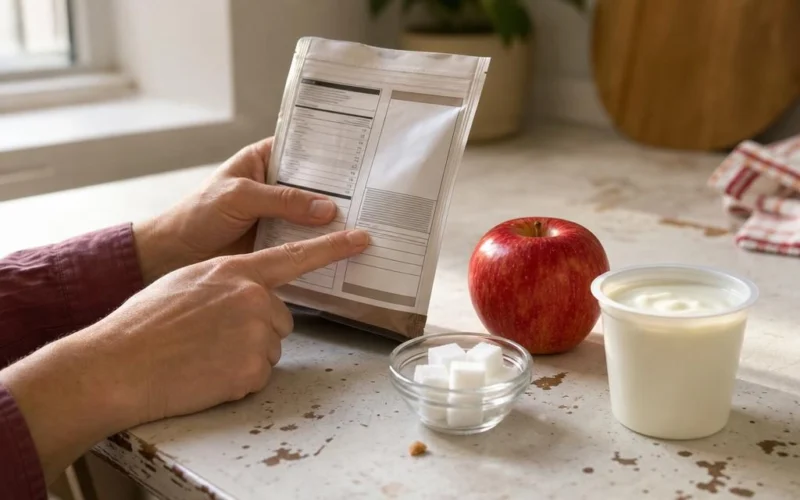
How much added sugar per day? Do not treat 50 grams as a goal: it is the FDA’s Daily Value for label calculations on a 2,000-calorie diet. The current 2025–2030 U.S. Dietary Guidelines say no amount of added sugar is recommended as part of a healthy diet and advise limiting each meal to 10 grams—a practical guideline, not a legal or universal personal maximum.
Use this three-number hierarchy when reading labels: 50 g equals 100% of the FDA Daily Value, 10 g is the current per-meal dietary guideline, and 5% DV or less is low while 20% DV or more is high per serving.
The three added-sugar numbers to know
The Nutrition Facts label and federal dietary guidance answer different questions. One helps shoppers compare packaged foods; the other describes how added sugar should fit into an overall eating pattern.
| Number | What it means | How to use it |
|---|---|---|
| 50 g daily | FDA label reference | Calculate % Daily Value |
| 5% DV | Low per serving | Compare everyday foods |
| 20% DV | High per serving | Limit or compare |
| 10 g per meal | Current federal guidance | Plan everyday meals |
The FDA sets the Daily Value for added sugars at 50 grams on a 2,000-calorie diet. A food containing 10 grams therefore shows 20% DV. This is a standardized reference for reading labels, not an amount everyone should try to consume.
The 2025–2030 Dietary Guidelines for Americans, released in January 2026, use stricter language. They state that no amount of added sugar is recommended or considered part of a healthy diet and advise limiting a meal to 10 grams or less.
This creates an apparent mismatch because current FDA consumer materials still discuss the previous recommendation to keep added sugars below 10% of calories. The label itself has not become unusable: its 50-gram Daily Value still provides a consistent basis for %DV calculations. It simply shouldn’t be treated as the preferred added sugar limit.
The American Heart Association offers another voluntary benchmark: about 25 grams per day for women and 36 grams for men, based on no more than 6% of calories from added sugar. These are general population benchmarks rather than individualized prescriptions.
Added sugar is already included in total sugar
The indented “Includes X g Added Sugars” line identifies the portion of total sugar added during processing or preparation. You do not add that number to Total Sugars.
Suppose a fictional yogurt label shows:
- Total Sugars: 15 grams
- Includes Added Sugars: 7 grams
- Added Sugars %DV: 14%
The yogurt contains 15 grams of sugar altogether, not 22 grams. Seven grams are added sugar, leaving 8 grams that occur naturally, mainly as lactose from milk.
The subtraction rule is:
Naturally occurring sugar = Total Sugars − Added Sugars
For a product with 18 grams total sugars and 12 grams added sugars, the result is 6 grams of naturally occurring sugar. This subtraction helps explain the label; it does not create a separate recommended intake for naturally occurring sugar.
Natural sugar versus added sugar
“Natural sugar” is informal consumer language, not a consistently useful regulatory category. Whole fruit contains intrinsic fructose, while plain milk contains lactose. These foods may show total sugar but zero added sugar.
Honey, maple syrup, agave and coconut sugar can sound more natural than table sugar, yet they count as added sugars when used to sweeten another food or drink. The FDA definition of added sugars includes sugars added during processing, honey, syrups and certain concentrated fruit or vegetable juices.
Whole fruit is different from a sweetener made with concentrated fruit juice. Fruit’s cellular structure, water and fiber affect fullness and eating speed, so its total sugar should not be judged as though it were the same as added sugar in a soft drink.
What added sugar does—and does not tell you about a food
The added-sugars line shows how much sugar was added during processing, but it does not describe a food’s overall nutritional quality. Foods with the same amount of added sugar can differ in calories, protein, fiber, sodium and micronutrients, so use this line alongside the rest of the Nutrition Facts label.
Drinks can add sugar quickly
Sugar-sweetened beverages deserve particular attention because a bottle may contain multiple servings and may be consumed in one sitting. Check the servings per container or the per-container column before assessing the added-sugar grams and % Daily Value.
Higher consumption of sugar-sweetened beverages is associated with adverse cardiometabolic outcomes in observational evidence syntheses, but this does not establish that one drink directly causes disease in an individual. The current Dietary Guidelines advise avoiding sugar-sweetened beverages.
How to read the added sugars label in 20 seconds
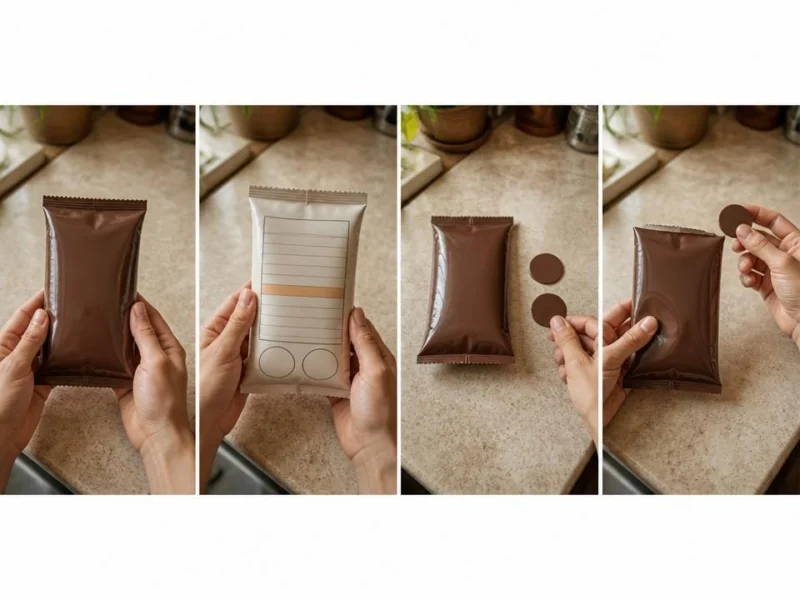
- Check the serving size. Confirm whether you usually consume that amount.
- Check servings per container. A bottle or bag may contain two or more.
- Find Total Sugars. This is all sugar in one labeled serving.
- Read “Includes Added Sugars.” Added sugar is already included in Total Sugars; do not add the two numbers together.
- Multiply by servings consumed. Apply the multiplier to the grams and %DV.
Serving size is not a recommended portion. According to the FDA serving-size guide, label values are generally listed per serving, although some packages use dual columns showing both per-serving and per-container values.
A two-serving bottle example
Imagine a 20-ounce drink whose label lists two servings. Each serving contains 16 grams of added sugar and 32% DV. Drinking the entire bottle provides 32 grams of added sugar and 64% DV.
Added sugar per serving × servings consumed = added sugar consumed
The key is noticing the servings-per-container line before drinking from a package that looks like one portion. Dual-column labels can make the calculation easier, but not every multi-serving product has one.
A one-week tracking scenario
Consider a hypothetical example: someone records 7 grams of added sugar from a flavored yogurt each morning. After seven days, the log contains 49 grams from yogurt alone.
However, the person also drinks one bottled coffee each morning. The bottle contains two servings, with 12 grams of added sugar per serving. That equals 24 grams per bottle and 168 grams from coffee for the week.
The corrected weekly total is 217 grams of added sugar: 49 grams from yogurt plus 168 grams from coffee. That is 31 grams per day on average. The 217-gram total includes both the yogurt and the coffee.
When tracking intake, record grams per serving and servings consumed separately. This makes multi-serving packages easier to calculate correctly.
A saveable added-sugar label cheat sheet
| What you see | What it means | What to do |
|---|---|---|
| Total Sugars 15 g | All sugars combined | Do not double-count |
| Added Sugars 7 g | Part of 15 g | Count seven grams |
| 14% DV | Seven of 50 g | Compare equivalent servings |
| Two servings eaten | Values must double | Count 14 grams |
| 20% DV | High per serving | Check lower options |
| No added sugar | No sugar added | Check total sugars |
Three calculations worth remembering
- Added sugar %DV: grams ÷ 50 × 100
- Calories from added sugar: grams × 4
- Package total: grams × servings eaten
For routine grocery shopping, compare equivalent serving sizes. If two breads, yogurts or cereals are similar in protein, fiber, sodium, price and portion size, the lower-added-sugar option is usually the better everyday choice. A generic plain yogurt is often less expensive than a specialty “low sugar” product, and fruit can be added at home for sweetness.
Products at or above 20% DV do not need to be forbidden. They make more sense as intentional treats than as unnoticed ingredients in several daily staples.
Common label traps beyond obvious sweets
“No added sugar” is not the same as low sugar
A “no added sugar” claim means sugar was not added in the way covered by labeling rules. The food may still contain substantial naturally occurring sugar, calories or sodium, and it may provide little protein or fiber.
Dried fruit and 100% juice are common examples. The claim can be accurate while the product remains concentrated in total sugar. Read the serving size and complete Nutrition Facts panel rather than relying on the front of the package.
Honey and maple syrup use special label formats
Single-ingredient honey, maple syrup and certain sugar products may display an added-sugars %DV without showing the usual “Includes X g Added Sugars” statement. The omission does not mean their sugars are excluded from added-sugar intake.
The FDA gives these products special label treatment to avoid implying that another sugar was mixed into a single-ingredient product. Use the %DV and serving size to interpret the amount.
Imported foods may not separate added sugars
Label rules differ by country. An imported product may list total sugars without a separate added-sugars line. In that situation, total sugar alone cannot reveal exactly how much was added.
Check the ingredients for sugar, syrups, honey, molasses, agave or fruit-juice concentrates used as sweeteners. Ingredient order can indicate relative predominance by weight, but it cannot provide an exact added-sugar gram count.
Questions that come up while reading the label
Is 10 grams of added sugar high for breakfast?
Ten grams equals 20% of the FDA Daily Value and reaches the current federal per-meal ceiling. For an everyday breakfast, compare lower-added-sugar versions—especially if coffee, juice or another sweetened item is part of the meal.
If total sugar is 18 grams and added sugar is 12 grams, is the total 30 grams?
No. The product contains 18 grams total: 12 grams added and 6 grams naturally occurring. The “Includes” wording means added sugar is a subset of the total.
Why does plain milk show sugar but zero added sugars?
Milk naturally contains lactose. Plain milk can therefore show total sugar with no added sugar. Chocolate milk usually contains both naturally occurring lactose and sugar added for sweetness.
Do honey, juice and maple syrup count the same under WHO guidance?
The categories overlap but are not identical. The World Health Organization uses the broader term free sugars, which includes added sugars plus sugars naturally present in honey, syrups, fruit juices and fruit-juice concentrates. The WHO recommends keeping free sugars below 10% of energy and suggests reducing them below 5% for additional benefit.
How should someone with diabetes use the added sugars label?
The line is useful, but added sugar is only part of carbohydrate management. Total carbohydrate, portion size, meal composition, medication and individual glucose response may all matter. Personalized carbohydrate targets or medication adjustments should come from a qualified clinician.
This content is based on nutritional physiology and energy metabolism research. It is for informational purposes only and does not constitute medical advice. Consult a qualified healthcare professional before making significant alterations to your caloric or macronutrient intake.