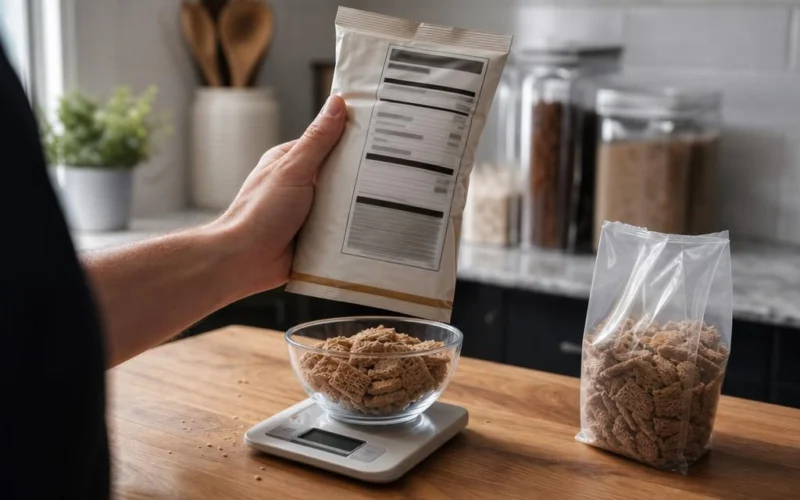
Use one equation whenever you read a nutrition label: actual intake = label amount × servings eaten. Check serving size first, calculate calories for the amount you expect to eat, and then use % Daily Value to compare nutrients between similar products.
A package showing 150 Calories per serving and 2.5 servings contains 375 Calories in total. The same 2.5 multiplier applies to its fat, carbohydrate, protein, fiber, added sugar, sodium, and % Daily Value figures.
The three label lines to read first
A Nutrition Facts panel contains plenty of useful information, but every line does not deserve equal attention at the shelf. The most efficient reading order is serving information, Calories, and then the nutrients relevant to your goal.
| Read | What it tells you | What to do |
|---|---|---|
| Serving size | Label’s reporting unit | Compare with your portion |
| Servings per container | Package’s serving count | Estimate servings eaten |
| Calories | Energy per serving | Multiply when needed |
| % Daily Value | Standard nutrient reference | Compare similar foods |
The Calories number is usually for one labeled serving, not automatically for the entire package. If a bottle contains two servings and you drink all of it, double every relevant number unless the panel provides a separate per-container column.
After that calculation, focus on nutrients that matter for the comparison. Someone comparing canned soups may prioritize sodium, while someone comparing breakfast cereals may look closely at fiber and added sugars. Calories alone cannot determine whether a food is a suitable choice.
Serving size is not a recommended portion
The distinction between serving size vs. servings per container causes many label-reading errors. Serving size is the amount used to calculate the listed nutrition values. Servings per container estimates how many of those units are inside the package.
A serving size is not an instruction about how much you should eat. The FDA bases serving sizes on reference amounts that reflect what people typically consume, rather than an official “healthy” portion. Both the FDA’s Nutrition Facts guidance and the NIDDK portion guide make this distinction.
Serving, portion, and package are different amounts
- Serving size: the standardized amount used on the label.
- Portion: the amount you personally choose to eat.
- Package size: everything inside the container.
Suppose a cereal label lists a 1-cup serving, but your bowl holds 1½ cups. Your portion is 1.5 servings, so the listed Calories and nutrients must be multiplied by 1.5. If you instead eat half a serving, multiply them by 0.5.
Volume measurements can also hide meaningful differences. A loosely filled cup and a densely packed cup may not weigh the same. For more precise tracking, use the label’s gram weight—such as “1 cup (55 g)”—and compare it with the amount weighed on a kitchen scale.
Calculate what you actually ate
The hardest part of label tracking is usually not arithmetic. It is noticing that a seemingly individual package contains 1.5, 2, or 2.5 servings. Fractional serving counts are easy to overlook when someone is hungry, distracted, or eating directly from the package.
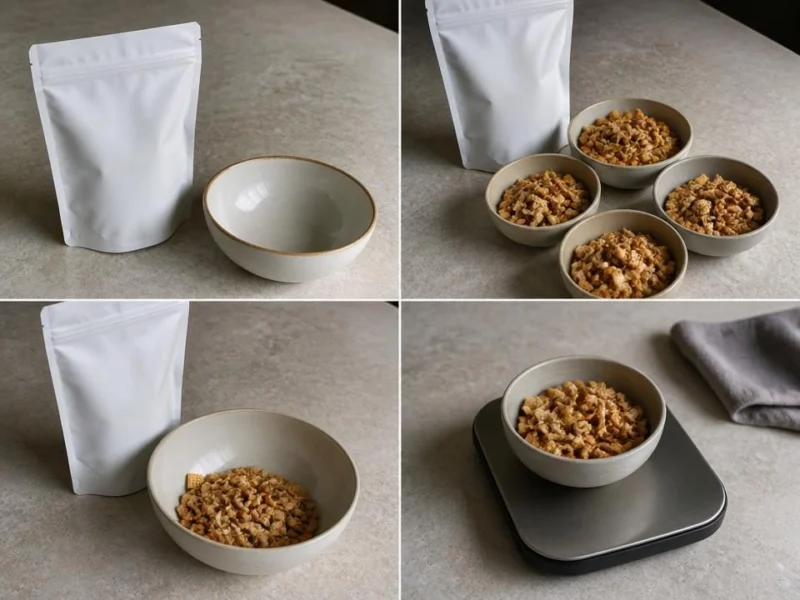
A worked example with 2.5 servings
Consider a snack package with these values per serving:
- 150 Calories
- 8 g fat
- 180 mg sodium
- 3 g fiber
- 4 g added sugars
If the entire package contains 2.5 servings, multiply each value by 2.5:
- 375 Calories: 150 × 2.5
- 20 g fat: 8 × 2.5
- 450 mg sodium: 180 × 2.5
- 7.5 g fiber: 3 × 2.5
- 10 g added sugars: 4 × 2.5
The same calculation applies to %DV. If sodium is listed as 12% DV per serving, eating 2.5 servings provides approximately 30% DV: 12% × 2.5 = 30%. Because label values are rounded, calculated totals may be approximate.
This calculation is more reliable than treating the large Calories number as a package total. According to the FDA, all listed quantities apply to the stated serving unless the label explicitly provides another basis.
A multiplication cheat sheet worth saving
| You ate | Multiply by | 150 Calories becomes |
|---|---|---|
| Half serving | 0.5 | 75 Calories |
| One serving | 1 | 150 Calories |
| One-and-a-half | 1.5 | 225 Calories |
| Two servings | 2 | 300 Calories |
| Whole 2.5-serving package | 2.5 | 375 Calories |
Here is a simple self-check: divide the amount eaten by the labeled serving amount. If you ate 90 g and one serving is 60 g, the calculation is 90 ÷ 60 = 1.5 servings. Multiply every label value by 1.5.
How one overlooked multiplier changes a food log
In a hypothetical seven-day tracking scenario, a person records a 150-Calorie package on four days because that is the most prominent number on the panel. On day five, they notice the package contains 2.5 servings and correct the entry to 375 Calories.
The difference is 225 Calories each time the whole package is eaten. Nothing about the food changed; the earlier record simply described one serving rather than the consumed portion. This is why checking the serving count before logging Calories is more useful than trying to perfect every gram of carbohydrate later.
How percent Daily Value works
The percent Daily Value, written as %DV, shows how much one serving contributes toward an FDA-established Daily Value for a nutrient. It is a standardized comparison tool, not a personalized nutrition prescription.
The FDA uses two practical benchmarks:
- 5% DV or less per serving is considered low.
- 20% DV or more per serving is considered high.
These thresholds and current nutrient reference values are detailed in the FDA’s Daily Value guidance. Values between 5% and 20% are neither officially “low” nor “high.”
| If your goal is | Look for |
|---|---|
| Less sodium | Lower sodium %DV |
| Less added sugar | Lower added-sugar %DV |
| More fiber | Higher fiber %DV |
| More calcium | Higher calcium %DV |
For nutrients commonly limited, compare saturated fat, sodium, and added sugars. For nutrients people may want more of, the label highlights dietary fiber, vitamin D, calcium, iron, and potassium. Context still matters: a food does not become universally “good” or “bad” because one percentage is high.
Why the label mentions 2,000 Calories
The statement about 2,000 Calories provides a general reference for nutrition labeling. It does not mean every adult should eat exactly 2,000 Calories.
Personal energy needs vary with factors such as age, body size, sex, activity, pregnancy, and health circumstances. %DV remains useful for comparing products even when someone’s personal calorie requirement differs, but it should not be read as a precise measurement of that individual’s needs.
The same multiplication rule still applies to percentages. If one serving provides 12% DV sodium and you eat 2.5 servings, the package provides 30% DV sodium based on the standardized reference.
Total sugars, added sugars, and missing percentages
Total sugars include sugars naturally present in foods and beverages as well as sugars added during processing. Added sugars appear as an indented line beneath total sugars because they are already included in that total.
For example, yogurt may list:
- Total sugars: 15 g
- Includes added sugars: 7 g
This means the yogurt contains 15 g of sugar in total, including 7 g added during processing. It does not contain 22 g. The remaining 8 g may include naturally occurring lactose from milk. The FDA’s added-sugars explanation confirms that added sugars are included within total sugars.
No %DV does not mean “unimportant”
Some label entries do not have an established %DV. Total sugars and trans fat are common examples. Protein grams usually appear, but a protein %DV is generally not required unless the product makes a protein claim or falls under certain labeling rules, including foods intended for young children.
Compare products only after matching the serving amount
A product with fewer Calories per serving is not necessarily lower in Calories for the same quantity. One granola label might use a 30 g serving while another uses 55 g. Comparing their headline numbers without adjusting the weights favors the product with the smaller reporting unit.
Use this sequence for bread, cereal, yogurt, soup, frozen meals, and packaged snacks:
- Compare products in the same general category.
- Check each serving’s gram or milliliter amount.
- Adjust both products to an equal amount.
- Compare Calories and relevant nutrients.
- Check ingredients for additional context.
Suppose Cereal A has 120 Calories per 30 g and Cereal B has 180 Calories per 50 g. At first glance, A looks lower. Converted to 100 g, however, A provides 400 Calories and B provides 360 Calories. The fair comparison reverses the initial impression.
| Common mistake | Better check |
|---|---|
| Compare unequal servings | Match gram weights |
| Assume package Calories | Check serving count |
| Add sugar lines | Use total sugars |
| Add %DV downward | Assess each nutrient |
| Trust front claims | Read full panel |
Front-of-package terms such as “light,” “high protein,” or “low sugar” may provide useful clues, but the Nutrition Facts panel supplies the quantities needed for comparison. A high-protein product, for example, can still differ substantially from another option in serving size, Calories, sodium, or added sugars.
Dual-column labels and other edge cases
Some packages display two columns: one for a serving and another for the entire container. If you consume the full package, use the per-container column. If you consume only part, use the per-serving column and calculate your multiplier.
Not every package provides a per-container column. Larger party-size packages may show only per-serving values, so multiply the listed values by the number of servings you consume. The FDA explains these formats in its serving-size and dual-column guidance.
Imported products may use a different format, including nutrition values per 100 g or 100 ml. That format can make product comparisons easier, but it does not tell you what your portion contains until you adjust for the amount eaten. If a food has 240 Calories per 100 g and you eat 75 g, calculate 240 × 0.75, giving 180 Calories.
Questions that come up while reading the panel
Why does a single bottle sometimes contain more than one serving?
Package size and serving size are separate concepts. Some containers that appear suitable for one occasion may hold multiple labeled servings. Check both the serving count and any dual-column information before treating the Calories number as a bottle total.
Does 20% Daily Value mean 20% of my personal needs?
Not precisely. It means one serving supplies 20% of the FDA’s standardized Daily Value for that nutrient. Personal requirements can differ, but the percentage remains useful for comparing similar products.
How do I calculate the label if I eat half the package?
If the package contains two servings, half the package equals one serving. If it contains five servings, half equals 2.5 servings. Multiply the per-serving numbers by the number of servings represented by that half.
Can I compare two foods with different serving sizes?
Yes, but first convert them to the same weight, volume, or realistic portion. Comparing per 100 g is often the simplest method: divide each per-serving value by its serving weight, then multiply by 100.
Why is there no %DV beside protein or total sugars?
Not every listed nutrient has a required %DV. Total sugars and trans fat lack one, while protein %DV is required only in certain circumstances. The missing percentage is a labeling issue, not evidence that the nutrient is irrelevant.
This content is based on nutritional physiology and energy metabolism research. It is for informational purposes only and does not constitute medical advice. Consult a qualified healthcare professional before making significant alterations to your caloric or macronutrient intake.