

There is no single calorie target that fits every adult. Your daily calorie needs depend on body size, age, sex, daily movement, exercise, life stage, and goal, so use a calculator estimate as a starting point—not a diagnosis of your metabolism. For most adults, the useful next step is to track normal intake and compare 7-day average body weight over about 14 days before making a modest adjustment.
Start With a Calorie Estimate, Then Check It Against Your Trend
The most useful hierarchy is population range → calculator estimate → personal trend validation. A broad range provides context, a calculator narrows it using personal information, and your intake and weight trend show whether that estimate is workable.
Broad Adult Calorie Ranges Are Context, Not Prescriptions
Older U.S. planning charts commonly placed many adult women around 1,600–2,400 calories and many adult men around 2,000–3,000 calories per day. These are historical population-level ranges, not current personalized prescriptions.
| Population reference | Typical broad range | Useful for | Cannot determine |
|---|---|---|---|
| Many adult women | 1,600–2,400 kcal | General context | Your personal target |
| Many adult men | 2,000–3,000 kcal | General context | Your personal target |
| 2,000-kcal label | Reference value | Comparing food labels | Your maintenance needs |
The current 2025–2030 Dietary Guidelines for Americans emphasize that calorie needs vary with age, sex, height, weight, and physical activity. They do not turn the older ranges above into individualized recommendations.
Age and sex categories also conceal considerable variation. Two people in the same category may differ in body size, muscle mass, occupation, steps, training volume, medications, and life stage. Older adults may need fewer calories while still requiring nutrient-dense food, so simply shrinking portions without considering protein, fiber, vitamins, and minerals can be counterproductive.
A Calculator Is More Useful Than a Generic Chart
A maintenance-calorie calculator commonly estimates resting energy expenditure from height, weight, age, and sex, then applies an activity assumption. The Mifflin–St Jeor equation has performed comparatively well in research on healthy adults, but prediction equations still have meaningful individual error.
Healthy adults can use the NIDDK Body Weight Planner to model how calorie intake and activity changes may affect weight over time. A calculator does not directly measure metabolism; it produces a planning estimate from population data and the information entered.
What to Do If Different Calculators Give Different Results
Different equations, activity multipliers, and definitions of “moderately active” can easily produce different answers. Check that every calculator received the same height, weight, age, and activity information. If the outputs form a plausible range, use the middle as a temporary starting point rather than choosing the lowest number.
For example, results of 2,180, 2,320, and 2,470 calories suggest that roughly 2,300 calories could be tested as a working estimate. Your subsequent trend matters more than debating which equation is theoretically perfect.
Maintenance Calories Mean Total Daily Energy Use, Not BMR
BMR, RMR, and TDEE in Plain English
Basal metabolic rate (BMR) and resting metabolic rate (RMR) describe the energy used for essential functions while the body is at rest. This includes breathing, circulation, temperature regulation, and cellular activity. RMR is generally measured under less restrictive conditions than BMR, but the terms are often used loosely in consumer calculators.
Your BMR is not your full daily calorie allowance. Total daily energy expenditure, or TDEE, includes several components:
- Resting metabolism: Energy used while at rest.
- Thermic effect of food: Digestion and nutrient processing.
- Exercise activity: Planned training and sports.
- Non-exercise activity: Walking, standing, chores, and fidgeting.
Maintenance calories are an estimate of this total. A review of energy-expenditure variability identifies resting metabolism, diet-induced thermogenesis, and activity as major components, with non-exercise movement contributing substantially to differences between people.
Why Two People With Similar Stats Can Need Different Calories
Three weekly gym sessions do not automatically make someone “very active.” A person who sits for work, drives everywhere, and trains for 45 minutes three times per week may expend much less than someone with the same workouts who stocks shelves, walks to work, and completes household chores daily.
Daily calorie needs can also shift after an injury, during a high-volume training block, following a change in job duties, or when commuting habits change. Poor sleep may alter appetite and spontaneous movement even when planned workouts remain unchanged. Recent weight loss or gain changes the energy required to move and maintain the body.
Use This 14-Day Method to Find Your Working Maintenance Estimate
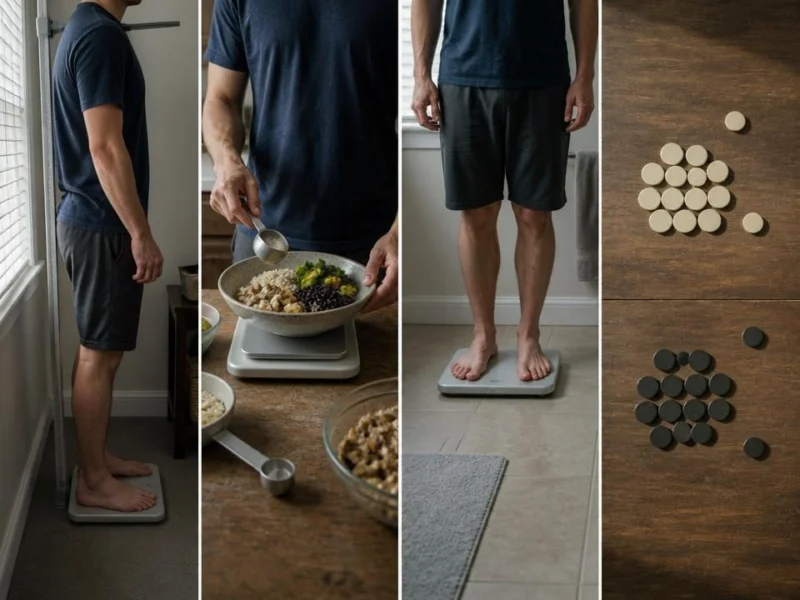
- Get a calculator estimate.
- Track normal intake.
- Record comparable morning weights.
- Compare two weekly averages.
Calorie tracking is optional, not a requirement for healthy eating. For readers seeking a numerical starting point, however, this method is more informative than treating a calculator result as fixed.
Days 1–14: Track Your Usual Intake Before Trying to “Eat Perfectly”
Changing your diet on day one prevents the test from answering the main question: what intake currently maintains your weight? Log your usual meals and snacks as accurately as is practical, including:
- Cooking oils, butter, and spreads
- Sauces, dressings, creamers, and dips
- Alcohol and other caloric drinks
- Bites, tastes, and unfinished portions
- Weekend and social meals
- Restaurant meals using reasonable estimates
Perfect accuracy is unrealistic, especially with restaurant food. Consistent logging is still useful because it exposes repeated omissions and gives you a stable method for comparing one period with another.
Weigh Consistently and Compare Weekly Averages
When weighing is appropriate for you, do it in the morning after using the bathroom and before eating or drinking. Use similar clothing—or no clothing—and keep the scale on the same hard surface.
Add the weights from days 1–7 and divide by seven. Repeat for days 8–14. Comparing those two averages filters out some of the noise that makes single weigh-ins misleading.
Read the Result Without Overreacting
- Similar averages: Intake is probably near maintenance.
- Downward average: Intake is likely below maintenance.
- Upward average: Intake is likely above maintenance.
- Unclear pattern: Track another 7–14 days before changing intake.
Fourteen days may be insufficient if the period includes travel, illness, menstrual-cycle changes, unusually salty meals, or a sharp change in training. In that situation, extending the observation period by another 7–14 days is more sensible than immediately changing calories.
If the trend is consistently upward or downward and does not align with your fat-loss or weight-gain goal, make a modest adjustment—often about 100–200 calories per day—then hold that intake and reassess the trend rather than reacting to a single weigh-in.
Why the Scale Can Rise Even When You May Be in a Deficit
A short-term scale increase does not prove that your calorie estimate is wrong. Body weight includes water, glycogen, food in the digestive tract, muscle, fat, and other tissues—not body fat alone.
- Sodium-heavy meals: Temporary fluid retention can raise weight.
- More carbohydrate: Stored glycogen carries associated water.
- Menstrual-cycle changes: Hormonal shifts can alter fluid balance.
- Constipation: Digestive contents remain on the scale.
- Hard training: Muscle inflammation can retain fluid temporarily.
- Alcohol or poor sleep: Both may disrupt hydration and appetite.
- Late meals: More food remains in the digestive tract.
- Changed conditions: Clothing and timing distort comparisons.
A high-carbohydrate restaurant meal can therefore be followed by a higher weigh-in even when average calorie intake remains below maintenance. The appropriate response is usually to resume comparable measurements and review the weekly average, not compensate with a severe restriction the next day.
Adjust Calories for Fat Loss, Weight Gain, or Maintenance Without False Precision
If Your Goal Is Fat Loss
Eating below maintenance generally produces weight loss over time, but no single deficit is right for every adult. After reviewing the trend, a modest adjustment of about 100–200 calories per day may be easier to evaluate and sustain than automatically subtracting 500 calories.
A workable deficit should leave enough room for nutrient-dense meals, adequate protein, normal daily function, and productive training. Protein tends to be more filling and has a higher thermic effect than carbohydrate or fat, but it cannot override total calorie intake. It is one part of diet quality and adherence, not a metabolic exemption from energy balance.
Persistent fatigue, deteriorating workouts, intense preoccupation with food, recurrent dizziness, or escalating restriction are signals not to keep lowering intake without qualified guidance.
If Your Goal Is Weight Gain
A consistent intake above maintenance generally supports weight gain, but the scale will not reveal how much is water, glycogen, lean tissue, or fat tissue. Start with a gradual increase, hold it long enough to observe a trend, and reassess rather than forcing rapid gain through a large surplus.
Training volume and spontaneous movement may rise when food intake increases, which can absorb part of the expected surplus. That is another reason to adjust from observed results instead of assuming a calculator predicts the exact outcome.
If Your Goal Is Maintenance
Maintenance is a range rather than one permanent number. Some days will be above the range and others below it while average body weight remains broadly stable.
The range may change after weight loss, with seasonal activity, during injury recovery, or after starting a more physical job. Aging can also reduce energy needs through changes in body composition and activity, although the effect varies considerably between individuals.
Why “3,500 Calories Equals One Pound” Is Only a Rough Teaching Rule
The 3,500-calorie rule is a static approximation, not a guarantee that a 500-calorie daily deficit will produce exactly one pound of weekly weight loss. Energy expenditure can change as body mass, food intake, movement, and training change. Water balance can hide or exaggerate tissue change over short periods.
The NIDDK Body Weight Planner uses a dynamic model that accounts for calorie and activity changes rather than assuming the same linear response continues indefinitely. Even such models remain estimates.
Common Calorie-Tracking Errors That Distort Your Estimate
| Mistake | Why it skews | Practical fix |
|---|---|---|
| Wrong pasta state | Water changes weight | Match raw or cooked |
| Skipping cooking oil | Calories go unlogged | Measure or use label |
| Counting weekdays only | Weekends disappear | Log all seven days |
| Double-counting exercise | Activity counted twice | Check app settings |
| Trusting watch calories | Burn estimates vary | Use as context |
| Changing intake daily | No stable test | Hold the target |
Dry pasta and cooked pasta are a common source of large database errors because cooking adds water and changes weight without adding calories. Weigh the portion in one state and choose an entry explicitly describing that same state.
The honest difficulty is that the first week often uncovers logging gaps rather than an unusually slow metabolism. A tablespoon poured freely from an oil bottle, a sweetened coffee, several tastes while cooking, and a loosely estimated weekend meal can create a sizable difference between recorded and actual intake.
Exercise creates a second problem. If an app already multiplied your resting estimate by an activity level, adding every displayed workout calorie may count some activity twice. Fitness watches can help compare your own activity patterns, but their calorie-burn figures should not automatically become permission to eat back the full amount.
When a Generic Calorie Target Is Not Appropriate
The NIDDK planner specifically excludes people under 18 and those who are pregnant or breastfeeding. Calculator results may also be less accurate for competitive athletes and people with metabolic disease, as explained by the Mayo Clinic calorie calculator.
Athletes can experience low energy availability when intake does not adequately cover basic physiology plus training demands. According to the American College of Sports Medicine, underfueling can occur even when calorie intake looks high and body weight remains stable. Competitive and high-volume athletes need individualized professional guidance that considers training load, recovery, performance, menstrual function where applicable, bone health, and injury patterns.
Questions Readers Ask After Getting a Calorie Estimate
Is 2,000 Calories a Day Maintenance or Just a Food-Label Number?
It is primarily a reference value used on many Nutrition Facts labels. It may be close to maintenance for one person, too high for another, and too low for someone larger or more active. Use it to compare nutrient percentages on labels, not as proof of your personal calorie needs.
Should I Eat Back the Calories My Fitness Watch Says I Burned?
Usually not automatically. First check whether your calorie target already contains an activity multiplier. Wearable calorie estimates have meaningful uncertainty, so use them to identify relative changes in activity rather than treating every displayed calorie as an exact addition to your food budget.
Do Maintenance Calories Go Down After Weight Loss?
Usually, because a smaller body often requires less energy at rest and during movement. Daily activity may change as well. Recalculate after a meaningful weight change, then validate the new estimate against your trend.
Adaptive thermogenesis—an energy-expenditure reduction beyond what body-size change alone predicts—may occur after weight loss, but its magnitude varies. A systematic review of adaptive thermogenesis found heterogeneous results and suggested the effect may be smaller after weight stabilization. This does not support claims that dieting permanently “damages” metabolism.
Can I Use This Method If I Lift Weights, Run Long Distances, or Have an Active Job?
The trend method can help establish a working estimate, but physically demanding work and high training loads create more day-to-day variability. Compare periods with similar work and training whenever possible. Competitive athletes, high-volume endurance athletes, and anyone concerned about low energy availability should seek individualized sports-nutrition guidance rather than using a generic deficit.
This content is based on nutritional physiology and energy metabolism research. It is for informational purposes only and does not constitute medical advice. Consult a qualified healthcare professional before making significant alterations to your caloric or macronutrient intake.