
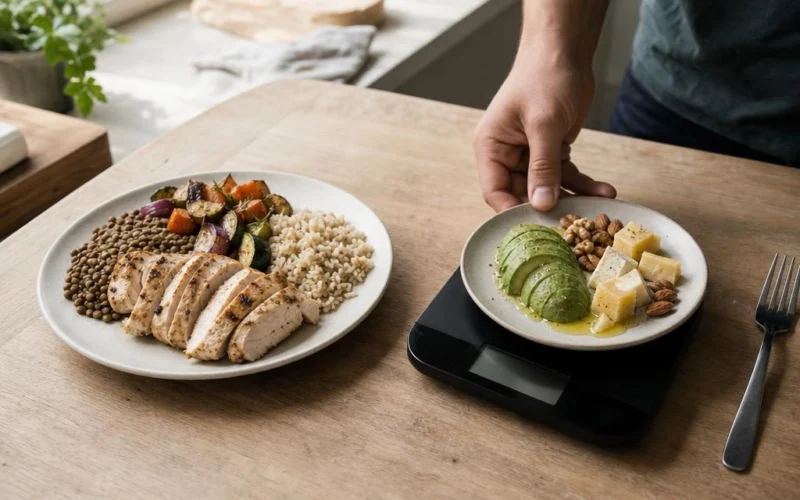
My verdict: calories determine whether weight loss can occur, while adequate protein makes the process easier to sustain and may help limit lean-mass loss. Set a workable calorie budget first, then aim for roughly 1.2–1.6 grams of protein per kilogram of body weight per day if that range suits your activity level and health status.
Calories and protein: the numbers that shape the decision
Calories determine whether an energy deficit exists and therefore drive the direction of weight change. For weight loss, maintaining that deficit on average comes first. Once calories are set, adequate protein becomes a priority for satiety, diet quality, training support, and limiting lean-mass loss—especially when paired with resistance exercise.
An older but still informative NHLBI evidence review found similar weight loss with calorie-restricted diets containing either 15% or 25% of calories from protein. This was not a direct comparison of calories versus protein; it shows that increasing protein within a calorie-restricted diet did not guarantee greater weight loss.
Newer research suggests higher-protein diets may provide a modest average advantage, although results vary with calorie intake, adherence, and the comparison diet. The likely benefits involve fullness and body composition rather than bypassing energy balance. If reaching a protein target would push you beyond your calorie budget, do not routinely erase the planned deficit to “catch up”; return to your normal protein target at the next meal or the next day.
Food choice matters because “high protein” does not always mean protein-efficient. The estimates below are per 100 g and use generic cooked or ready-to-eat entries from USDA FoodData Central. Values vary by brand, cut, water loss, added oil, skin, and preparation.
| Food or category | Per 100 g | Protein per 100 calories | Practical note |
|---|---|---|---|
| Chicken breast, cooked | 165 kcal; 31 g protein | About 19 g | Lean, highly efficient |
| Tuna in water, drained | 116 kcal; 26 g protein | About 22 g | Convenient pantry option |
| Nonfat Greek yogurt | 59 kcal; 10 g protein | About 17 g | Easy snack or breakfast |
| Firm tofu | 144 kcal; 17 g protein | About 12 g | Values vary by brand |
| Lentils, cooked | 116 kcal; 9 g protein | About 8 g | Provides protein and fiber |
| Whole egg, cooked | 155 kcal; 13 g protein | About 8 g | Nutrient-rich, moderate efficiency |
| Cheddar cheese | 403 kcal; 23 g protein | About 6 g | Protein-rich but calorie-dense |
| Almonds | 579 kcal; 21 g protein | About 4 g | Nutritious but energy-dense |
Cheese, nuts, fatty meats, and many protein bars can provide useful nutrients but may make a calorie deficit harder to maintain. When calories are tight, prioritize foods that provide more protein per calorie while leaving room for fiber-rich foods and unsaturated fats.
| Goal or situation | First priority | Protein approach |
|---|---|---|
| Weight loss | Maintain an average calorie deficit | Meet a workable protein floor most days |
| Fat loss with resistance training | Maintain the calorie plan and training | Consider the higher end of an appropriate range |
| Low appetite | Obtain adequate total nutrition | Choose compact, protein-rich foods |
| Kidney-directed diet | Follow the clinical nutrition plan | Use an individualized target |
Why protein changes hunger and body composition—but not energy balance
Protein costs more energy to process
The thermic effect of food is the energy used to digest, absorb, transport, and metabolize nutrients. Approximately 20%–30% of protein energy may be expended during processing, compared with about 5%–10% for carbohydrate and 0%–3% for fat, according to the National Academies’ review of energy requirements.
This difference is real, but it is not a free-calorie loophole. Do not subtract estimated thermic-effect calories from a food log. Nutrition labels and standard calorie-planning methods already use established metabolizable energy values, and the actual response varies among people and meals.
A 250-calorie protein bar still counts as roughly 250 calories in your daily plan. Its protein does not cancel the chocolate coating, nuts, oils, or syrup used to make it.
Fullness can improve, but protein is not an appetite switch
Protein-rich meals can affect appetite signals including ghrelin, cholecystokinin (CCK), peptide YY, and GLP-1. These signals help communicate hunger and fullness between the digestive system and brain.
A systematic review and meta-analysis of randomized trials found that acute protein intake modestly reduced hunger and increased fullness. Long-term findings were less conclusive. An immediate hormone response should not be treated as a guarantee that someone will spontaneously eat fewer calories for months.
Meal texture and processing also matter. A sweet protein drink may be consumed in two minutes and provide little chewing or food volume. A plate containing chicken or tofu, beans, vegetables, and a potato may supply similar protein with more physical volume and a longer eating time.
Fiber fills a gap that protein cannot
Protein for satiety works best as part of a complete meal. Fiber-rich foods add volume, slow eating, and can be fermented by gut bacteria into short-chain fatty acids. Those effects differ from protein’s amino-acid and appetite-signaling effects.
A person eating 130 grams of protein through shakes, bars, cheese, and deli meat may still feel hungry if meals contain little produce, whole grains, legumes, or other high-volume foods. A useful general planning benchmark is about 14 grams of fiber per 1,000 calories, though tolerance and medical needs differ.
- Protein: supports fullness and tissue maintenance.
- Fiber: adds volume and supports bowel function.
- Unsaturated fat: supplies essential fatty acids.
- Resistance training: provides the stimulus to retain muscle.
Rapidly increasing fiber can cause gas, bloating, or altered bowel habits, especially for people with irritable bowel syndrome or sensitivity to fermentable carbohydrates. Increase it gradually and use foods you tolerate.
Muscle retention depends on more than protein
Weight lost during a calorie deficit can include fat mass and lean tissue. Adequate protein may help limit lean-mass loss, particularly when paired with resistance exercise. It does not turn into muscle automatically, and eating more protein cannot replace a training stimulus.
A planning range of 1.2–1.6 g/kg/day may suit many physically active adults intentionally losing weight, according to recent sports-nutrition guidance. Lean, resistance-trained people in a substantial deficit may benefit from individualized targets above that range. Sedentary adults do not universally need bodybuilding-level intake.
Using 165 pounds as a hypothetical example:
- 165 lb ÷ 2.205 = about 75 kg.
- 75 × 1.2 = 90 g protein.
- 75 × 1.6 = 120 g protein.
- Planning range: about 90–120 g daily.
That range is a starting point, not a medical prescription. Current weight can overstate needs at a very high body weight, while goal weight can understate needs for someone who is muscular or dieting aggressively. In those situations, an individualized target based on body composition, training, and clinical history is more useful than forcing a simple formula.
Tracking mistakes that make calories and protein look contradictory
Calories and protein are not competing targets. Use this priority ladder:
- Keep the planned calorie deficit viable on average. This determines the direction of weight change.
- Reach a realistic protein floor most days. Adequate protein can support fullness, training, and lean-mass retention.
- Include fiber-rich plants and unsaturated fats.
- Use resistance exercise where appropriate.
Daily intake does not need to be mathematically perfect. A slightly higher day can fit within a successful week, but routinely erasing the planned deficit to “catch up” on protein defeats the purpose of the calorie target.
What to do when protein is short tonight
| Calories remain? | Protein gap | Already over budget? | Best next step |
|---|---|---|---|
| Yes | Small: 15–25 g | No | Choose a lean protein that fits the remaining calories. |
| No | Small: 15–25 g | No; at the target | Stop for the day and resume normal protein intake at the next meal. |
| No | Small: 15–25 g | Yes | Do not add catch-up calories solely to complete the target. |
| Yes | Large: 40+ g | No | Use the remaining calories for lean protein, but do not force the entire gap. |
| No | Large: 40+ g | No; at the target | Redistribute protein across the next day instead of adding a large shake. |
| No | Large: 40+ g | Yes | Do not create a larger calorie overrun; redesign the next day’s meals. |
If the target is missed routinely, reconsider whether it is realistic or move more protein into breakfast and lunch—for example, by adding Greek yogurt or eggs at breakfast and increasing the lean protein or legumes at lunch.
Cooked chicken logged as raw can distort the day
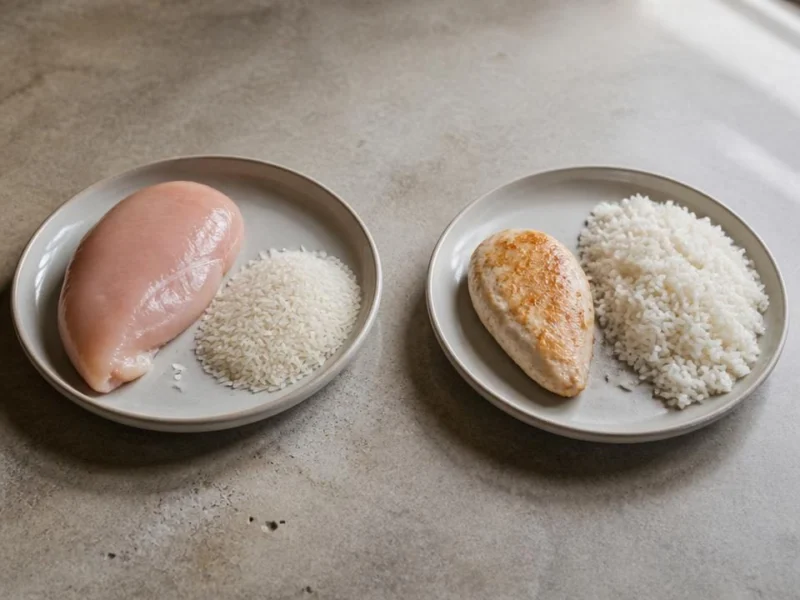
Cooking changes water weight. One hundred grams of cooked chicken is more concentrated than 100 grams of the same chicken before cooking because water has been lost. Rice and pasta create the opposite problem: they absorb water and become heavier.
Suppose someone weighs 600 grams of cooked chicken but selects a raw-chicken database entry. The app may understate both calories and protein because the entry does not match the food’s weighed state. Correcting the entry changes the log; it does not mean the person’s metabolism changed.
| Logging error | Specific fix |
|---|---|
| Raw and cooked entries mixed | Match the database entry to the food’s weighed state. |
| Cooking oil omitted | Measure and log the amount used. |
| Sauce or dressing ignored | Log it as a separate serving. |
| Restaurant portion treated as exact | Use a reasonable calorie range. |
| “High-protein” label trusted | Check protein per calorie. |
| Weekend extras forgotten | Review the seven-day average. |
Oil, dressings, drinks, tasting while cooking, and weekend portions can add calories without noticeably increasing meal size. Measuring these items for one or two representative weeks may reveal the pattern without requiring permanent gram-by-gram tracking.
Check whether protein crowds out the rest of your diet
Use this two-step self-check:
- Protein planning range: body weight in kilograms × 1.2–1.6 grams.
- Protein calorie share: protein grams × 4 ÷ daily calories × 100.
For 110 grams of protein in a 1,850-calorie plan, protein supplies about 440 calories, or 24% of daily energy. That can leave room for fiber-rich carbohydrates and fats. If the target crowds vegetables, fruit, legumes, whole grains, or unsaturated fats out of the budget, choose more calorie-efficient protein sources or reconsider the target.
Budget-friendly staples include eggs, canned tuna, dried lentils, beans, milk, yogurt, and tofu. Protein powders can be convenient, but they are optional. Compare cost per serving, protein per 100 calories, and whether the product replaces other food or merely adds calories.
Generic high-protein advice is unsuitable for people with diagnosed chronic kidney disease, dialysis-related needs, pregnancy, unintended weight loss, an eating-disorder history, or medically prescribed dietary limits. The NIDDK advises individualized protein planning for chronic kidney disease. People using appetite-suppressing medications may also need help meeting total nutrition needs despite reduced hunger.
Protein-versus-calorie questions from imperfect dieting days
Why am I hitting protein but not losing weight?
Meeting a protein target does not guarantee a calorie deficit. Calorie-dense protein foods, unlogged oils and sauces, restaurant estimates, larger weekend portions, or an overly high calorie target can keep average intake near or above maintenance. Judge progress from consistent food records and scale trends over several weeks because water, sodium, carbohydrate intake, and bowel contents can obscure short-term changes.
Also check for raw-versus-cooked logging mismatches. Cooking changes food weight through water loss or gain, so weighing a food cooked but selecting a raw database entry can distort both calorie and protein estimates. Match the logged entry to the food’s state when weighed.
Do I need a protein shake during weight loss?
No. Shakes are a convenience tool, not a fat-loss requirement. The Mayo Clinic notes that protein shakes can add calories, especially when consumed in addition to regular meals. Ordinary foods can cover protein needs if they suit your schedule, preferences, and budget.
Can more protein fix hunger in a low-fiber diet?
Not necessarily. Protein may improve fullness, but hunger also depends on food volume, fiber, meal timing, sleep, and the size of the calorie deficit. Pair protein with vegetables, fruit, legumes, or whole grains rather than treating protein grams as the only measure of satiety.
Is one gram of protein per pound mandatory?
No. One gram per pound is about 2.2 g/kg, above the 1.2–1.6 g/kg/day planning range that may suit many adults intentionally losing weight, particularly those who are physically active. Higher targets may be appropriate for some lean, resistance-trained people during a calorie deficit, but they are not universally necessary. A sustainable target that leaves room for fiber-rich carbohydrates and healthful fats is generally more useful than copying a bodybuilder’s intake.
This content is based on nutritional physiology and energy metabolism research. It is for informational purposes only and does not constitute medical advice. Consult a qualified healthcare professional before making significant alterations to your caloric or macronutrient intake.