
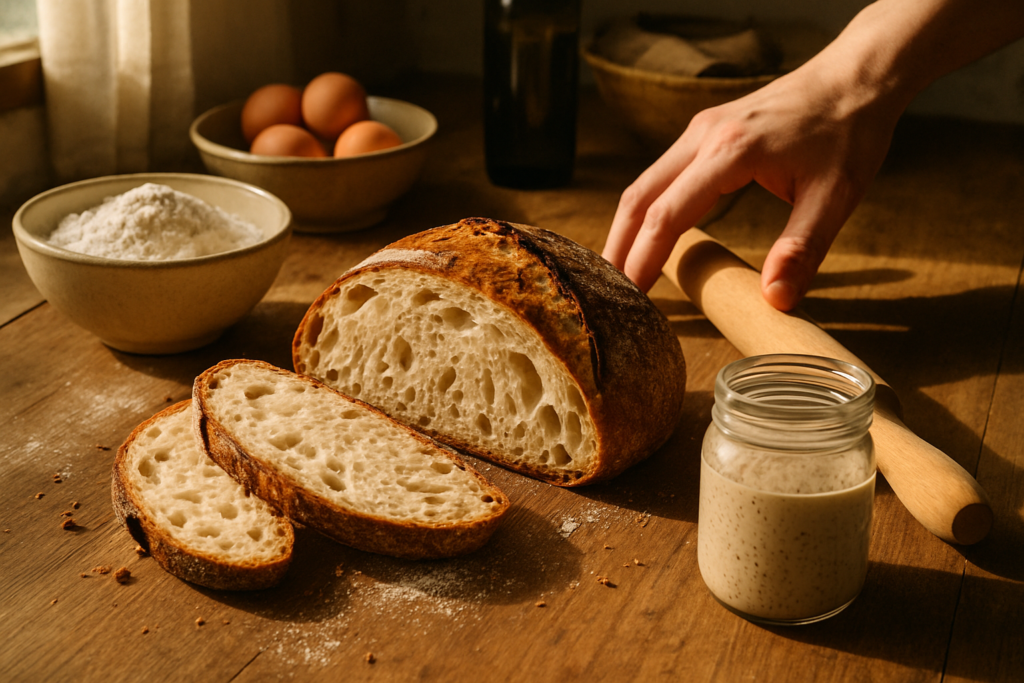
Sourdough can be a better bread choice than regular white yeast bread when the flour, slice size, and fermentation are comparable—but it is not automatically healthier. For most adults, one to two medium slices per meal (about 60–90 g total) is a practical portion; choose whole-grain sourdough for substantially more fiber, then build the meal around protein and produce.
The sourdough bread benefits come mainly from its acidic fermentation: lactic-acid bacteria lower dough pH, change starch behavior, and can reduce phytate. Those effects are real, yet a white-flour sourdough loaf can still be low in fiber and calorie-dense, so the fair comparison is same flour against same flour, not sourdough white bread against a whole-wheat yeast loaf.
Sourdough bread nutrition facts: what is actually in a 100 g portion?
Nutrition varies more by flour and bakery formula than by the word “sourdough” on a bag. A dense country loaf, airy supermarket boule, seeded rye sourdough, and whole-wheat pan loaf can differ sharply in water content, sodium, slice weight, and carbohydrate per serving.
The figures below are practical USDA-style benchmarks for plain, white-flour sourdough. They describe the bread itself, not butter, jam, olive oil, avocado, or sandwich fillings.
| Nutrient/Metric | Amount per 100 g | %DV or metric | Primary role |
|---|---|---|---|
| Calories | ~300 kcal | 15% daily energy | Energy intake |
| Carbohydrate | ~58 g | 21% DV | Glucose fuel |
| Fiber | ~2–3 g | 7–11% DV | Stool bulk |
| Protein | ~10–11 g | 20–22% DV | Amino acids |
| Fat | ~2 g | 3% DV | Texture, energy |
| Sodium | ~500–650 mg | 22–28% DV | Fluid balance |
| Iron | ~3 mg | 17% DV | Oxygen transport |
| Magnesium | ~25 mg | 6% DV | Enzyme reactions |
A thick 59 g slice of white sourdough can provide roughly 188 calories, 37 g carbohydrate, and only about 2 g fiber. That slice is much larger than the thin toast slice many people picture, which explains why “two slices” is an unreliable nutrition measure.
The flour matters more than the crust’s sour flavor
White sourdough begins with refined wheat flour. Fermentation may alter digestibility and mineral availability, but milling has already removed much of the bran and germ. The final loaf generally has a similar calorie range to white sandwich bread and modest fiber.
Whole-wheat sourdough retains the bran and germ, so it usually supplies more fiber, magnesium, potassium, and plant compounds. Its darker color alone is not proof of whole grain content; malt, molasses, caramel color, and rye flavoring can darken a loaf made mostly from refined flour.
Rye sourdough has a different structure from wheat bread. Rye contains more soluble arabinoxylans, which bind water and create the sticky, compact crumb familiar in Nordic-style loaves. That viscosity can slow the movement of starch through digestive enzymes, though recipes vary widely and rye is still unsuitable for celiac disease unless certified gluten-free.
Whole-grain wheat sourdough is usually the strongest option for daily bread eating. A conventional 100% whole-wheat yeast bread can still beat refined sourdough for fiber, so sourdough vs whole wheat bread is not a contest with one permanent winner.
- Best everyday choice: whole-grain sourdough first ingredient.
- Best softer texture: wheat sourdough with whole grain.
- Dense, high-fiber option: rye-forward sourdough.
- Least fiber: white artisan sourdough.
What the sourdough fermentation process changes before baking
A true starter contains wild yeasts and lactic-acid bacteria living in flour and water. Yeasts produce carbon dioxide that raises the dough; bacteria produce lactic and acetic acids that create the characteristic tang. Commercial baker’s yeast bread rises rapidly because it is designed primarily for gas production rather than a long acidification phase.
The acidification matters because cereal grains contain phytate, the storage form of phosphorus. Phytate can bind minerals such as iron, zinc, magnesium, and calcium in the digestive tract. As sourdough pH drops, grain enzymes called phytases become more active and split phytate molecules.
In whole-wheat breadmaking, a controlled sourdough fermentation experiment found greater phytate reduction than standard yeast fermentation—62% versus 38%—along with improved magnesium and phosphorus solubility. Mineral solubility is not the same as a guaranteed increase in every person’s mineral status, but it is a meaningful food-chemistry difference.
I can see the process in dough handling. At 30 minutes after mixing, a whole-wheat dough often feels rough and tears at the edges. After a 12-hour cool ferment, the same dough stretches farther, smells lightly fruity, and releases from the bowl with a softer, more cohesive pull. A short “sourdough-flavored” dough made with vinegar and commercial yeast will smell sharp but does not necessarily get the same time-dependent enzymatic changes.
Why sourdough blood sugar can be lower—but not predictably low

Organic acids can influence how starch behaves during baking and digestion. Acetic acid may reduce the rate at which digestive enzymes access starch, while a firm crumb and intact grain particles can physically slow chewing and enzyme contact. Cooling bread before eating also encourages some starch retrogradation, producing a small amount of resistant starch.
That does not make every sourdough low glycemic. Flour fineness, proofing time, loaf density, serving size, toast level, and the rest of the meal all change sourdough blood sugar. A fluffy white sourdough eaten alone can still raise glucose quickly because it delivers a large amount of rapidly available carbohydrate.
A human challenge trial involving 36 healthy adults found lower after-meal glucose responses from the tested sourdough breads than from baker’s-yeast bread, with long fermentation linked to faster oro-cecal transit in that setting. Read the details in the Food Research International trial. The result applies to those specific breads, not every loaf with a blistered crust.
The broader evidence deserves restraint. A systematic review of 25 clinical trials found too much variation among breads and study designs to declare sourdough fermentation alone a dependable clinical advantage. More than half of white-wheat comparisons did not show a significant glycemic difference.
A practical bread test for people using glucose monitors
For sourdough for diabetics, use grams rather than bakery marketing. Compare the label’s total carbohydrate, fiber, and serving weight. A slice with 24 g carbohydrate is not equivalent to a slice with 40 g carbohydrate, even if both are called artisan sourdough.
Test one repeatable meal on a normal day: weigh or identify the exact slice, eat it with eggs, tofu, fish, Greek yogurt, or beans plus vegetables, and log glucose according to the plan supplied by your diabetes clinician. Change one variable at a time. Replacing a 35 g slice with a 75 g slab invalidates the comparison.
Does sourdough bread digestion feel easier for some people?
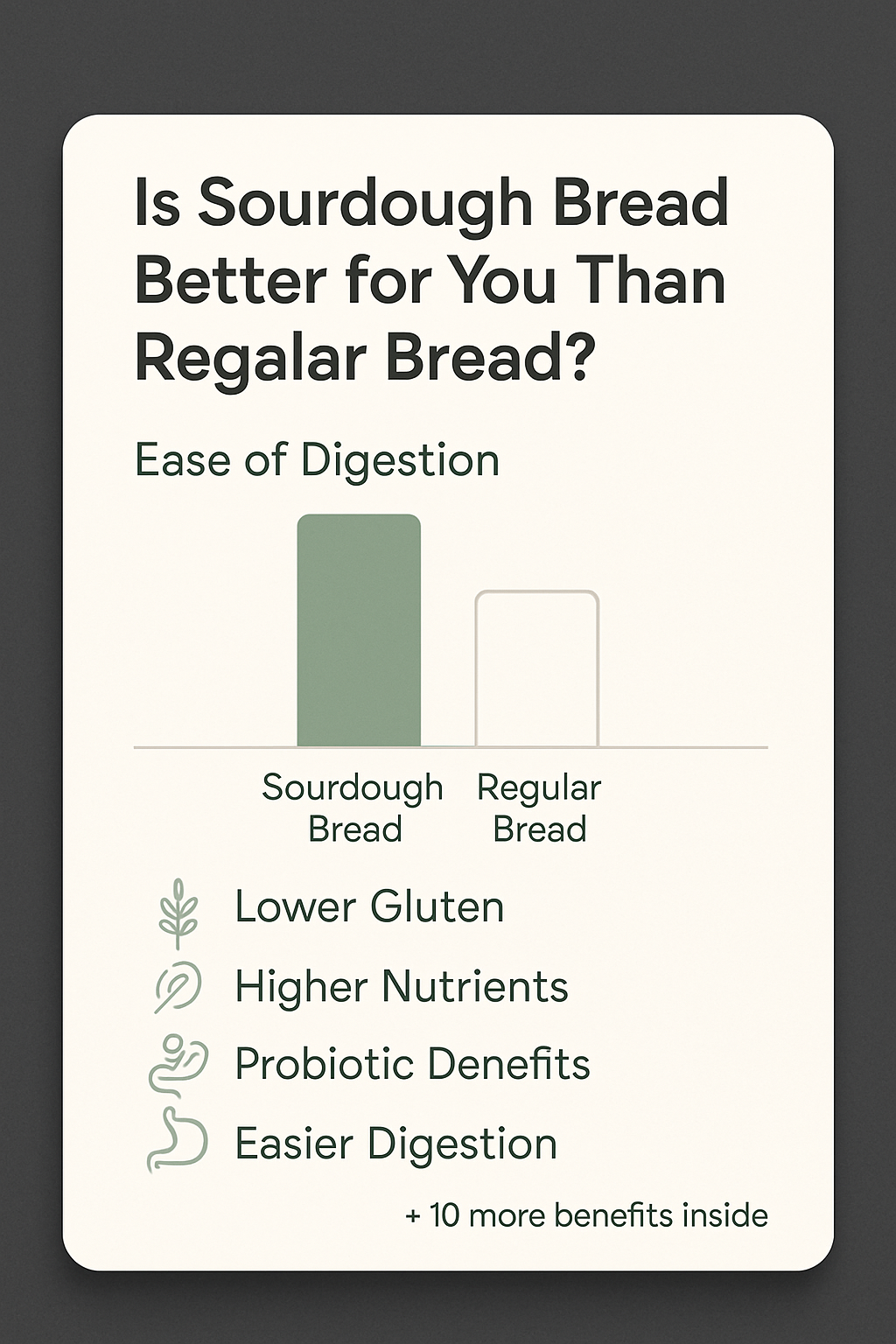
Sourdough bread digestion is not one single issue. Some people mean less fullness after a meal, others mean fewer IBS symptoms, and others are asking about gluten. Fermentation can reduce some fermentable carbohydrates called fructans, part of the FODMAP family, but the amount left depends on flour, starter activity, fermentation length, and recipe.
Fructans are carbohydrates rather than gluten proteins. In people with IBS, they can be fermented rapidly by colonic microbes, creating hydrogen, methane, carbon dioxide, distension, pain, or urgent stools. A person may feel better on one long-fermented wheat sourdough and assume gluten was the issue, when lower fructans or a smaller portion may explain the change.
One client replaced two large breakfast bagel halves with one 70 g slice of naturally fermented rye-wheat sourdough for seven days. Her evening bloating decreased by day four, but it returned after she added a second slice plus an apple and onion-heavy lunch. The useful clue was the day’s total FODMAP load, not a claim that sourdough was symptom-proof.
A pilot trial in people with wheat sensitivity or IBS found that long fermentation reduced FODMAPs and amylase-trypsin inhibitors, yet did not significantly improve gastrointestinal symptoms compared with yeast bread. That distinction is covered in the Nutrients pilot study. Symptoms are personal; biochemical reduction does not guarantee clinical relief.
Gluten falls somewhat, but celiac safety does not follow
Sourdough gluten content may be lower than that of an otherwise similar fast-risen wheat loaf because microbial and flour enzymes partially break down proteins during fermentation. Ordinary bakery fermentation does not reliably reduce gluten below the legal gluten-free threshold of 20 parts per million.
People with celiac disease should not use ordinary wheat or rye sourdough as a gluten-free substitute. Choose bread specifically certified gluten-free and prevent cross-contact from shared toasters, cutting boards, bakery bins, and knives. Those with wheat allergy need the same avoidance unless a clinician has confirmed a safe alternative.
Non-celiac gluten sensitivity is harder to interpret because fructans, wheat proteins, expectation effects, and portion size can overlap. A structured dietitian-guided challenge is more informative than eliminating broad food groups indefinitely.
Sourdough for gut health: useful substrate, not a probiotic loaf
Calling baked bread a probiotic is inaccurate. The starter can contain living lactic-acid bacteria and yeasts before baking, but oven heat kills those organisms in the finished loaf. Sourdough bread probiotics are therefore not a reliable reason to choose it.
The more defensible gut-health angle is substrate and byproducts. Whole-grain sourdough supplies fermentable fiber and resistant starch that colonic microbes can convert into short-chain fatty acids, including butyrate. Butyrate is a primary fuel for colon cells and is produced from fiber reaching the large intestine; it does not arrive as an intact “probiotic benefit” from a toasted slice.
The starter’s organic acids and altered carbohydrate structure can still affect flavor, texture, and digestion. For a microbiome-focused plate, the larger dietary pattern matters: beans, oats, vegetables, fruit, nuts, seeds, and intact whole grains provide more total fermentable material than bread alone.
A fresh loaf can create a false sense of virtue. I have watched people switch from packaged white bread to bakery sourdough, then eat three slices with butter because the crust felt “cleaner.” Their fiber intake barely moved while their bread calories rose. Sourdough is a food format, not a pass to ignore quantity.
Portion limits, side effects, and who should be careful
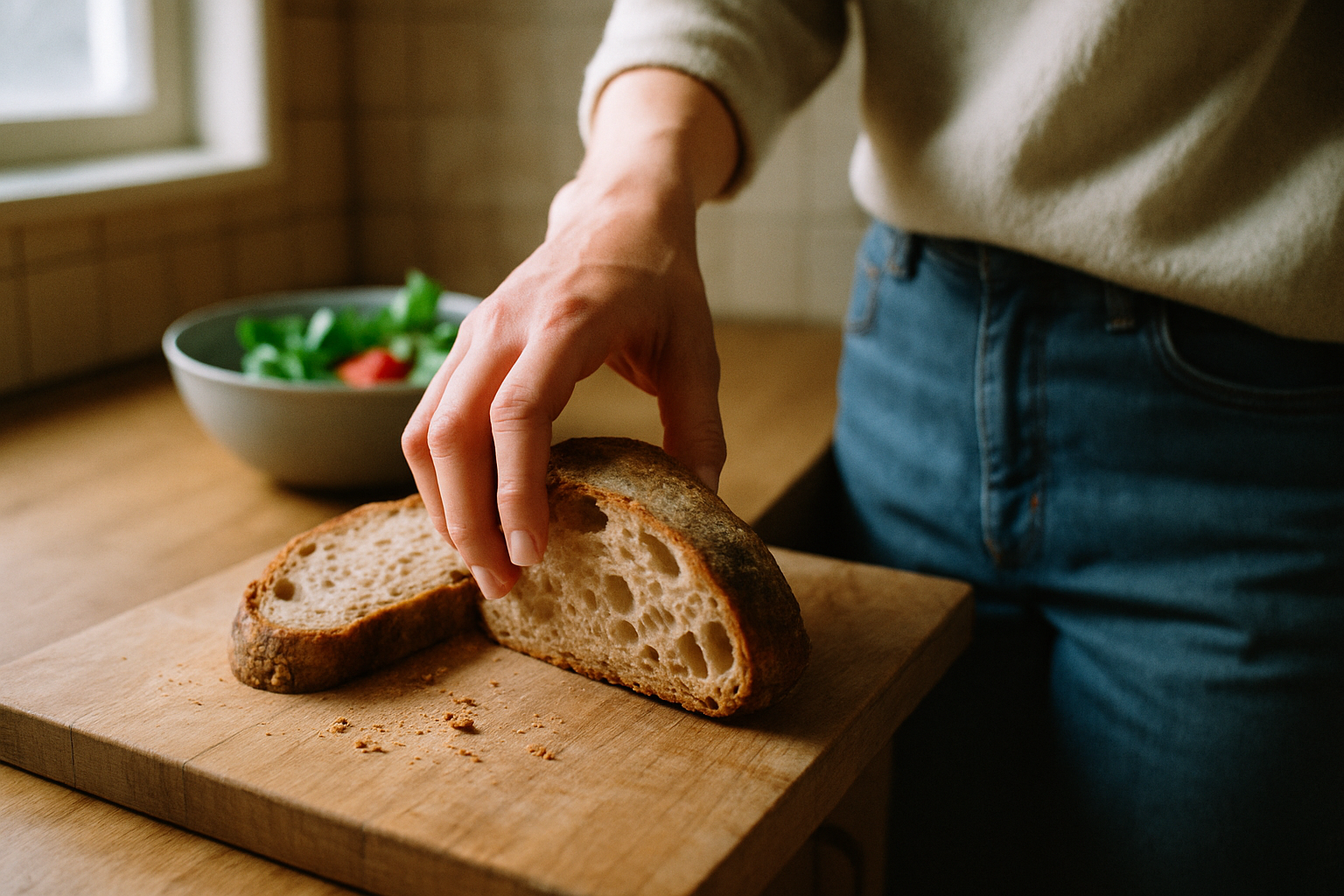
A useful upper limit depends on your energy needs and the rest of the meal, yet many adults do well treating bread as one carbohydrate component rather than the meal’s foundation. For a person without carbohydrate restrictions, 60–90 g per meal is often reasonable. That equals one large artisan slice or two smaller slices.
People with diabetes, prediabetes, insulin resistance, or high triglycerides may need a smaller carbohydrate allocation. Chronic kidney disease can require individualized attention to potassium, phosphorus additives, sodium, and protein targets. People following a medically prescribed low-sodium pattern should examine labels closely because bakery sourdough can supply a substantial sodium load before fillings are added.
The “real sourdough” mistake at the grocery shelf
The honest difficulty is that ingredient lists cannot prove fermentation time. A loaf may contain flour, water, salt, commercial yeast, vinegar, and “sourdough flavor,” then be marketed with rustic language. It can still taste good, but it may not reflect a slow starter-led process.
- Check first ingredients: whole wheat, rye, or wheat flour.
- Check added sweeteners: honey, syrup, malt, sugar.
- Check sodium: compare per actual slice.
- Ask the bakery: starter use and ferment time.
- Ignore crust color: darkness proves little.
Flavored loaves create another trap. Cranberry-walnut, cinnamon-raisin, cheddar, olive, and seeded sourdough can be delicious, but they change calorie, sodium, sugar, and fat totals. “No preservatives” does not mean low sodium, high fiber, or suitable for a glucose-conscious meal.
A two-minute portion self-check before you slice again
Place your bread on a small plate and count the carbohydrate sources already present. If the meal contains bread, potatoes, rice, pasta, cereal, or dessert, choose one main starch rather than stacking all of them. A palm-sized piece around 60 g is a practical visual reference for many rustic loaves.
Track bread for three days by photographing the slice beside your hand before toppings go on. Note hunger two to four hours later, bowel symptoms, and—if relevant—glucose response. Persistent bloating, constipation, diarrhea, rash, wheezing, vomiting, or severe abdominal pain needs medical assessment rather than repeated home testing.
Pair sourdough with foods that change the meal, not just the flavor
Plain bread has limited protein and few vegetables. Pairing changes gastric emptying, satiety, micronutrient intake, and the blood-glucose curve of the whole meal. The goal is not to disguise bread as a health food; it is to make the slice earn its place on the plate.
| Sourdough meal | Pair or prep | Why it works |
|---|---|---|
| Avocado toast | Add egg, lemon | Protein, vitamin C |
| Tomato toast | Use olive oil | Improves carotenoid uptake |
| Bean toast | Add peppers | Vitamin C aids iron |
| Soup side | Choose lentil soup | More protein, fiber |
| Breakfast slice | Add plain yogurt | Protein slows meal |
Tomatoes supply lycopene, a fat-soluble carotenoid; olive oil improves its absorption because dietary fat supports micelle formation in the intestine. Beans supply non-heme iron, while bell peppers or lemon add vitamin C, which improves absorption by keeping iron in a more absorbable form.
Three kitchen moves that improve homemade sourdough benefits
Use some whole-grain flour in the build. A loaf made with 20–50% whole-wheat or rye flour has more grain-derived fiber and minerals than a fully white loaf. Increase water gradually; whole-grain flour absorbs more, and a dough that feels manageable at 70% hydration with white flour can become tight and under-hydrated after a large bran increase.
Allow a genuine cold ferment. After bulk fermentation, an overnight refrigerator proof of roughly 8–16 hours develops acidity and flavor. Do not chase extreme sourness by leaving dough warm for days; over-fermentation weakens gluten structure, creates a gummy crumb, and can make shaping frustrating rather than nutritious.
Cool before slicing. Cutting a hot loaf compresses the crumb and releases steam, making it seem gummy. I wait at least 90 minutes for a standard boule; the interior stops feeling wet and the slices hold toppings without tearing. Cooling also modestly changes starch crystallization compared with eating it piping hot.
Which loaf fits your goal at the bakery?
Bread selection becomes easier when the goal is explicit. This guide is intentionally about trade-offs: fermentation can be useful, while flour type, toppings, and serving size still decide most of the nutritional outcome.
| Goal | Recommended option |
|---|---|
| More daily fiber | Whole-grain sourdough |
| Lower meal glucose | Whole grain, protein topping |
| Possible IBS trial | Small long-fermented portion |
| Celiac disease | Certified gluten-free bread |
Is sourdough good for weight loss? It can fit, but fermentation does not create a fat-loss effect. Weight change reflects sustained energy balance, appetite, food quality, activity, sleep, medications, and medical factors. A satisfying slice with eggs and vegetables may reduce grazing for one person; a bread basket before dinner may make calorie intake harder to manage for another.
Questions people ask while choosing sourdough
Is sourdough healthier than regular bread?
It can be healthier than regular white yeast bread if both loaves use similar refined flour and the sourdough was properly fermented. The likely advantages are phytate reduction and, in some cases, a slower glucose response. Whole-wheat yeast bread remains a stronger choice than refined sourdough if fiber is your main priority.
Does sourdough bread have less gluten than regular bread?
Long fermentation can partially break down gluten proteins, but the amount varies too much to rely on for medical decisions. Standard wheat sourdough still contains gluten and is unsafe for celiac disease unless it is specifically certified gluten-free.
Is sourdough actually gluten-free?
No. Traditional sourdough made from wheat, rye, barley, or conventional flour blends is not gluten-free. A gluten-free sourdough can be made from certified gluten-free flours such as rice, buckwheat, sorghum, millet, or gluten-free oat flour, but certification and cross-contact controls matter.
Can I eat sourdough bread every day?
Daily sourdough can fit a balanced diet if your portion, fiber intake, sodium intake, and medical needs support it. Rotate grain sources across the week—beans, oats, brown rice, quinoa, potatoes, and whole-grain bread—rather than making refined sourdough your only carbohydrate source.
Is sourdough bread better for digestion if I have IBS?
Some people tolerate a modest portion of long-fermented sourdough better because fructans may be lower, but symptom relief is not assured. Work with a dietitian if you are using a low-FODMAP approach, because strict long-term restriction can unnecessarily narrow the diet and affect microbial diversity.
This content is based on food chemistry and clinical nutrition research. It is for informational purposes only and does not constitute medical advice. Consult a qualified healthcare professional before making significant changes to your dietary routine.