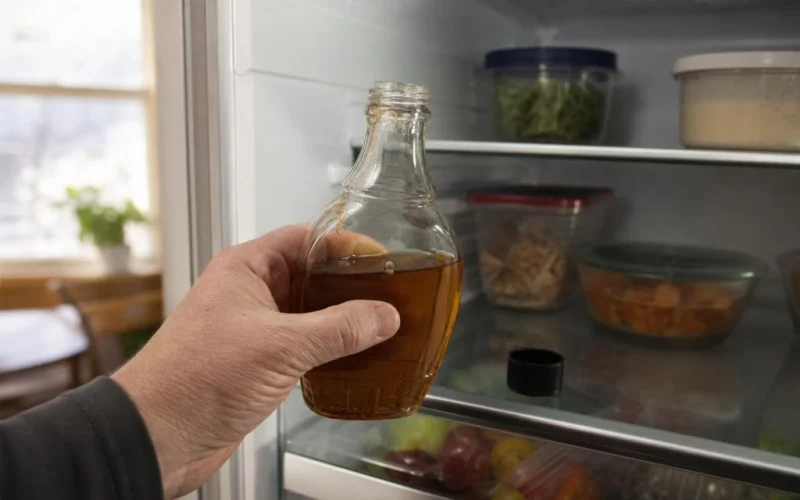
Yes—opened pure maple syrup should generally be refrigerated in a tightly sealed container. Unopened, commercially packaged pure maple syrup can usually stay in a cool, dark pantry, while pancake or table syrup may have different instructions, so check the label. Refrigeration slows mold growth and quality loss; syrup does not become automatically unsafe the moment it sits at room temperature.
Pure Maple Syrup vs. Pancake Syrup: Check the Product First
Look at the ingredient list before deciding where to store the bottle. Pure maple syrup should list maple syrup as the sole ingredient, or identify the product as “100% pure maple syrup.” It is made by concentrating sap from maple trees.
Pancake, table or maple-flavored syrup is a different product. It may contain corn syrup, sugar, water, flavorings, coloring or other ingredients. Because formulations and processing methods vary, the package directions control for commercial pancake syrup. Do not assume that storage advice for pure maple syrup applies to every syrup sold for pancakes.
How to Store Maple Syrup After Opening
Refrigerate opened pure maple syrup promptly and keep it tightly sealed. Use the original container if it closes securely, or transfer the syrup to a clean, food-safe container if needed.
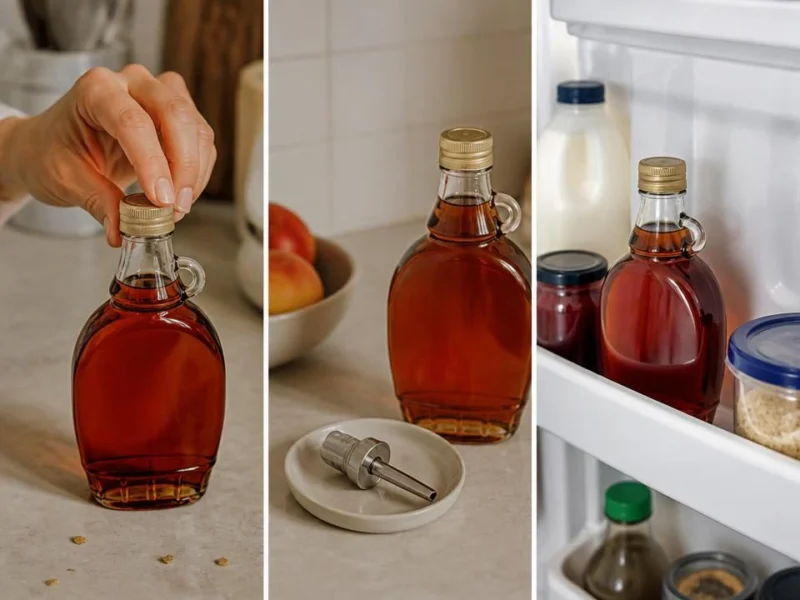
- Close the container firmly after each use.
- Use a clean pour spout or utensil, and keep the opening away from food and dirty surfaces.
- Do not pour syrup left in a serving dish back into the bottle.
Refrigeration slows mold growth and helps preserve the syrup’s flavor and appearance. Pure maple syrup’s high sugar content slows some microbial growth, but it does not make opened syrup immune to mold or quality loss. Syrup does not automatically become unsafe the moment it is left at room temperature, but clean handling and refrigeration reduce the risk of problems.
Purdue Extension recommends refrigerating opened maple syrup and keeping it tightly sealed. Oregon State University Extension likewise notes that properly processed unopened syrup can be shelf-stable, while opened syrup has greater exposure to mold and should be refrigerated.
Maple Syrup Storage Decisions
| Product or situation | Where to store it | What to do |
|---|---|---|
| Unopened pure maple syrup | Cool, dark pantry | Keep sealed; follow the label if it gives different instructions. |
| Opened pure maple syrup | Refrigerator | Close tightly and use a clean container or pour spout. |
| Opened pancake or table syrup | As directed on the package | Follow the manufacturer’s storage instructions. |
| Syrup left at room temperature | Refrigerator after inspection | Check for mold, unusual odor or other abnormal changes before using. |
| Frozen pure maple syrup | Freezer, with headspace | Thaw in a sealed container and mix if separation occurs. |
What to Do If Maple Syrup Looks or Smells Different
Visible mold means discard the entire bottle. Do not use syrup with fuzzy growth, colored mold spots or other clearly visible mold, even if it appears only on the surface.
An unusual fermented or sour odor, bubbling or another clearly abnormal change is also a reason not to use the syrup. Storage life varies with the formulation, packaging, temperature, handling and cleanliness, so there is no universal shelf-life promise for every bottle.
Crystallized sugar or sediment is not automatically mold. These changes can result from storage or the product itself, but they should not be confused with fuzzy growth, off odors or fermentation-like changes. If you cannot confidently distinguish a harmless quality change from spoilage, discard the syrup.
Do Not Skim, Filter or Reboil Moldy Syrup
Although some older consumer advice suggests skimming, filtering or reheating moldy syrup, current extension guidance recommends discarding it. Removing visible mold does not establish that the remaining syrup is safe, and boiling is not a reliable way to eliminate every mold-related hazard.
What If Pure Maple Syrup Was Left Out?
Leaving pure maple syrup on the counter overnight, or for another short period at ordinary room temperature, is not a precise universal safety deadline. The risk depends on factors such as how warm the room was, whether the bottle was open, and whether the cap, pour spout or serving container was clean.
Refrigerate the syrup, then inspect it before use. If it has visible mold, an off odor, bubbling or fermentation-like changes, discard it. Be especially cautious with syrup that was left uncovered in a decorative container or repeatedly exposed to food and utensils.
A short time outside the refrigerator does not by itself prove that the syrup is spoiled. Refrigeration is the recommended routine for opened pure maple syrup because it helps slow mold growth and quality deterioration.
Can Maple Syrup Be Frozen?
Pure maple syrup can be frozen for longer-term storage. Leave some empty space in the container because liquid expands as it freezes, and make sure the container is tightly sealed to reduce freezer odors and contamination.
Thaw the syrup in the refrigerator or at room temperature while it remains sealed. If the texture or appearance separates slightly, mix it before using. Freezing is optional for a small bottle; refrigeration is usually sufficient for routine storage.
Refrigerate opened pure maple syrup, follow the package directions for pancake syrup, and discard syrup with visible mold or clearly abnormal spoilage signs.