
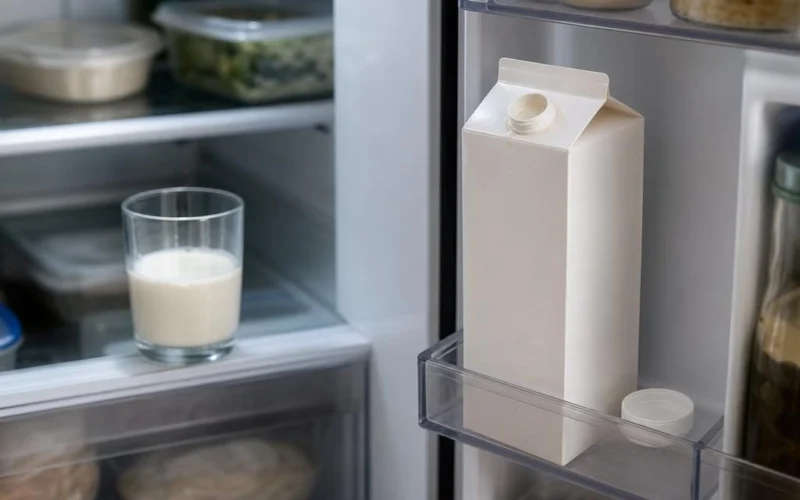
Most commercial almond milk should be refrigerated promptly after opening and used within the time printed on its carton. Many brands say 7–10 days, while others allow up to 14 days; discard it if it was left out for more than 2 hours, or more than 1 hour in temperatures above 90°F (32°C).
Check the Carton Instructions First
The carton is the best source for your specific product. Manufacturers set after-opening guidance based on that product’s formulation, packaging, and processing, so its instruction should take priority over a general almond milk shelf-life range.
For example, Silk’s guidance says to refrigerate opened plant beverages and use them within 7–10 days. Blue Diamond’s Almond Breeze guidance allows up to 14 days after opening. Those are brand-specific examples, not universal safety guarantees.
Also, count from the day you opened the carton. A printed best-by or use-by date applies to the unopened product when it has been stored correctly; it does not override the after-opening window or unsafe warm-temperature exposure.
How Long Opened Almond Milk Usually Lasts
| Product type | Before opening | After opening | Practical rule |
|---|---|---|---|
| Refrigerated almond milk | Keep refrigerated | Refrigerate promptly; follow the carton window, commonly 7–14 days depending on brand | Use the package instruction |
| Shelf-stable almond milk | Can stay at room temperature only while sealed and labeled shelf-stable | Refrigerate promptly; follow the carton window, commonly 7–14 days depending on brand | “Shelf-stable” no longer applies after opening |
“Shelf-stable” describes an unopened, intact carton. After opening, shelf-stable almond milk needs refrigeration just like almond milk sold from the refrigerated case.
Keep opened almond milk at 40°F (4°C) or below, the refrigerator temperature recommended by the USDA Food Safety and Inspection Service for perishable foods. When practical, store it in the main refrigerator compartment rather than the door, where temperatures fluctuate; Blue Diamond also advises against door storage for its refrigerated products.
The 7–14-day range is context, not a safety guarantee: some brands specify 7–10 days, while others allow up to 14 days. Follow the after-opening instruction on your carton.
Freezing is not usually the best default for an opened carton because thawing can cause separation or a grainy texture. If smooth texture matters, use it within the labeled refrigerated window instead.
How to Tell Whether It Has Spoiled
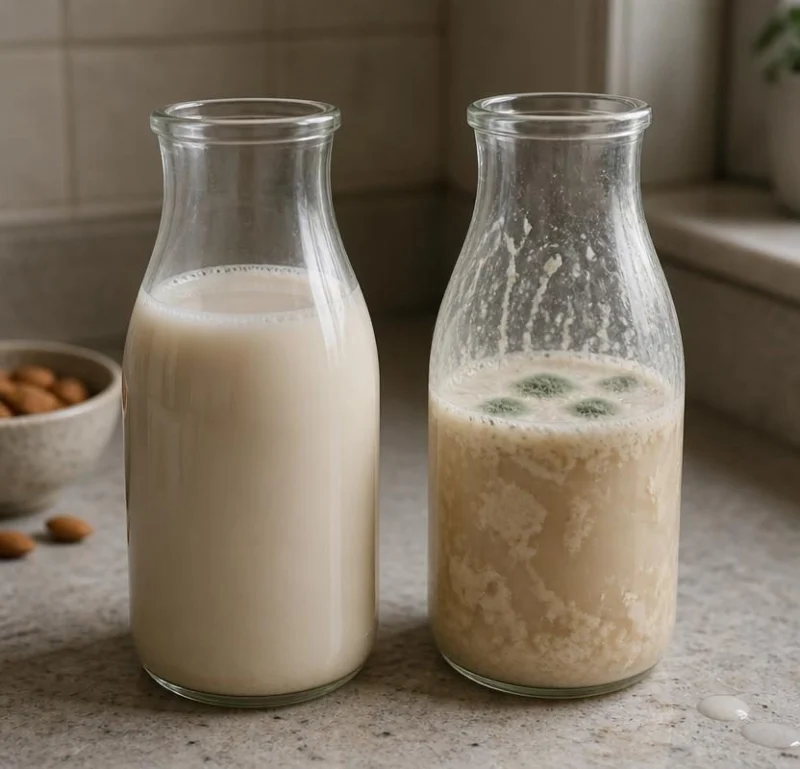
Normal Separation Versus Spoilage
Separation is common in plant-based beverages. Almond particles can settle during storage, so shake the carton as directed and see whether it returns to its usual smooth consistency.
Separation that blends back in is a quality issue, not necessarily spoilage. Persistent clumps, curdling, slime, unusual thickness, or a texture that remains abnormal after shaking are reasons to discard the almond milk.
Appearance and smell can reveal obvious spoilage, but they cannot prove that a carton is safe after poor temperature control. A carton left warm for too long should be discarded even if it still looks and smells normal.
Discard These Signs
- Sour, rancid, fermented, or otherwise unpleasant odor
- Persistent lumps or curdling after shaking
- Slimy or unusually thick texture
- Mold
- Unusual color
- Fizzing, carbonation, leaking, or a swollen carton
- Any uncertainty after questionable storage
What If the Carton Was Left Out?
Use the USDA’s general time-and-temperature rule for refrigerated perishable foods: discard almond milk that has been at room temperature for more than 2 hours. If the surrounding temperature is above 90°F (32°C), such as in a hot car or outdoor setting, the limit is 1 hour. See the USDA’s 2-hour rule guidance.
Putting the carton back in the refrigerator does not reset the time it spent warm. An opened carton left out overnight should be discarded, even if it seems fine.
Keep or discard?
- Did the carton’s instructions allow the elapsed time since opening?
- Was it refrigerated promptly and kept at 40°F (4°C) or below?
- Was it left out longer than 2 hours, or longer than 1 hour above 90°F (32°C)?
- Does shaking restore the expected texture?
- Is there any sour odor, persistent curdling, slime, mold, unusual color, gas, leaking, or swelling?
- If storage was questionable, discard it rather than taste-test it.
A Simple Storage Routine
- Check the carton’s after-opening instructions.
- Write the opening date on the carton.
- Recap it immediately after pouring, and avoid drinking directly from the carton.
- Wipe the spout if needed and keep the cap clean.
- Refrigerate it promptly at 40°F (4°C) or below, preferably in the main refrigerator compartment when practical.
- Use the almond milk within the package’s stated after-opening window.
- Discard it if that window has passed, it was left out beyond the temperature limit, or it shows spoilage signs.