
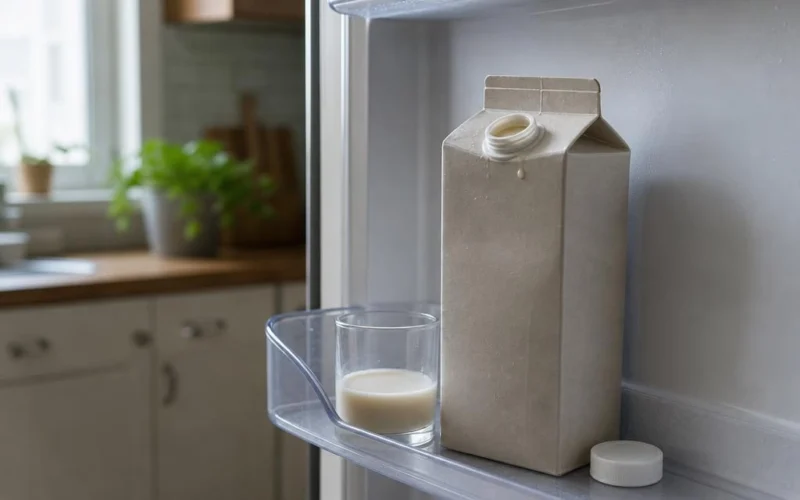
Most opened oat milk lasts about 5 to 10 days in the refrigerator, but the instruction on your current carton comes first. Refrigerate both shelf-stable and refrigerated oat milk after opening, and discard it if it sat out too long or shows clear signs of spoilage.
How Long Does Oat Milk Last After Opening?
There is no single after-opening shelf life for every oat milk. Oatly advises using some of its products within about 5 to 7 days after opening, while Silk and Califia Farms commonly advise 7 to 10 days for applicable products. Formulation, packaging, and product type can affect the recommendation.
Use this order when deciding whether to keep a carton: follow the current carton instruction first, check the manufacturer’s guidance if needed, then use the general 5-to-10-day range only as background.
The day you open the carton starts the practical clock, even if its printed best-by, use-by, or expiration wording is later. Those printed dates generally apply to an unopened product stored as directed; they do not replace the package’s after-opening instruction. Readers outside the United States should follow the wording and storage directions on their local carton.
Storage history matters, too. A carton that looks and smells normal is not necessarily safe if it spent too long at room temperature.
Refrigerated and Shelf-Stable Oat Milk Are Different Before Opening
Refrigerated oat milk
Refrigerated oat milk is sold from the chilled section and should stay refrigerated before and after opening. Once you pour some, return it promptly to a refrigerator set at 40°F (4.4°C) or below, the temperature recommended by the USDA Food Safety and Inspection Service.
Shelf-stable oat milk
Shelf-stable oat milk can usually be kept at room temperature while the carton is unopened, as long as the package says to do so. This packaging is designed for unopened storage, not for an opened carton.
After opening, shelf-stable oat milk needs refrigeration just like refrigerated oat milk. For example, Oatly distinguishes between room-temperature storage before opening and refrigerated storage afterward, while its after-opening window is shorter than some other brands’ guidance.
Use This Keep-or-Discard Check
For an opened carton, decide in this order: confirm its storage history first, check the carton’s after-opening instruction second, and inspect it for abnormal changes third.
| Carton situation | What to do | Why or condition |
|---|---|---|
| Unopened, shelf-stable | Store as labeled. | It is usually suitable for room-temperature storage until opened. |
| Unopened, refrigerated | Keep refrigerated. | Follow the carton’s storage direction. |
| Opened and within the label window | Use only if it was continuously chilled, remains within the carton’s after-opening window, and has no abnormal signs. | All three conditions must be met. |
| Opened for about 5–10 days | Check storage history, then the brand’s instruction, then inspect the product. | The general range does not override a shorter carton instruction, and normal appearance alone is not approval. |
| Left out over 2 hours | Discard it. | USDA guidance sets this limit for perishable foods. |
| Left out over 1 hour above 90°F (32°C) | Discard it. | Hot conditions shorten the room-temperature limit. |
| Moldy, swollen, sour, slimy, fizzy, or clearly abnormal | Discard it. | These are spoilage or package-failure signals. |
Refrigerating a carton again does not reverse excessive time at room temperature. If its storage history is uncertain, discard it rather than taste-test it.
How to Tell If Oat Milk Has Gone Bad
Visible or noticeable changes are useful discard signals. Their absence, however, does not override a poor storage history or a passed after-opening date. The USDA notes that harmful bacteria may not cause obvious changes in smell, taste, or appearance.
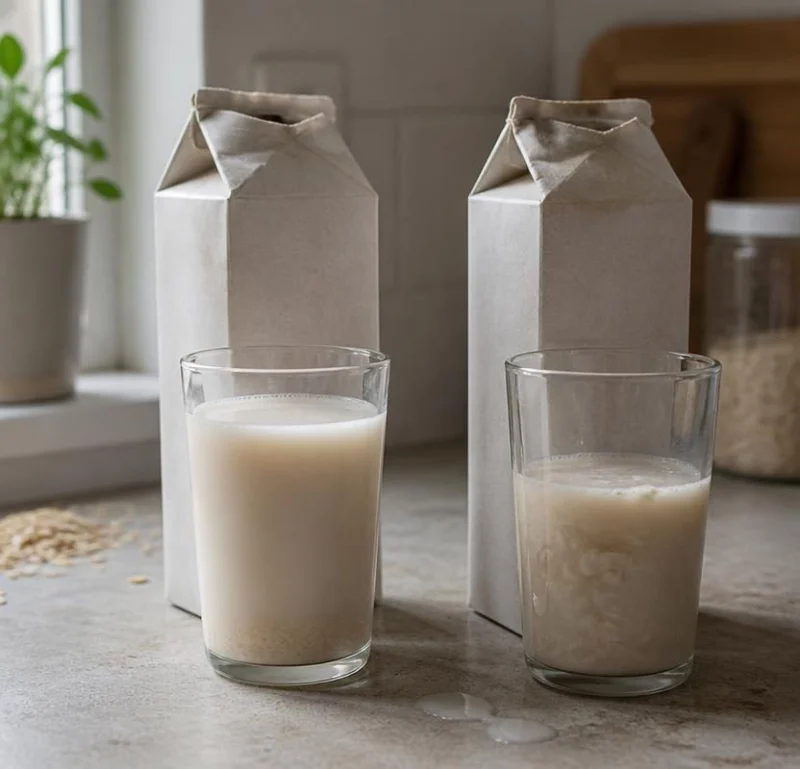
- Sour, rancid, fermented, or unpleasant odor: Fresh oat milk should not smell sharply sour or off.
- Thick, slimy, chunky, or persistently curdled texture: Discard it if shaking does not restore a smooth consistency.
- Mold or unusual color: Do not scrape away mold or pour around it; discard the entire carton.
- Fizzing or unexpected carbonation: Oat milk should not behave like a carbonated drink.
- Leaking, bulging, or swollen packaging: A puffed-up carton can indicate gas production or package damage and should be discarded.
Separation by itself is often normal, especially with plant-based drinks. Shake the closed carton well before checking it. If it recombines into a smooth liquid and has no off odor, unusual color, gas, or problematic texture, separation alone does not mean the oat milk has spoiled.
Persistent curds, clumps, sliminess, or fizzing are different from ordinary separation. Those changes are reasons to discard the product.
How to Store Opened Oat Milk Properly
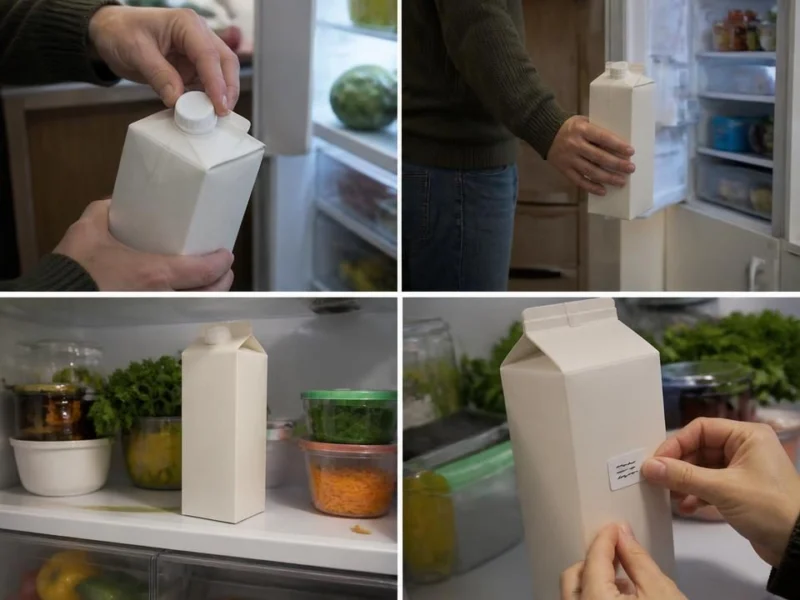
- Refrigerate the carton promptly after pouring.
- Keep the cap securely closed between uses.
- Avoid drinking directly from the carton.
- Wipe the spout or opening if residue builds up.
- Store it in the main body of the refrigerator when practical, where temperatures are generally steadier than near the door.
- Write the opening date on the carton if it is not easy to remember.
Returning oat milk to the refrigerator does not reverse excessive room-temperature exposure. If you freeze it, check the brand’s guidance first: freezing can cause separation or a grainier texture after thawing, so the result may be better suited to cooking or baking than drinking.
Follow the carton’s after-opening instruction, keep the product at 40°F (4.4°C) or below, and discard it after unsafe temperature exposure or clear abnormal changes.