
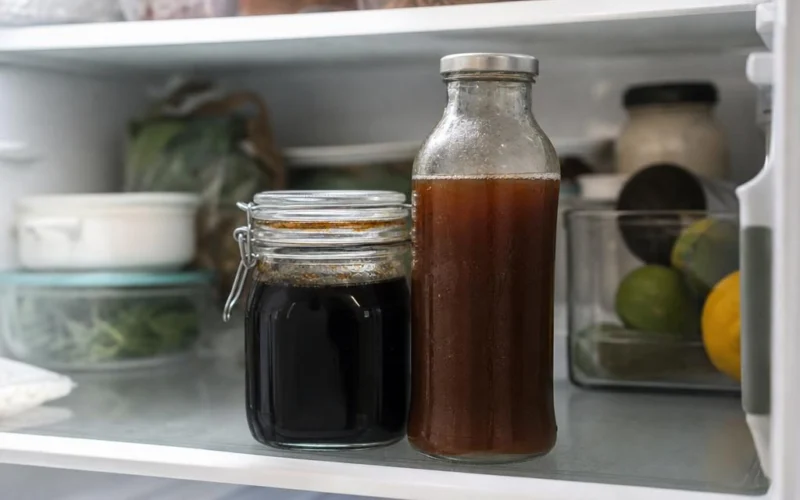
Homemade cold-brew concentrate is generally best used within about 7 days in the refrigerator. Some product guidance allows up to 14 days for quality when it has remained sealed, clean, and consistently cold, but that is not a universal safety guarantee. Diluted ready-to-drink cold brew should be used sooner—ideally within 2 to 4 days, with 7 days as a cautious outer limit only when it has been continuously refrigerated and handled cleanly. Cold brew with milk or cream follows the shorter perishable-drink approach, while store-bought cold brew should be stored and used according to its package date, opening instructions, and refrigeration requirements.
Discard any cold brew that was warm for an extended period—about two hours on the counter is a cautious reason to discard, though the exact risk depends on temperature and handling—or that shows mold, bubbling, fermentation-like activity, slime, or an abnormal odor. Do not taste-test a questionable batch.
Identify Which Cold Brew You Have
The right storage window depends on what is actually in the container, not just whether the label says “cold brew.”
- Homemade concentrate: Cold-brewed coffee made strong, typically intended to be diluted with water, ice, or milk before drinking.
- Homemade diluted or ready-to-drink cold brew: Coffee already mixed to drinking strength, whether it started as concentrate or was brewed at a standard ratio.
- Commercially packaged cold brew: A bottled, canned, boxed, or kegged product made under a manufacturer’s process and storage instructions.
- Cold brew with milk or cream: Plain cold brew that has already been mixed with dairy or another refrigerated addition.
Concentrate Is Not a Standardized Strength
“Concentrate” can mean very different things from one recipe or brewer to another. A strongly brewed, undiluted batch may hold its flavor longer than a lightly concentrated batch, but a batch that is already close to drinking strength should be treated more like ready-to-drink cold brew.
In other words, do not rely on the word concentrate alone. Consider whether you still need to add a substantial amount of water before serving, how carefully the batch was filtered, and how it has been stored.
Cold-Brew Storage Windows by Type
| Type | Best-quality target | Cautious home-storage guidance | What to do after the window |
|---|---|---|---|
| Homemade plain concentrate | Use within about 7 days | Up to 14 days appears in product and secondary guidance as a quality-oriented upper range when sealed, clean, and continuously refrigerated; it is not a universal expiration date. | Discard if storage was uncertain or it seems abnormal; otherwise expect flavor to decline. |
| Homemade plain diluted cold brew | Use within 2–4 days | 7 days is a conservative outer limit only with uninterrupted refrigeration and clean handling. | Do not stretch the window if it sat warm, was repeatedly handled, or has quality or spoilage warning signs. |
| Cold brew with milk or cream | Use the shorter perishable-drink approach | No universal homemade number was verified; follow the milk product’s label and discard after mishandling. | When uncertain, discard. |
| Store-bought, sealed cold brew | Follow the package date | Follow the package refrigeration directions. | Do not substitute homemade-batch guidance for the manufacturer’s instructions. |
| Store-bought, opened cold brew | Follow opening instructions | Keep refrigerated as directed on the package. | Discard according to the package guidance or earlier if it was mishandled or seems abnormal. |
Count from the brewing or production date, not from the day you first opened the container.
Conditions That Make the Guidance Apply
These storage windows assume careful handling from the start. Refrigerate cold brew at 40°F (4°C) or below, as recommended in FoodSafety.gov cold food storage guidance. Wisconsin’s retail cold-brew guidance uses 41°F or below under its specific food-service conditions.
Filter out spent grounds before storage, then transfer the coffee promptly to a clean, food-safe, tightly covered container. Keep equipment and containers clean, and avoid storing the batch in the refrigerator door, where temperatures can fluctuate more than on a back or center shelf. A tight seal can limit oxidation and new contamination, but it cannot correct a contaminated batch, inadequate chilling, or improper handling.
If cold brew was left at room temperature for about two hours or longer, discard it as a cautious rule. The exact risk depends on the temperature and how the coffee was handled, but extended counter time means the usual refrigerated storage window no longer applies. Discard any batch that shows mold, bubbling, slime, or an abnormal odor; do not taste-test it.
How to Store Homemade Cold Brew
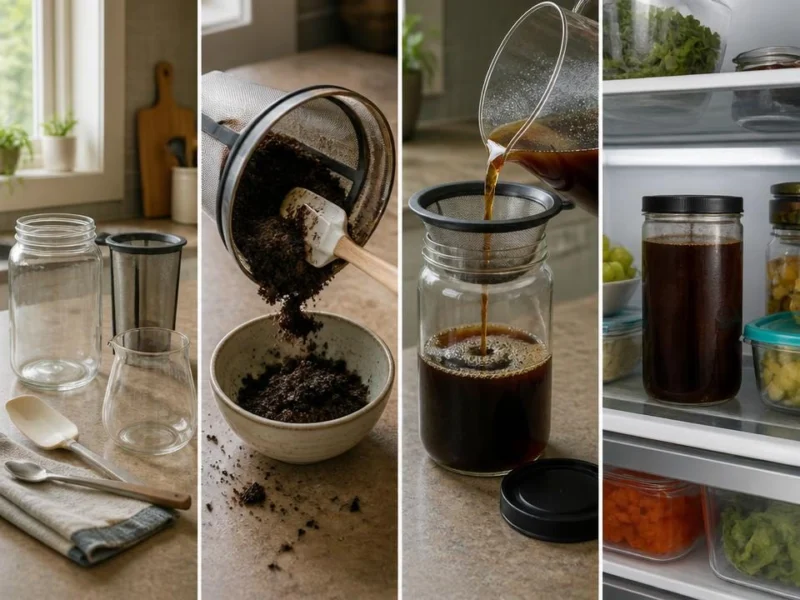
- Wash the brewer, filter, utensils, and storage container thoroughly. Sanitize equipment where appropriate for your brewing setup.
- Filter the coffee thoroughly and remove all spent grounds.
- Transfer the finished cold brew to a clean, food-safe container with a tight-fitting lid.
- Label the container with the brewing date.
- Refrigerate promptly at 40°F (4°C) or below.
- Pour servings into a separate glass instead of repeatedly drinking from or leaving the storage container open.
- Add water, ice, milk, or cream shortly before serving when practical.
Glass and plastic can both work. Choose a clean, food-safe, tightly covered container that fits in your refrigerator and is easy to wash. There is no need to assume glass is inherently safer than food-safe plastic, and the original brewing pitcher is fine only if it can be covered securely and cleaned well.
If grounds stayed in the coffee longer than planned, the most predictable result is more bitterness and a stale, over-extracted flavor. Their presence does not create a reliable alternate shelf-life rule. Filter the batch and refrigerate it promptly, but discard it if it was warm, visibly abnormal, or has an uncertain storage history.
When to Discard Cold Brew
Cold brew can lose freshness before it develops obvious spoilage signs. Flat, stale, oxidized flavor; increasing bitterness; or a harsh taste from prolonged contact with grounds are quality problems. A batch may be unpleasant without necessarily showing visible spoilage.
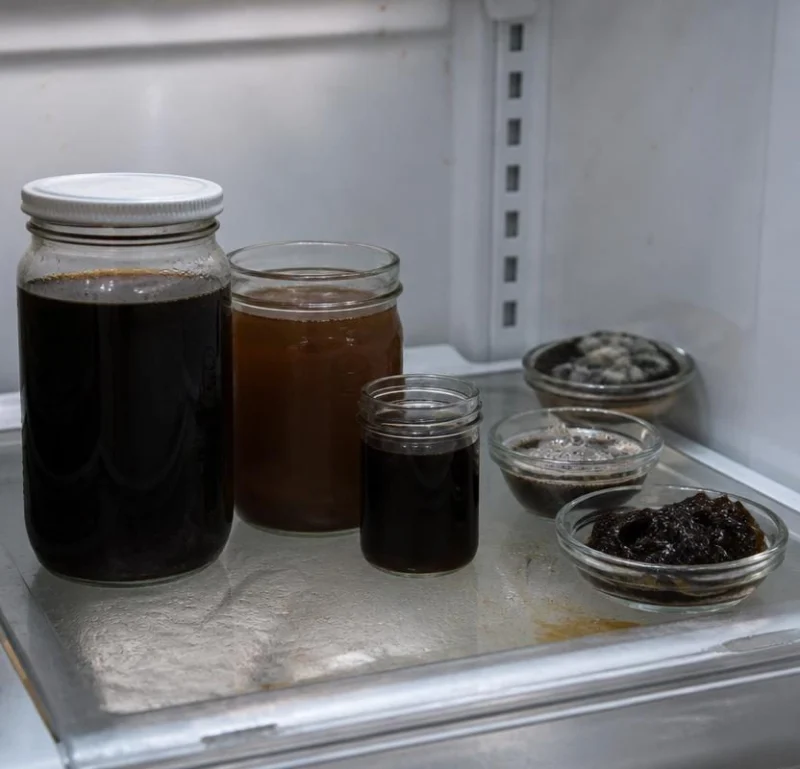
Discard cold brew if you notice any of the following:
- Mold or fuzzy growth
- Bubbling or fermentation-like activity
- A strongly sour, yeasty, or otherwise abnormal odor
- Slime, unusual thickness, or a changed texture
- An obviously abnormal appearance
- Extended time at room temperature
- An unknown storage history
- Any questionable batch containing milk or cream
Coffee’s acidity is not a dependable safety shield. The Wisconsin Department of Agriculture, Trade and Consumer Protection cold-brew fact sheet identifies unheated cold brew as a potential time/temperature-control-for-safety concern in retail settings, with sanitation and refrigeration playing important roles.
Special Cases That Change the Decision
Cold Brew With Milk or Cream
Once milk or cream is mixed into cold brew, treat it as a mixed perishable beverage. Do not use the longer plain-concentrate range. Follow the storage instructions on the milk or cream product, keep the drink refrigerated, and discard it if it was left warm or otherwise mishandled.
This also applies when making a large batch of lattes or adding creamer directly to a pitcher. Keeping plain concentrate separate and adding dairy per serving gives you more control over freshness and reduces waste.
Cold Brew in a Keg, Nitrogen System, or Reduced-Oxygen Package
Nitrogen flushing, vacuum sealing, and keg storage are not simple household preservation shortcuts. Reduced-oxygen packaging can require additional controls, and Wisconsin’s cold-brew guidance addresses these systems separately from an ordinary refrigerated pitcher.
Use the manufacturer’s or food-service system’s instructions for a kegged or nitrogenated product. Do not assume that a nitrogen tap, sealed growler, or vacuum container gives homemade coffee the same storage timeline as commercially processed packaged cold brew.
Cold Brew Left in the Refrigerator Door or on the Counter
A refrigerator door can be warmer and less stable than the main refrigerator compartment. If your batch was stored there for several days, use more caution than the table suggests, particularly if your refrigerator temperature is unknown.
Extended room-temperature storage is a stronger concern. If you do not know how long the coffee sat out, or whether it remained adequately chilled, discard it rather than trying to recover the batch with refrigeration.
Why Shelf-Life Numbers Differ
There is no single, universally verified household expiration date for homemade cold brew. The commonly cited 7-day figure has a food-safety context: Wisconsin retail guidance uses a 7-day date-marking limit for unheated cold brew held at 41°F or below under specified conditions. That is useful evidence for caution, but it is not a laboratory-tested expiration date for every home batch.
The FDA Food Code is likewise a model for retail and food-service food safety, not a universal household storage chart. See the FDA’s Food Code 2026 for that regulatory context.
Advice allowing up to two weeks usually refers to flavor retention under controlled conditions, or to a specific brewer’s instructions. For example, the Espro CB1 manual says its refrigerated concentrate can remain fresh for up to two weeks. That does not establish two weeks as a universal safety guarantee for every recipe, container, refrigerator, or handling routine.
Home batches differ in concentration, sanitation, filtration, container choice, refrigerator temperature, and how often the container is opened. Freezing may affect quality, but no universal homemade freezer-storage window was verified here, so it should not be used as a substitute for careful refrigeration and date labeling.
Use the shortest applicable window when the batch is diluted, contains milk, was handled repeatedly, became warm, or has an uncertain history. If the cold brew looks, smells, or feels abnormal—or you are unsure how it was stored—discard it rather than taste-testing it.