
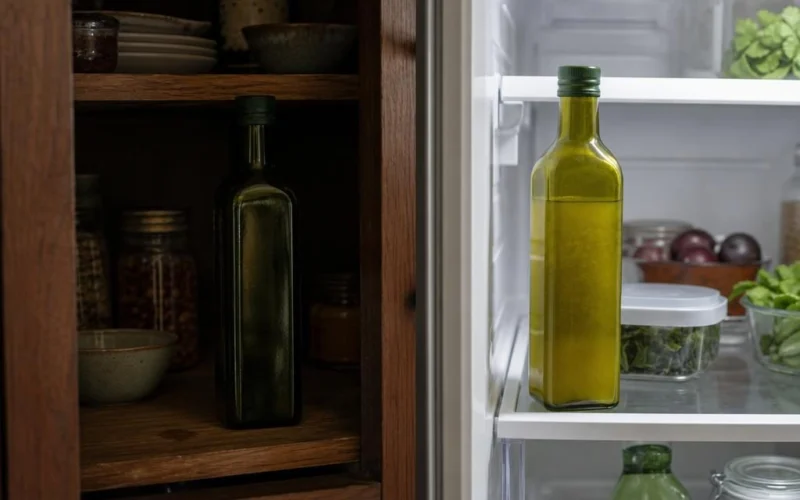
Usually, no—olive oil used regularly should be stored in a tightly closed bottle in a cool, dark cabinet rather than in the refrigerator. Refrigeration can make olive oil cloudy, thick, or partly solid, but this is usually a reversible temperature-related change, not proof that the oil is spoiled. Consider refrigeration only for unusually hot conditions or longer-term backup storage.
Where Should You Store Olive Oil at Home?
For a daily-use bottle, choose a stable, cool, dark cabinet away from the stove, oven, dishwasher, and sunny windows. Olive oil does not need a special wine cellar at home. Storage around 59–64°F (15–18°C) is often discussed as a quality-focused range, but it is a controlled-storage reference—not a strict household requirement.
| Storage location | Suitability | Main concern | Best use |
|---|---|---|---|
| Cool, dark cabinet | Preferred | Minimal heat and light exposure | Daily-use bottle |
| Sunny countertop or windowsill | Poor | Light and changing temperatures | Only temporarily, if the area is cool and shaded |
| Beside or above the stove | Poor | Repeated heat exposure | Avoid, even with dark glass |
| Refrigerator | Optional | Cloudiness, thickening, slower pouring, and inconvenience | Very hot kitchens or selected backup bottles |
| Cool garage or basement | Possible | Humidity, odors, dirt, and temperature swings | Only if consistently cool, dry, and clean |
| Large backup bottle in a cool, dark area | Good if well stored | More air enters as the bottle is repeatedly opened | Unopened or infrequently used supply |
Dark glass or opaque packaging helps reduce light exposure, but it does not make a bottle beside a hot stove an ideal choice. Location still matters because heat can build up around cooking appliances.
What Conditions Protect Olive Oil Quality?
Olive oil quality gradually declines when its fats and flavor compounds react with oxygen. Light and heat accelerate that process. The USDA Agricultural Marketing Service identifies light, air, and temperatures above approximately 86°F (30°C) as factors associated with quality deterioration, particularly when they occur together.
- Temperature: Keep the bottle away from sustained heat. A normal room-temperature cabinet is generally more practical than trying to maintain an exact target.
- Light: Store oil away from windows and bright fixtures. Protective dark glass or opaque packaging is helpful, but darkness around the bottle is still important.
- Oxygen: Close the cap promptly and tightly after pouring. A partially used bottle has more air space, so leaving it open works against quality preservation.
- Time and bottle size: Buy an amount you can use while it still tastes fresh. There is no universal month-based deadline because age at purchase, packaging, opening frequency, oil type, and storage conditions all vary.
These practices are mainly about preserving flavor, aroma, and other quality characteristics. They are not ordinary food-safety requirements for a shelf-stable bottle of properly stored olive oil.
When Might Refrigerating Olive Oil Make Sense?
Refrigerating olive oil can be reasonable when the kitchen stays consistently very hot, especially if the usual cabinet regularly approaches or exceeds temperatures that can speed quality loss. It may also be considered for a large unopened backup bottle that will sit unused for an extended period.
However, the evidence does not support treating refrigeration as a universal upgrade. Guidance from olive-oil organizations commonly favors a cool, dark cabinet for routine storage, while extension information notes that lower temperatures may help preserve oil in some longer-storage situations. The practical choice depends on the actual conditions and the trade-offs.
A useful compromise is to keep a smaller daily-use bottle in a cool cabinet and store only a backup bottle under different conditions if your home is unusually warm. Avoid repeatedly moving the same bottle from refrigerator to room temperature and back. Temperature cycling can be inconvenient, and condensation around a cold bottle may create an additional quality concern, although it does not inevitably ruin the oil.
Why Does Olive Oil Turn Cloudy in the Refrigerator?
Cold temperatures can cause waxes and other naturally occurring components in olive oil to crystallize or solidify. As a result, refrigerated oil may look cloudy, become thick, or turn partly solid. This is a physical response to low temperature, not a dependable test of the oil’s authenticity, freshness, or spoilage.
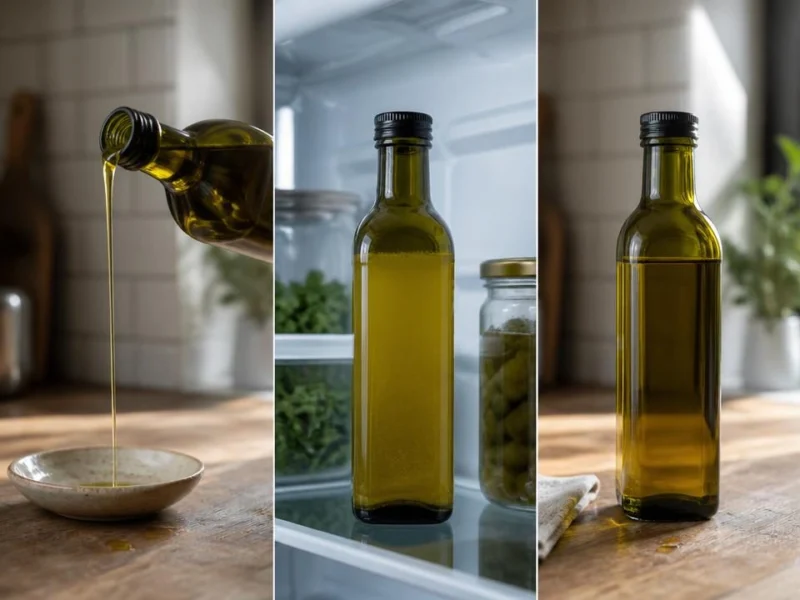
After warming, the oil will commonly become clear and pourable again. Appearance alone cannot diagnose the oil’s quality, so judge it by its smell and flavor once it has returned to room temperature.
How Can You Tell Whether Olive Oil Has Lost Quality?
Let refrigerated oil return naturally to room temperature before assessing it. Cloudiness or thickening is a temperature-related physical change, not a dependable test of authenticity, freshness, or spoilage. Once the oil is liquid again, judge its quality by its smell and flavor rather than by its appearance alone.
A stale or rancid oil may have a wax-crayon, stale-nut, putty-like, or otherwise unpleasant smell or flavor. Fresh olive oil should smell and taste clean for its style, although extra-virgin oils can naturally have bitter or peppery notes that are not signs of spoilage. If the oil smells and tastes fresh after returning to room temperature, temporary refrigerator cloudiness alone is not a reason to discard it.
When available, check the harvest or milling date on the label. That information provides useful context but does not establish a guaranteed household shelf life. The oil’s age when purchased, packaging, exposure to air and light, and how often the bottle is opened all affect how long its quality lasts.
Keep the bottle you use every day in a cool, dark cabinet, tightly capped and away from heat. Refrigerate only when the specific storage conditions justify the handling trade-offs, and do not discard olive oil solely because it becomes cloudy in the refrigerator.