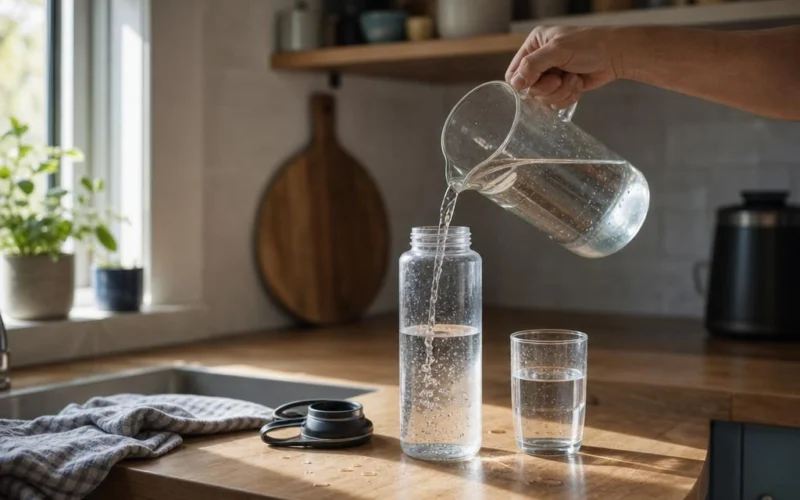
For healthy adults, a useful starting reference is 3.7 liters (125 ounces) of total water for men and 2.7 liters (91 ounces) for women per day. Those figures include water from food and every beverage—not just glasses of plain water—so most people do not need to drink 91–125 ounces from a bottle.
Build your daily water intake around regular drinks with meals, add fluid when heat or prolonged sweating increases losses, and then check thirst, urine trends, and how you feel. Eight glasses can be a workable habit, but it is not a universal biological requirement.
Your Starting Point Changes With the Day
The National Academies’ adequate intake values are population-level reference points for generally healthy adults. They are not prescribed amounts of plain water: in the underlying survey, beverages supplied roughly 3.0 liters, or 13 cups, for men and 2.2 liters, or 9 cups, for women, with the remainder coming mainly from food, while individual plain-water needs vary with diet, beverage choices, and fluid losses.
That distinction explains why public recommendations can sound inconsistent. A source discussing plain water may suggest fewer cups than one discussing total water from coffee, tea, milk, soup, fruit, vegetables, and other foods.
| Strategy or source | Biological mechanism | Timing or target | Expected result |
|---|---|---|---|
| Meals and beverages | Replace routine losses | Across the day | Steadier fluid intake |
| Water-rich foods | Provide food moisture | At meals | Supports total intake |
| Extra heat-day drinks | Replace sweat losses | Before and during heat | Less fluid deficit |
| Food plus electrolytes | Replace sodium losses | Prolonged heavy sweating | Better loss replacement |
| Clinician-set limit | Prevents fluid overload | As prescribed | Condition-specific safety |
Use the reference figures as a baseline, then apply a simple three-part rule: base intake + unusual losses + a body check. A sedentary office day in mild weather does not require the same drinking plan as roofing work in summer or a four-hour hike.
| Situation | Starting approach | Add or adjust | Watch for |
|---|---|---|---|
| Ordinary workday | Drink with meals | Respond to thirst | Urine trend |
| Hot outdoor shift | Start hydrated | Frequent drink breaks | Heat illness |
| Workout under one hour | Water usually works | Adjust for heat | Heavy sweating |
| Several sweaty hours | Plan fluid intake | Add food or electrolytes | Overdrinking |
| Medical fluid limit | Follow prescribed amount | Ask about exercise | Rapid weight change |
What Your Brain, Kidneys, and Sweat Glands Are Tracking
Thirst responds to concentration, not a bottle quota
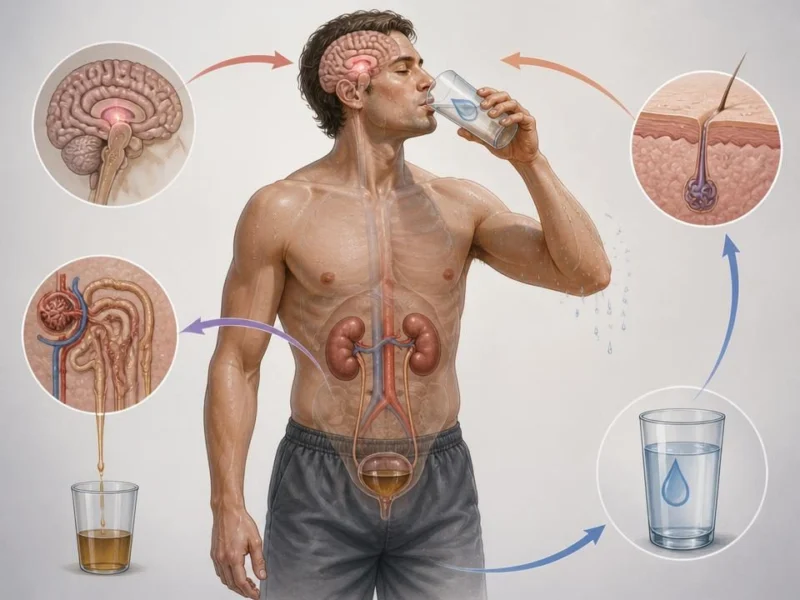
Your brain monitors the concentration of dissolved particles in the blood, known as osmolality. When water availability falls relative to substances such as sodium, thirst rises and the body releases antidiuretic hormone, or ADH.
ADH signals the kidneys to conserve water, reducing urine volume and making urine more concentrated. This system is why healthy, sedentary adults in temperate conditions can often meet their needs through habitual drinking with meals and a response to thirst, as described by the National Academies.
Thirst should not be treated as the only signal in every situation. Older adults may have a less noticeable thirst response, while busy workers and athletes can ignore thirst because breaks are delayed. Keeping a drink visible and attaching it to meals or scheduled breaks makes intake less dependent on remembering.
Your kidneys balance water against sodium
Hydration is not simply a matter of putting as much water as possible into the body. The kidneys must balance incoming fluid with water lost through urine, sweat, breathing, and stool while maintaining a safe concentration of sodium in the blood.
If someone drinks fluid faster than the body can eliminate it—especially during a long event—blood sodium can become dangerously diluted. Hyponatremia is generally defined as blood sodium below 135 mEq/L. As sodium falls, water can move into cells and cause swelling; swelling in the brain can produce severe neurological symptoms.
A sports drink does not automatically prevent this problem. The central risk in exercise-associated hyponatremia is drinking more than is being lost, according to the international consensus statement on exercise-associated hyponatremia.
Sweat changes both fluid and electrolyte losses
Sweating transfers heat from the body to the environment as sweat evaporates. Sweat contains water and electrolytes, including sodium, but the amount lost varies considerably with weather, clothing, exercise intensity, acclimatization, body size, and individual sweat rate.
For a routine 30-minute gym session, water and regular meals are usually sufficient. The CDC and NIOSH heat-hydration guidance reserves electrolyte-containing drinks or suitable salty foods for circumstances such as prolonged sweating over several hours. It also advises against routinely using salt tablets.
Heat exposure requires more active planning, but “drink as much as possible” is unsafe advice. Duration, sweat loss, access to breaks, and symptoms matter more than chasing one fixed hourly number for everyone.
Pale yellow is useful; perfectly clear is not the goal
Urine color offers a convenient rough check rather than a diagnosis. Consistently pale-yellow urine generally fits adequate hydration, while repeated dark urine combined with thirst or reduced urination can suggest that more fluid is needed.
Completely clear urine throughout the day may simply reflect intake beyond current needs. B-vitamin supplements, foods, medications, and some medical conditions can also alter color, so a single bathroom visit should not dictate aggressive drinking. A systematic review of urine color as a hydration marker found it useful as a practical screen but imperfect across populations.
Build a Hydration Routine Without Chasing a Gallon
Use the base–losses–check method
A weight-based calculator can look scientific while creating false precision. Two adults of the same weight may have very different needs because one works in air conditioning and the other spends six hours outside.
Use this three-step decision tool instead:
- Set the base: Have ordinary drinks with meals and include water-rich foods.
- Account for losses: Add fluid for heat, sustained exercise, fever, vomiting, diarrhea, pregnancy, breastfeeding, or heavy sweating.
- Check the trend: Consider thirst, urine color over several trips, urine frequency, dizziness, and unusual fatigue.
If several signs point toward inadequate intake, drink gradually and address the cause. Severe weakness, fainting, confusion, inability to keep fluids down, or signs of heat illness need medical assessment rather than a larger bottle.
An example of distributing drinks across an ordinary day
The schedule below is an example of spreading drinking opportunities across the day instead of saving most intake for a large evening catch-up. It is not a required amount or a prescription to drink at every listed time. Adjust total intake according to thirst, heat and activity losses, fluid from foods and other beverages, personal comfort, and any clinician-directed fluid limit.
| Time | Example action |
|---|---|
| After waking | Drink if thirsty |
| Breakfast | Choose a preferred beverage |
| Mid-morning | Refill as needed |
| Lunch | Drink with the meal |
| Afternoon break | Pause and assess thirst |
| Dinner | Avoid forced catch-up drinking |
Consider an illustrative office-day scenario. Before changing the routine, a person drinks coffee at 8 a.m., forgets fluids until 3 p.m., and then tries to finish a 40-ounce bottle before leaving work. During a seven-day trial, they move some of that fluid to breakfast, drink with lunch, and use the 2:30 p.m. break to assess thirst or refill as needed; the measurable change is a more even schedule with no evening catch-up requirement.
The difficult part is usually not understanding hydration—it is losing track during meetings, commuting, or a late shift. A bottle marked with motivational slogans cannot fix an inaccessible bathroom or a job with restricted breaks. Pair drinking opportunities with events that already happen: clocking in, lunch, a scheduled safety break, or arriving home.
Hot shifts and long workouts need a different plan
Start a hot work period or long exercise session normally hydrated rather than attempting to preload with a very large volume. Keep fluid available, use scheduled rest opportunities, and increase intake in response to sustained sweating and conditions.
- Under about one hour: Water is generally adequate in moderate conditions.
- Several sweaty hours: Plan fluid alongside meals, salty foods, or an appropriate electrolyte drink.
- After exercise: Continue drinking gradually and eat a normal meal.
- During endurance events: Avoid gaining weight through aggressive drinking.
Maintaining or gaining body weight during a long event does not prove good hydration; it can indicate that fluid intake has exceeded losses. Someone expecting a long race, hike, or hot-weather shift may benefit from an individualized plan based on experience, conditions, available food, and guidance from a qualified sports-health professional.
Electrolytes are situational, not a daily requirement
Most people eating a varied diet receive sodium and potassium through food. An electrolyte powder is usually unnecessary for desk work, errands, or a brief workout, and some products add substantial sugar or sodium without a matching need.
Electrolyte-containing drinks become more relevant during prolonged heavy sweating, repeated fluid loss from illness, or when a clinician recommends them. With meaningful vomiting or diarrhea, use an appropriate oral rehydration solution when suitable and take it gradually rather than drinking a large amount at once. An oral rehydration solution has a deliberate glucose-and-electrolyte composition; it is different from casually adding salt to water.
Replacing a sugar-sweetened drink with water can reduce calorie intake. Drinking excess water, however, should not be presented as a detox, fat-burning method, appetite cure, or lasting metabolism booster in someone who is already adequately hydrated.
Recognize dehydration and overhydration without confusing them
Thirst, dry mouth, reduced urination, repeated dark urine, dizziness, and unusual fatigue can accompany inadequate fluid intake. These symptoms are not specific to dehydration, and severe or persistent symptoms deserve medical evaluation.
The CDC Yellow Book guidance warns against forcing fluid beyond thirst during prolonged exertion because excessive intake can contribute to exercise-associated hyponatremia. There is no single safe maximum that applies to every body, climate, and activity.
Pregnancy, illness, aging, and fluid limits need separate rules
The American College of Obstetricians and Gynecologists recommends 8–12 cups, or 64–96 ounces, of water daily during pregnancy. Needs can rise further with heat, activity, or vomiting; persistent vomiting warrants clinical advice.
Breastfeeding also increases fluid demand, but forcing large amounts beyond thirst does not guarantee increased milk production. Keeping a drink near the usual feeding location is a practical way to respond to thirst without imposing a rigid quota.
For meaningful vomiting or diarrhea, use an appropriate oral rehydration solution when suitable and drink it gradually. Seek medical advice promptly if symptoms persist, fluids cannot be retained, urination decreases substantially, or severe weakness, fainting, or confusion occurs.
Older adults should avoid relying exclusively on a strong thirst sensation. Regular drinks with meals, medication times, and daily routines can provide useful prompts, while sudden changes in intake, urination, or mental status should be evaluated.
People with kidney, heart, liver, or other conditions requiring fluid restriction should contact their clinician for individualized instructions rather than following general hydration or illness guidance. Some medicines can also alter water or sodium balance. A clinician-set target overrides recommendations from an app, challenge, calculator, or general article.
Questions People Still Have About Daily Water Intake
Is eight glasses of water enough for most adults?
Eight 8-ounce glasses provide 64 ounces, or about 1.9 liters. That can be a reasonable plain-water habit for some adults because other beverages and food also supply water, but it is neither a guaranteed minimum nor an ideal target for everyone. Heat, activity, body size, diet, illness, pregnancy, and medical restrictions can shift needs.
Do coffee, tea, milk, sparkling water, and soup count?
Yes. They all contribute water. Caffeine can have a small short-term diuretic effect, but normal servings of coffee and tea generally still provide net fluid, especially for regular caffeine consumers, according to a review of caffeine and fluid balance.
Calories, added sugar, alcohol, sodium, and caffeine still matter when choosing beverages. “Counts toward hydration” does not mean every drink is nutritionally interchangeable with water.
Should I drink a gallon of water every day?
Not automatically. One U.S. gallon is 128 ounces, or about 3.8 liters, of plain water—before counting coffee, meals, produce, and other sources. That may be appropriate for some people with substantial losses, but it exceeds what many sedentary adults need from plain water alone.
How much extra should I drink for a workout?
There is no reliable universal add-on. A brief indoor session may require little beyond normal drinking, while hours of sweating in heat require a planned combination of fluid, food, and sometimes electrolytes. Avoid fixed formulas that ignore sweat rate, weather, duration, and fluid obtained from meals.
Can I use urine color as my main hydration test?
Use it as one part of the picture. Pale yellow across the day generally fits adequate hydration, but supplements, medicines, foods, and health conditions can change color. Combine the trend with thirst, urine frequency, activity, weather, and symptoms rather than trying to keep urine completely clear.
This content is based on lifestyle science, behavioral nutrition, and performance coaching research. It is for informational purposes only and does not constitute medical advice. Consult a healthcare provider before making significant changes to your sleep, diet, or fluid intake routines.