
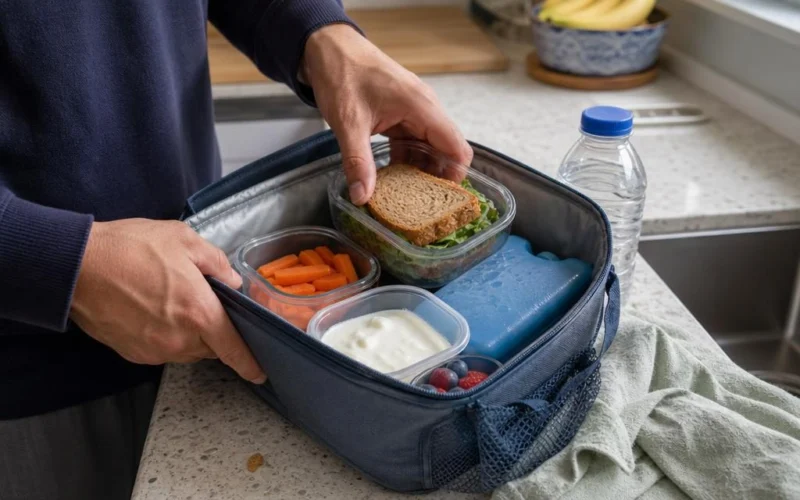
Build lunch from a protein food, produce, a whole grain or other starchy food, and a satisfying fat, dairy food, or fortified alternative. If any component is perishable, chill it before packing and place it in an insulated bag with two fully frozen cold sources unless it will go directly into a refrigerator.
Match the meal to both nutrition and temperature
A balanced packed lunch and a food-safe lunch are separate goals. Chicken, eggs, tuna, yogurt, hummus, cooked rice, cut fruit, and leftovers can all fit a nutritious meal, but they still require temperature control.
This four-part lunch builder reflects the food groups emphasized in the current 2025–2030 Dietary Guidelines for Americans:
- Protein food: Chicken, fish, eggs, beans, lentils, tofu, hummus, nuts, or seeds.
- Produce: Vegetables, fruit, or both.
- Whole grain or starchy food: Whole-grain bread, brown rice, oats, corn, potatoes, pasta, or crackers.
- Satisfying fat, dairy, or fortified alternative: Avocado, nut or seed butter, olive-oil dressing, yogurt, cheese, milk, or a fortified soy alternative.
This is a flexible assembly method, not a fixed calorie or portion prescription. Portions vary with body size, activity, appetite, and what else someone eats that day. A larger lunch might include a substantial sandwich, vegetables, fruit, and yogurt. A smaller one might pair lentil soup with whole-grain crackers and an apple.
After building the meal, assess its temperature-control needs separately. Healthy ingredients are not automatically shelf-stable.
Three realistic ways to use the formula
- Cold lunch: A whole-grain chicken wrap, sliced bell peppers, an orange, and plain yogurt. The wrap, peppers, and yogurt need cold holding.
- Hot lunch: Bean-and-vegetable chili in a preheated insulated food jar, plus whole-grain crackers and a whole pear. The chili must be packed hot and the jar kept closed until lunch.
- Shelf-stable backup: An unopened tuna pouch, whole-grain crackers, a whole apple, shelf-stable nut butter, and an unopened shelf-stable milk or fortified soy drink. Check each package label because some products require refrigeration.
| Situation | Best approach |
|---|---|
| Work refrigerator available | Refrigerate immediately |
| No refrigerator | Use two frozen cold sources |
| Hot commute | Use a cooler; avoid the car |
| Lunch may be delayed | Pack a shelf-stable backup |
Why a nutritious lunch can still become unsafe
The danger zone favors microbial growth
Perishable food should remain at 40°F (4°C) or colder. Between 40°F and 140°F (4°C and 60°C), many foodborne microorganisms can grow more readily. Freezing or chilling slows growth, but freezing does not reliably destroy all food-poisoning germs.
Consumer guidance from FoodSafety.gov says perishable food left at room temperature for more than two hours should be discarded. That limit falls to one hour above 90°F (32°C). These are discard limits after inadequate temperature control, not permission to leave lunch unrefrigerated until the deadline.
Cold food slows bacterial growth; insulation does not create cold
An insulated bag reduces heat transfer from the surroundings. It cannot cool warm pasta, a room-temperature sandwich, or leftovers taken straight from a warm cooking pot. Start with fully chilled food and frozen cold sources so the system does not spend the morning trying to remove heat that was already present.
Using two cold sources is a practical packing approach supported by university extension guidance. One can sit above the food and the other below or beside it. Performance still varies with bag insulation, outdoor temperature, lunch volume, how often the bag opens, and how cold the food was at packing time. No universal “eight-hour ice pack” promise applies to every lunch bag.
Food quality cannot reveal dangerous contamination
Smell, taste, and appearance are poor safety tests because pathogens do not always produce obvious spoilage. Never taste questionable food to test it. This distinction matters most for pregnant people, adults 65 and older, young children, and people with weakened immune systems, who face greater risk from foodborne illness according to FoodSafety.gov guidance for higher-risk groups.
Pack the lunch in the order that protects it
The night before: cool, portion, and refrigerate
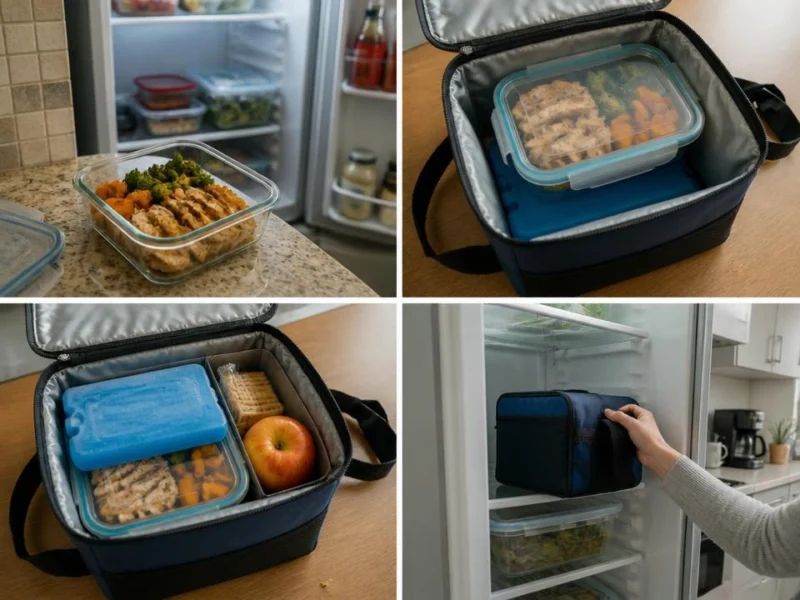
Cool cooked food promptly in shallow containers rather than leaving it in a deep pot for hours. Once chilled, portion it into clean, leak-resistant containers and refrigerate the lunch components overnight.
Use cooked leftovers within four days. A container of Monday’s chicken may be suitable for Tuesday or Wednesday lunch when handled correctly; keeping it until the following week is not a safe meal-prep strategy.
Morning: assemble cold food around two cold sources
Two fully frozen cold sources in an insulated bag are a practical precaution, not a guarantee. Their performance varies with the bag, surrounding temperature, food volume, starting temperature, and how often the bag is opened. Perishable food should remain refrigerated or be verified at 40°F (4°C) or below.
- Wash your hands and use clean containers and utensils.
- Take food from the refrigerator last, immediately before leaving.
- Place one cold source below the chilled perishable container.
- Add the second above or beside it so the food is surrounded by cold sources.
- Separate dry foods such as crackers to preserve their texture.
- Close the bag promptly and avoid opening it unnecessarily during the commute.
| Lunch component | Safe packing method | Examples | Storage type |
|---|---|---|---|
| Cold protein | Pack fully chilled with cold sources | Chicken, eggs, hummus | Keep cold |
| Dairy food | Pack fully chilled | Yogurt, cheese, milk | Usually keep cold |
| Prepared produce | Refrigerate after cutting | Melon, salad, peppers | Keep cold |
| Cooked starch | Cool promptly, then refrigerate | Rice, pasta, potatoes | Keep cold |
| Whole dry food | Keep sealed and dry | Apple, nuts, crackers | Often shelf-stable |
| Hot entrée | Use a preheated food jar | Soup, chili, stew | Keep hot |
“Plant-based” does not mean “safe at room temperature.” Cooked grains, cut melon, prepared salads, tofu dishes, and refrigerated dips may require cold holding. Follow storage directions on commercial packaging, particularly after opening.
On arrival: use the refrigerator if one is available
Move the lunch into a workplace refrigerator as soon as possible. If workplace rules and space allow, leave the insulated bag open so refrigerated air can reach the containers more effectively.
Do not leave the bag on a car seat during a meeting or errand. A parked car can heat rapidly. Set an arrival reminder, or place an essential work item such as an access badge beside the lunch so both leave the car together.
At lunch: reheat leftovers completely
Reheat cooked leftovers to 165°F (74°C). Stir food during microwave heating to reduce cold spots, and follow any standing time specified by the appliance or product instructions.
If a perishable lunch was left unrefrigerated and you cannot verify that it remained at 40°F (4°C) or below, discard the perishable components—especially after a hot-car exposure or prolonged delay. Two cold sources do not prove that the food stayed safe. Do not rely on how the food feels, looks, or smells, and do not use the condition of the cold pack as a safety test.
Use the three-question cold-chain check
- Does the lunch contain perishables? These may include meat, fish, eggs, dairy, leftovers, cooked grains, cut produce, and refrigerated dips.
- Was it kept cold? Confirm refrigeration or a measured temperature of 40°F (4°C) or below.
- Was the cold chain interrupted? Consider a hot car, prolonged delay, frequently opened bag, or food that was warm when packed.
If safe cold holding cannot be confirmed, discard the perishable food rather than tasting it. A refrigerator thermometer can verify that a workplace refrigerator is operating at 40°F (4°C) or below.
A one-week routine that removes the morning scramble
Consider an illustrative scenario: on Monday, lunch is packed at 7 a.m. with a single half-frozen pack, then left beside a sunny office window until noon. On Tuesday evening, two cold sources go into the freezer and the leftovers are chilled in a shallow container. Wednesday morning, the container is packed between both cold sources and placed in the office refrigerator on arrival.
The improvement is procedural rather than a promised change in energy or weight: fewer forgotten items, no warm leftovers going into the bag, and a clear decision if the cold chain fails. The routine becomes easier because freezing, chilling, and packing each have a fixed time.
| Time | Action |
|---|---|
| After dinner | Cool leftovers in shallow containers |
| 8 p.m. | Refrigerate lunch components |
| Before bed | Freeze two cold sources |
| 7 a.m. | Pack chilled food last |
| On arrival | Refrigerate the lunch |
| Noon | Confirm safe storage before eating |
Lower-cost swaps for deli meat and snack packs
Deli meat and individually packaged foods are convenient, but neither is required for a balanced work lunch. These alternatives may reduce costs while providing similar lunch components.
| Common choice | Practical alternative |
|---|---|
| Deli turkey | Home-cooked chicken pieces |
| Cheese snack pack | Beans with whole-grain pita |
| Cut fruit cup | Whole apple or orange |
| Single-serve hummus | Portioned homemade hummus |
| Protein snack box | Egg, carrots, and crackers |
Chicken, eggs, prepared beans, and homemade hummus still require appropriate refrigeration. Whole fruit and sealed crackers are easier to keep as shelf-stable backups, but follow package directions rather than assuming an item remains shelf-stable after opening.
Questions that come up on real workdays
Is one ice pack enough for a lunch bag?
One large frozen pack may keep some lunches cold under favorable conditions, but there is no reliable universal duration. Two cold sources placed around chilled food provide a more dependable packing arrangement, especially without a refrigerator. They are still a practical method rather than a temperature guarantee.
Can I pack a lunch completely the night before?
Yes. Refrigerate the food and packed containers overnight, but keep dry items separate if moisture will affect them. Add fully frozen cold sources in the morning rather than storing gel packs in the refrigerator. Avoid packing leftovers while they are still warm.
Can a hot lunch go into a thermos-style food jar?
Yes. Use a clean insulated food jar intended for hot food. Preheat it with boiling water, empty it, add thoroughly heated food, and close it immediately. Keep the jar sealed until lunch; opening it repeatedly releases heat.
What can I pack for an all-day shift without a refrigerator?
Use a well-insulated cooler system capable of maintaining cold food at 40°F (4°C) or below, or choose foods labeled shelf-stable until opened. Useful options include unopened tuna or salmon pouches, nut or seed butter, whole fruit, whole-grain crackers, nuts, roasted chickpeas, and shelf-stable milk or fortified alternatives. Do not leave the cooler in a parked car.
Can I save an uneaten sandwich for the trip home?
Only if its perishable ingredients remained safely cold throughout the day. Use the cold-chain check before saving it; if its temperature history is uncertain, follow the discard rule above.