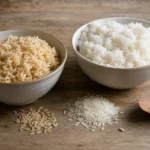
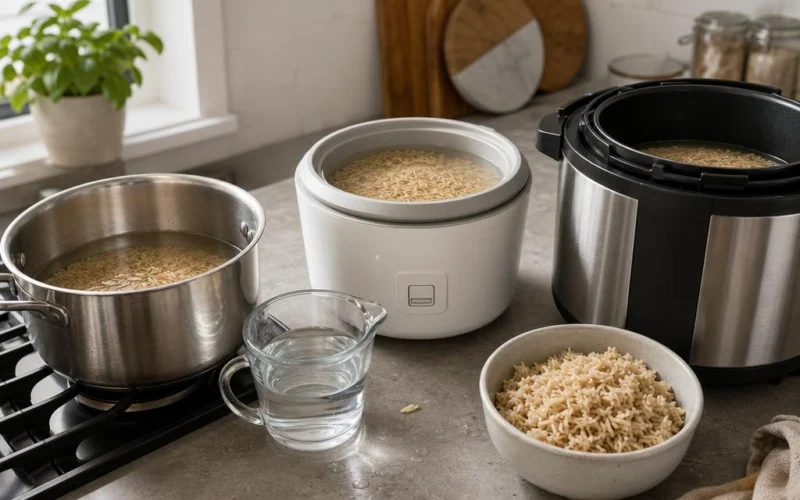
For 1 U.S. cup of brown rice, start with 2 cups of water on the stovetop, use the Brown Rice water line in a rice cooker, or use about 1¼ cups of water in an Instant Pot or similar pressure cooker. Stovetop brown rice usually takes 40–45 minutes plus a 10-minute rest; pressure-cooked rice takes about 20–25 minutes at high pressure plus time for the cooker to build pressure and naturally release. Treat these as starting points, not universal rules, and follow your appliance manual when it gives different instructions.
One important measurement detail: a rice-cooker cup is commonly about ¾ of a standard U.S. measuring cup. Do not mix the two systems unless your appliance instructions specifically tell you to.
Brown Rice Water Ratio at a Glance
This table uses 1 standard U.S. cup of dry brown rice unless the row specifies rice-cooker cups. “Rest” means leaving the rice covered or undisturbed after active cooking so moisture can redistribute through the grains.
| Method | Starting ratio for 1 cup rice | Active cooking time | Rest/release | Texture and measurement notes |
|---|---|---|---|---|
| Stovetop | 2 cups water | 40–45 minutes at a gentle simmer | 10 minutes, covered | Use a tight-fitting lid; add slightly more water if rice remains firm. |
| Rice cooker | Brown Rice water line; if unavailable, about 1½ rice-cooker cups water per rice-cooker cup rice | Appliance-controlled; often 45–60 minutes | Follow the cycle; rest 10–15 minutes if recommended | Use Brown setting or manual; water lines are model-specific. |
| Instant Pot/pressure cooker | About 1¼ cups water | 20–25 minutes at High Pressure | Natural release; allow extra time | Starting point for plain brown rice, not a universal formula. |
Pressure-cooker time is only the programmed time at pressure. The total time is longer because the cooker must build pressure before cooking and naturally release pressure afterward.
How to Cook Brown Rice on the Stovetop
A dependable stovetop baseline is 1 cup of brown rice to 2 cups of water, simmered for about 45 minutes. This ratio is consistent with guidance from Utah State University Extension.
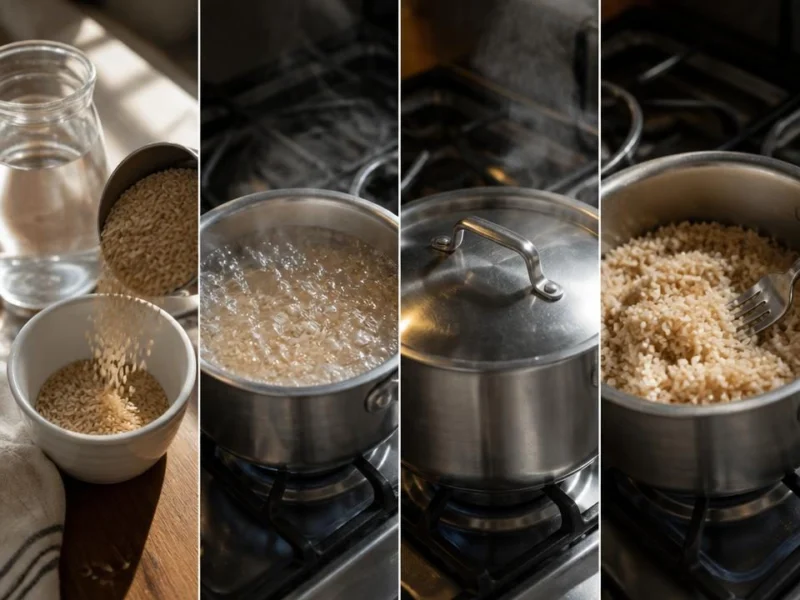
- Measure 1 U.S. cup of brown rice and 2 cups of water.
- Rinse the rice if desired or if the package recommends it, then drain it thoroughly.
- Put the rice and water in a saucepan with a tight-fitting lid. Add salt only if desired.
- Bring the water to a boil over medium-high heat.
- Reduce the heat to a low, gentle simmer, cover tightly, and cook for 40–45 minutes.
- Turn off the heat and leave the pan covered for 10 minutes.
- Fluff gently with a fork before serving.
Avoid repeatedly lifting the lid. Escaping steam changes the available moisture and can leave the rice unevenly cooked.
Rinsing removes some loose surface starch, but rice that is not drained well also carries extra water into the pot. For repeatable results, use the same rinsing routine each time. This ratio is for plain brown rice; do not use it automatically for a one-pot recipe containing vegetables, meat, sauce, or broth.
How to Cook Brown Rice in a Rice Cooker
Use the Brown Rice setting or water line
When your rice cooker has a Brown Rice setting and corresponding inner-pot markings, those markings should take priority over a generic brown rice to water ratio. The lines account for how that specific cooker heats, steams, and senses moisture.
- Measure the rice with the supplied rice cup if your cooker uses its own cup-and-line system.
- Rinse and drain the rice if recommended by the appliance or package.
- Add water to the Brown Rice line that matches the amount of rice.
- Select the Brown Rice cycle and start the cooker.
- When the cycle ends and the cooker switches to warm, let the rice sit briefly if the manual recommends it, then fluff gently.
A rice-cooker cup is often about ¾ cup by U.S. measuring-cup standards, rather than a full 8-fluid-ounce cup. Do not measure rice with a standard cup and then use a rice-cooker cup for water unless your manual explicitly uses that combination.
If the rice cooker has no Brown Rice setting
For Zojirushi-style cookers without a Brown Rice setting, Zojirushi guidance suggests starting with approximately 1½ rice-cooker cups of water for each rice-cooker cup of brown rice. That is a useful starting point, but it is not a universal setting for every brand or model.
Soak only if your appliance instructions recommend it. Different cookers handle soaking, heating, and rest periods differently. Use the first batch as a reference: if the grains are too firm, add a small amount more water next time; if they are overly soft, reduce it slightly.
How to Cook Brown Rice in an Instant Pot
Check your appliance manual first: its plain-rice ratio, timing, and release instructions take priority. For plain brown rice in an Instant Pot or similar electric pressure cooker, use 1 U.S. cup of rice and about 1¼ cups of water as an approximate starting point. This ratio and the 20–25-minute timing can vary by appliance model, brown-rice variety, and preferred texture. A sealed pressure cooker loses far less water to evaporation than a saucepan, which is why it generally uses less liquid.
- Rinse and thoroughly drain 1 U.S. cup of brown rice.
- Add the rice and approximately 1¼ cups of water to the inner pot.
- Check that the sealing ring, lid, and valve are positioned according to your appliance manual.
- Cook on High Pressure for approximately 20 minutes for firmer rice or up to 25 minutes for softer rice, unless your manual specifies otherwise. Model and rice-variety guidance can differ substantially, including shorter official cooking times, so use your manual’s plain-brown-rice setting when available and treat 20–25 minutes only as a cautious starting point.
- Allow the cooker to release pressure naturally rather than making quick release the default.
- Open only after pressure has fully released. Fluff the rice, then let it sit for a few more minutes if it seems moist.
Pressure-cook time is not total cooking time: allow additional time for the cooker to build pressure and release it naturally. Natural release is the better default for starchy foods such as rice; Instant Pot explains the difference between natural and quick release in its pressure-release guidance. Do not force the lid open or open it before pressure has fully released.
Published pressure-cooker instructions vary by rice variety, desired texture, appliance, and recipe context. Instant Pot recipes may use brown-rice cooking times in the 15–25-minute range, but a recipe containing chicken, broth, vegetables, or sauce does not establish a universal instruction for plain rice. For any post-cook correction, follow your pressure cooker’s manual; use the results to make a small, one-variable adjustment for the next batch.
Adjust the Ratio for Rice Type and Texture
The listed ratios are most likely to suit standard long-grain brown rice. Other types can absorb water differently or produce a naturally different texture.
- Long-grain brown rice: Usually a reasonable fit for these starting ratios.
- Short- or medium-grain brown rice: Tends to be softer and stickier. Adjust water cautiously rather than making a large change.
- Brown basmati or brown jasmine: Grain length, aroma, and absorption differ. Use package directions when they conflict with a general ratio.
- Quick-cooking or parboiled brown rice: Use the package instructions. It is processed differently and is not interchangeable with regular brown rice.
- Rinsed versus unrinsed rice: Rinsing removes surface starch, but poorly drained rice adds moisture to the batch.
For a 1-cup batch, change only one variable at a time—preferably 1–2 tablespoons of water. Do not assume that doubling the batch will produce identical results in every rice cooker or pressure cooker.
- If the rice is firm after cooking, add 1–2 tablespoons of water, cover, and continue gently.
- If it is cooked but wet, let excess moisture escape briefly or drain carefully.
- If you switch varieties, begin with the package or appliance guidance rather than carrying over the previous ratio.
Brown Rice Troubleshooting
Use this guide to rescue the current batch when practical and to make a measured correction next time. Do not keep adding water without checking whether the grains are already fully cooked. For pressure cookers, follow the appliance manual for any post-cook correction rather than using stovetop continuation steps.
| Problem | Likely cause | What to do now | Adjustment next time |
|---|---|---|---|
| Hard or chewy | Too little water, too little time, low heat, or steam escaped | For stovetop rice, add 1–2 tablespoons water, cover tightly, cook on low for 5–10 minutes, then rest covered. For pressure-cooker rice, follow the appliance manual for correction. | Add 1–2 tablespoons water or cook slightly longer. |
| Wet or watery | Too much water or not enough evaporation | If cooked, carefully drain excess water; spread briefly on a tray or, for stovetop rice, return uncovered to very low heat while watching closely. For pressure-cooker rice, follow the appliance manual. | Reduce water slightly; rinse and drain consistently. |
| Mushy | Excess water or overcooking | Leave uncovered a few minutes and fluff gently. Avoid prolonged stirring. For pressure-cooker rice, follow the appliance manual for further correction. | Reduce water modestly; shorten cooking only if grains are fully cooked. |
| Sticky | Surface starch, overwatering, or vigorous stirring | Rest, then fluff gently without mashing the grains. | Rinse more thoroughly, drain well, or reduce water slightly. |
| Unevenly cooked | Uneven heat, overcrowding, or inconsistent measuring | For stovetop rice, check for dry pockets, add a small splash only where needed, cover, and rest. For pressure-cooker rice, follow the appliance manual. | Measure consistently and stay within appliance capacity. |
Brown Rice Measuring and Cooking Checklist
- Use one measurement system consistently.
- Confirm whether a recipe means a standard U.S. cup or a rice-cooker cup.
- Check package directions for variety-specific instructions.
- Rinse and drain the same way from batch to batch.
- Use a tight-fitting lid for stovetop rice.
- Choose the Brown Rice setting when your cooker has one.
- Treat Instant Pot ratios and cooking times as starting points.
- Include pressure build-up and natural release when estimating total time.
- Rest the rice before fluffing it gently.
Common Brown Rice Ratio Questions
Why does brown rice need less water in an Instant Pot than on the stovetop?
Pressure cookers retain steam in a sealed environment, so much less added water is lost through evaporation. A saucepan releases steam throughout simmering, which is why it starts with more water.
Can I use the same ratio for brown basmati, short-grain brown rice, and quick-cooking brown rice?
Not reliably. Brown basmati and short-grain rice can differ in absorption and texture, while quick-cooking brown rice is processed differently. Use the package or appliance instructions when available, then adjust cautiously.
Start with the method-specific ratio in the table, keep your measuring system consistent, rest the rice before fluffing, and change only one variable—usually 1–2 tablespoons of water—when adjusting the next batch.