

Intermittent fasting is a meal-timing structure, not a special fat-loss mechanism. For most beginners, a 12:12 schedule is a sensible default: eat within a 12-hour period and fast overnight for 12 hours. A 14:10 schedule is an optional next step only if the initial routine does not disrupt hunger, sleep, training, nutrition, or your relationship with food. Neither schedule guarantees weight loss.
Choosing an eating window that fits your actual day
Intermittent fasting alternates periods of eating with periods of little or no calorie intake. The most common beginner version is time-restricted eating, in which all meals and snacks fit within a consistent daily window.
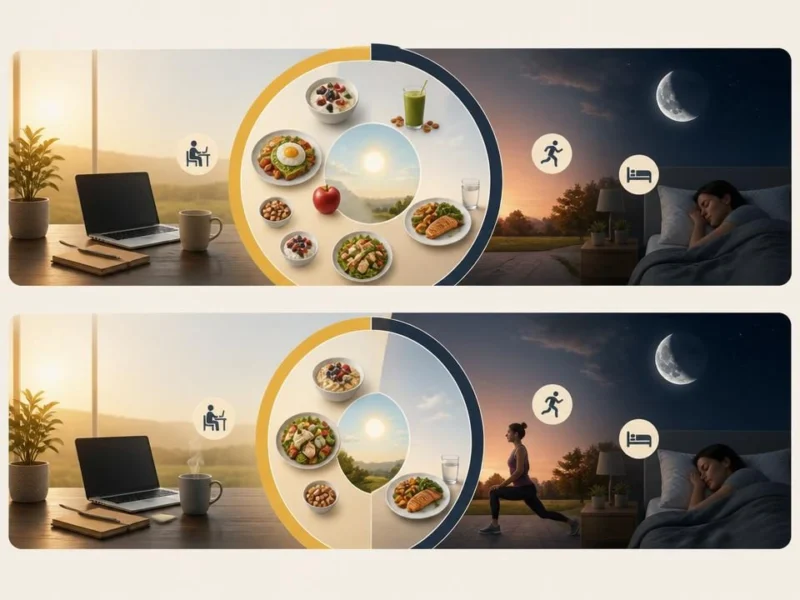
A 14:10 schedule provides a 10-hour eating window and a 14-hour overnight fast. A 16:8 schedule uses an eight-hour eating window. Longer fasting periods are not automatically more effective, and the schedule should fit work, training, sleep, and family meals rather than an arbitrary “optimal” clock time.
| Method | Eating pattern | Difficulty | Best use | Main drawback |
|---|---|---|---|---|
| 12:12 | 12-hour window | Low | Default beginner experiment | Small behavioral change |
| 14:10 | 10-hour window | Low to moderate | Optional next step | May affect social meals |
| 16:8 | 8-hour window | Moderate | People comfortable with shorter windows | Compensatory hunger |
| 5:2 | Two restricted days | Moderate to high | Weekly structure | Difficult low-calorie days |
The 5:2 method and alternate-day fasting are different from daily time-restricted eating. Their results and risks cannot be assumed to apply to a 12:12, 14:10, or 16:8 schedule, even though all are described as intermittent fasting.
What to eat inside the window
“Eat normally” should not mean fitting a day’s food into one oversized meal. Two or three balanced meals are usually easier for obtaining enough protein, fiber, fluids, and micronutrients while controlling hunger.
A useful meal framework combines:
- Protein: eggs, fish, poultry, tofu, beans, Greek yogurt, or lean meat.
- High-fiber carbohydrates: oats, potatoes, fruit, beans, or whole grains.
- Produce: vegetables or fruit at most meals.
- Unsaturated fats: nuts, seeds, avocado, or olive oil.
- Fluids: water with meals and between them.
These foods do not need to appear in perfect proportions at every meal. Across the eating window, however, the plan should provide adequate nutrition rather than creating a cycle of prolonged restriction followed by convenience food or grazing.
Match the method to the goal
| Goal | Recommended approach |
|---|---|
| Weight management | Start with 12:12 and review overall intake |
| Simpler routine | Consistent 12:12 |
| Muscle retention | Allow multiple protein-containing meals |
| Diabetes medication use | Use a clinician-directed plan |
Resistance training and sufficient protein remain relevant during weight loss. A very short eating window can make protein distribution harder because it reduces practical opportunities to eat.
What fasting changes in your body—and what it cannot override
After a meal is absorbed, insulin generally falls while glucagon rises. That hormonal shift allows the body to draw more heavily on stored fuels between meals. This is normal physiology and happens overnight even without a formal fasting plan.
Using more stored fat during part of the day does not prove that body fat will decrease over several weeks. If the calories consumed during the eating window replace or exceed those skipped during the fast, the energy balance needed for weight loss may not occur.
This distinction is supported by an isocaloric randomized trial published in Annals of Internal Medicine. When calories were held stable, a 10-hour time-restricted schedule did not outperform a usual eating pattern for body weight or glucose regulation. A separate 12-month randomized trial found that adding an eight-hour eating window to calorie restriction did not produce greater weight loss than calorie restriction alone.
Intermittent fasting can still be useful. The National Institute on Aging explains that reducing the hours available for eating may reduce calorie intake. For someone who routinely snacks late at night, closing the kitchen after dinner could remove a regular source of calories without requiring detailed tracking.
Possible benefits are modest and variable
Reviews of randomized trials report average improvements in some measures of body weight and cardiometabolic health among adults with overweight or obesity. The size and certainty of those effects vary across fasting schedules and study populations, according to an umbrella review of randomized-trial meta-analyses.
Research also remains mixed on whether earlier eating windows have benefits beyond calorie reduction. Meal timing may interact with circadian rhythms, but controlled, calorie-matched trials do not support presenting clock time as a guaranteed metabolic advantage.
Who should avoid fasting or seek clinical supervision
Intermittent fasting is not a suitable self-directed experiment for everyone. Restricting meal timing can worsen an existing problem or complicate medication management even if the schedule appears mild.
- Pregnancy or breastfeeding: energy and nutrient needs make intentional fasting inappropriate without individualized medical guidance.
- Current or previous eating disorder: rigid windows may reactivate restriction, bingeing, guilt, or obsessive food rules.
- Type 1 diabetes: fasting can raise the risks of hypoglycemia, dehydration, and ketoacidosis.
- Insulin or sulfonylurea use: skipping meals may cause dangerously low blood glucose.
- Children and adolescents: growth and development require dependable nutrition.
- Malnutrition or unintended weight loss: a shorter window may further reduce intake.
- Frailty or bone-loss risk: meeting energy, protein, and mineral needs takes priority.
- Significant gastrointestinal symptoms: large, compressed meals may worsen reflux, nausea, or bloating.
The National Institute of Diabetes and Digestive and Kidney Diseases advises that people with diabetes need individualized planning around medicines, glucose monitoring, hydration, and fasting. Medication doses should never be changed solely to accommodate an online fasting schedule.
Menstrual changes deserve attention
Strict energy restriction can affect reproductive function, particularly when combined with low energy availability, heavy training, or weight loss. Evidence specific to time-restricted eating is less settled. A 2026 systematic review found limited and inconsistent evidence concerning female reproductive hormones.
That uncertainty does not support prescribing different fasting windows for specific menstrual-cycle phases. A missed or persistently irregular period, unusual fatigue, declining training performance, or inadequate food intake is a reason to stop tightening the window and consult an appropriate healthcare professional.
A seven-day observation-and-adjustment experiment
The first week is not a test of whether you can reach 14:10. Its purpose is to observe your current routine, try a manageable 12:12 schedule, and decide whether meal timing helps or creates problems. Keep food choices, portions, and caffeine habits broadly consistent so that several major changes do not obscure the result.
| Day | Timing experiment | What to observe |
|---|---|---|
| 1 | Record the first and last calorie-containing item | Usual hunger, sleep, meals, and activity |
| 2 | Identify a realistic 12-hour window | Work, exercise, and family-meal conflicts |
| 3 | Try 12:12 without skipping a planned meal | Morning and evening hunger |
| 4 | Repeat 12:12 or widen the window if needed | Energy, concentration, and bowel habits |
| 5 | Move one boundary by no more than 30 minutes if it improves the fit | Sleep and food preoccupation |
| 6 | Test the schedule on a training or social day | Performance, recovery, and flexibility |
| 7 | Choose 12:12, return to usual timing, or widen the window | Whether the routine is sustainable |
For a hypothetical beginner who usually consumes calories from 7 a.m. until 10 p.m., a 12:12 experiment could keep breakfast at 7 a.m., move dinner earlier, and end evening grazing by 7 p.m. If that is impractical, both boundaries can move later. The goal is a repeatable routine, not a particular clock time.
Use 12:12 for another one to two weeks before considering a shorter eating window. A 14:10 schedule is optional only when hunger remains manageable, sleep and training stay stable, nutrition remains adequate, and fasting does not increase food preoccupation. There is no failure in remaining at 12:12 or returning to a longer eating window.
What the adjustment period may feel like
A common early obstacle is a late-morning hunger surge after abruptly removing breakfast. Another is an afternoon headache caused by changing both caffeine intake and meal timing. Irritability, poor concentration, constipation, and low energy can also occur, as summarized by the Mayo Clinic.
Mild, temporary hunger may settle as meal times become predictable. Severe or recurring symptoms are not proof that the plan is working and should not be treated as a challenge to overcome.
An optional 14:10 workday menu
This example uses an 8 a.m. to 6 p.m. eating window for someone who has already tolerated 12:12 and chosen to test 14:10. Portions and calorie needs vary, so it is a meal pattern rather than an individualized prescription.
| Time | Meal | Main components |
|---|---|---|
| 8:00 a.m. | Breakfast | Oats, yogurt, berries, walnuts |
| 12:30 p.m. | Lunch | Chicken, quinoa, vegetables, dressing |
| 3:30 p.m. | Snack | Apple and cottage cheese |
| 5:45 p.m. | Dinner | Salmon, potatoes, broccoli, olive oil |
A vegetarian version could replace chicken with lentils and tofu, and salmon with tempeh or a bean-based meal.
The calorie-compensation traps to watch
| Common mistake | Better substitution |
|---|---|
| Skipped breakfast, huge lunch | Planned protein-rich lunch |
| Black coffee replaced by a sweet latte | Unsweetened coffee or tea |
| No snacks, followed by nightly grazing | Planned afternoon snack |
| Short window with one protein-poor meal | Two or three protein servings |
| Fast ends with pastries | Balanced plated meal |
| Early dinner followed by late drinks | Keep caloric drinks within the window |
Liquid calories count as energy intake. Cream, sugar, alcohol, juice, sweetened tea, and specialty coffee drinks end a calorie-free fast and can replace the calories removed by limiting food.
Select, test, and reassess your schedule
Choose the initial 12-hour window around the parts of your day that are hardest to move. These examples are starting points, not mandatory schedules:
| Situation | Possible starting window | Decision rule |
|---|---|---|
| Early riser | 7 a.m. to 7 p.m. | Keep an early breakfast if delaying it causes poor concentration or excessive hunger |
| Evening exerciser | 9 a.m. to 9 p.m. | Leave room for food after training; widen the window if performance or recovery declines |
| Family-dinner participant | 8 a.m. to 8 p.m. | Protect the shared dinner and adjust the morning boundary instead |
| Shift worker | Begin after waking and end about 12 hours later | Anchor the window to the main waking period and revise it when shifts rotate |
Exercising before the first meal is tolerable for some people during low- or moderate-intensity sessions. Long endurance workouts, demanding intervals, or heavy resistance sessions may feel worse without prior food. Performance, recovery, and safety matter more than preserving a fasting streak.
Shift workers should not assume that daytime eating hours are appropriate for an overnight schedule. A 10-hour time-restricted schedule was feasible over 12 weeks in a trial involving 24-hour shift workers, but that study does not establish one ideal schedule for every occupation, overnight shift, or rotating roster.
Monitor the selected schedule for one to two weeks rather than judging it from a single morning. Review all of the following:
- Hunger: Is it manageable without recurring overeating?
- Sleep: Are you sleeping normally without waking hungry?
- Training: Are performance and recovery stable?
- Nutrition: Can you still eat enough food and include protein, produce, and fiber?
- Daily functioning: Are energy, concentration, and bowel habits acceptable?
- Food preoccupation: Are thoughts about timing and eating remaining proportionate?
- Physical symptoms: Are you free from recurring dizziness, headaches, or weakness?
If several measures worsen, shorten the fast by widening the eating window or return to your usual meal timing. Do not advance from 12:12 to 14:10 unless these measures remain stable. Abandon the self-directed experiment and seek medical advice for fainting, confusion, persistent dizziness, repeated symptoms of low blood sugar, menstrual disruption, inability to meet nutritional needs, or a return of disordered-eating behaviors.
Questions beginners ask before settling on a schedule
Is 14:10 enough, or do I need 16:8?
You do not need 16:8. Start with 12:12 and treat 14:10 as an optional later experiment, not a required destination. Consider 14:10 only after one to two stable weeks and only if the change serves a practical purpose without worsening hunger, sleep, training, nutrition, or food preoccupation.
What can I drink during the fasting period?
Water, plain sparkling water, unsweetened tea, and black coffee are commonly used because they contribute little or no energy. Milk, cream, sugar, juice, alcohol, and sweetened drinks belong inside the eating window. People who experience reflux, anxiety, poor sleep, or palpitations may need to limit caffeine regardless of fasting status.
Why am I much hungrier at night after skipping breakfast?
The window may be too aggressive, or shifting the first meal may be causing compensation later in the day. Restore breakfast, widen the eating window, or return to 12:12. Persistent nightly overeating indicates that the current schedule is not serving its intended purpose.
Can I exercise before my first meal?
Some people tolerate low- or moderate-intensity exercise before eating. If you experience dizziness, weakness, poor performance, or impaired recovery, eat before training or move the eating window. Demanding workouts should not be compromised merely to preserve a fast.
Does intermittent fasting work if calories stay the same?
Calorie-matched trials have not shown an automatic weight-loss benefit from shortening the eating window. Timing may still make a routine simpler, but weight loss generally requires lower average energy intake over time. Food quality remains relevant to fullness, nutrient adequacy, muscle retention, and cardiometabolic health.
When should I shorten or stop the fasting window?
Widen the eating window if you develop recurring severe hunger, headaches, sleep disruption, declining exercise performance, constipation, food preoccupation, or difficulty eating enough. Stop and seek medical advice for fainting, confusion, persistent dizziness, repeated symptoms of low blood sugar, menstrual disruption, or disordered-eating behaviors.
Can shift workers use an eating window safely?
Some shift workers may be able to use a consistent window anchored to their main waking period, but the evidence is limited and no single schedule fits every shift pattern. Rotating schedules may require wider or changing windows. Anyone using glucose-lowering medication or experiencing safety-sensitive fatigue should seek individualized clinical guidance.
Can I change the window for weekends or social events?
Yes. Moving the window for an occasional dinner is unlikely to invalidate the overall routine. A schedule that accommodates social meals is often more sustainable than one enforced to the minute. Large, frequent shifts may make hunger and sleep less predictable, so retain a broadly consistent overnight fasting period where practical.
This content is based on clinical nutrition research and practical meal planning. It is for informational purposes only and does not constitute medical advice. Consult a qualified healthcare provider before making major changes to your dietary routine.