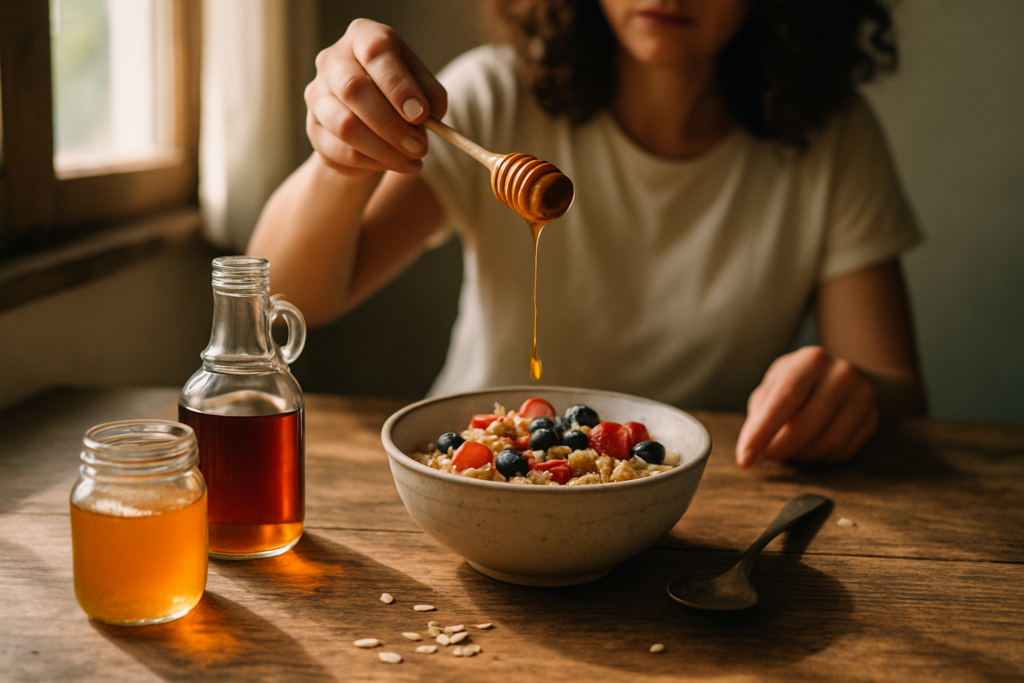
Pure maple syrup wins for everyday use: it delivers less sugar and fewer calories in a standard pour, is usually easier on a low-FODMAP diet, and brings meaningful manganese and riboflavin without honey’s infant-safety restriction. Honey still earns a place for cough-soothing drinks and recipes that need floral aroma or a thick, glossy finish, but maple syrup is the healthier default for most adults choosing between honey vs maple syrup.
The common “maple syrup versus honey healthy” argument gets distorted by comparing one tablespoon of each without asking how sweet the finished food tastes. Honey is sweeter and denser, so a smaller pour can close much of maple’s apparent calorie advantage. The practical answer is to use maple as the routine sweetener, then use honey deliberately for its specific flavor and texture.
Honey vs Maple Syrup Nutrition: the numbers behind a normal pour
USDA FoodData Central values make the first comparison straightforward: one tablespoon is about 21 g of honey and 20 g of pure maple syrup. Those weights are close, though not identical, and each product varies slightly by floral source, season, and water content.
| Metric per 1 tbsp | Honey, 21 g | Maple, 20 g | Winner & takeaway |
|---|---|---|---|
| Calories | 64 kcal | 52 kcal | Maple: 12 fewer |
| Total carbohydrate | 17.3 g | 13.4 g | Maple: smaller dose |
| Total sugars | 17.2 g | 12.1 g | Maple: lower sugar |
| Manganese | 0.02 mg | 0.58 mg | Maple: clear lead |
| Riboflavin | Trace | 0.25 mg | Maple: clear lead |
| Potassium | 11 mg | 42 mg | Maple: modest lead |
| Main sugar form | Fructose, glucose | Sucrose | Neither is low-carb |
Maple syrup’s mineral advantage is real, especially for manganese, a trace mineral used by manganese-dependent enzymes such as superoxide dismutase. It is still a small serving of a sweetener, not a practical way to meet mineral needs. A tablespoon of maple syrup provides a useful fraction of daily manganese but no fiber, protein, or meaningful fullness.
Honey’s nutrition profile is dominated by free fructose and glucose. Maple syrup is dominated by sucrose, the two-unit sugar made from glucose bound to fructose. Intestinal sucrase rapidly splits maple’s sucrose before absorption, so “maple contains sucrose” does not automatically make it metabolically gentler than honey.
Both qualify as added sugar in dietary planning. The FDA sets the Daily Value for added sugars at 50 g on a 2,000-calorie diet; pure single-ingredient honey and maple syrup have special labeling context, but they are still sugars to count in the diet. See the FDA’s explanation of added-sugar labeling before treating “natural” as a free pass.
A tablespoon is not your real pour
The equal-tablespoon comparison is useful for labels, yet it is a poor prediction of what lands in your oatmeal, latte, or salad dressing. Honey has a more intense sweetness because its fructose fraction tastes sweeter than sucrose. In a plain Greek-yogurt bowl, 2 teaspoons of orange-blossom honey can taste as sweet as roughly 1 tablespoon of lighter Grade A maple syrup.
That sweetness-matched swap changes the math. Two teaspoons of honey contain roughly 43 calories and 11.5 g sugar; one tablespoon of maple syrup contains 52 calories and 12.1 g sugar. Maple’s headline advantage disappears if you habitually use a substantially bigger maple pour to obtain the same sweetness.
Your Real Pour calculator for sugar, calories, and added-sugar budget
Use the label on the bottle rather than an internet average, especially for infused products. Multiply the label’s per-tablespoon numbers by the actual tablespoons used. For a teaspoon, divide by three. Divide sugar grams by 50 and multiply by 100 to estimate the percentage of the FDA Daily Value.
- Honey example: 1½ tbsp × 17.2 g = 25.8 g sugar.
- Honey calories: 1½ tbsp × 64 = 96 kcal.
- Maple example: 2 tbsp × 12.1 g = 24.2 g sugar.
- Maple calories: 2 tbsp × 52 = 104 kcal.
- Daily Value: 25 g sugar is 50% DV.
The optional glycemic-load estimate is only a rough screening tool: GL equals available carbohydrate grams multiplied by GI, divided by 100. A tablespoon of maple with a generic GI around 54 yields an estimated GL near 7; honey can span roughly 9 to 13 using a GI range of 50 to 74. That is not a diabetes prediction, because meal composition, sleep, activity, medication, and the specific product alter the glucose curve.
What happens after honey or maple reaches the small intestine
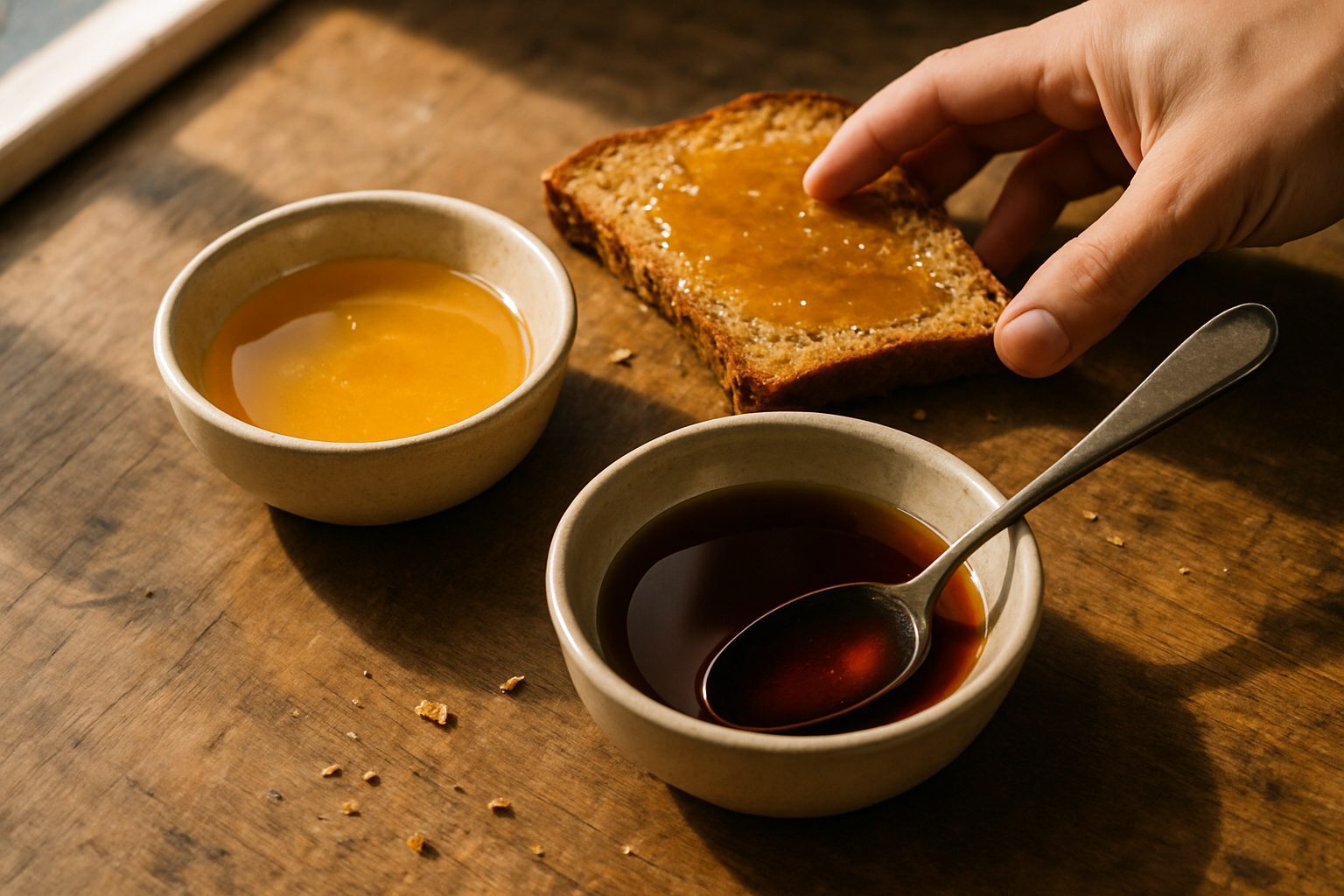
Maple syrup starts as mostly sucrose. Brush-border sucrase in the small intestine cleaves it into glucose and fructose, which then use separate transport routes: glucose largely uses SGLT1 and fructose uses GLUT5. Glucose stimulates insulin release; fructose is handled largely by the liver. The body does not experience maple syrup as intact sucrose for very long.
Honey arrives with much of its fructose and glucose already free. Its glucose can be absorbed promptly, while fructose absorption depends on GLUT5 capacity and is often better tolerated when glucose accompanies it. Honey’s fructose-to-glucose balance varies by flower source, which is why crystal formation and digestive tolerance differ among jars.
A small amount of honey’s carbohydrate includes oligosaccharides that can reach gut microbes, but the dose in a teaspoon or tablespoon is modest. Calling honey a meaningful prebiotic food exaggerates the serving size. Beans, oats, onions, garlic, and firm green bananas provide far more fermentable substrate for short-chain fatty acid production.
Honey’s excess fructose and the low-FODMAP issue
For people with fructose malabsorption or IBS following a structured low-FODMAP plan, maple syrup is generally the easier choice. Honey can contain excess fructose relative to glucose, leaving some fructose incompletely absorbed. Water then moves into the bowel, and colonic fermentation can create gas, pain, or urgent stools.
Symptoms often appear after a supposedly modest “healthy” breakfast: honey stirred into yogurt, a banana, granola, and coffee can stack several fermentable carbohydrates. Maple syrup does not make a meal low-FODMAP by itself, but it is commonly used as the sweetener substitution. Test tolerance with the portion specified by your clinician or dietitian rather than declaring all honey permanently off-limits.
Antioxidants are chemistry, not permission for a larger pour
Honey contains polyphenols and other plant-derived compounds transferred from nectar, while maple syrup contains phenolics formed or concentrated during sap boiling. Darker products can taste more robust because those compounds and caramelized notes are more noticeable, but color is not a standardized antioxidant score.
Heat and storage change delicate honey enzymes and some aroma compounds. Raw honey may retain more enzyme activity than heavily heated, filtered honey, yet raw honey is still mostly sugar. A 2023 review of controlled honey trials found possible cardiometabolic improvements, while emphasizing substantial uncertainty from floral source, dose, and processing differences; read the honey trial review as substitution evidence, not a reason to add honey freely.
Honey vs maple syrup glycemic index: why one number misleads
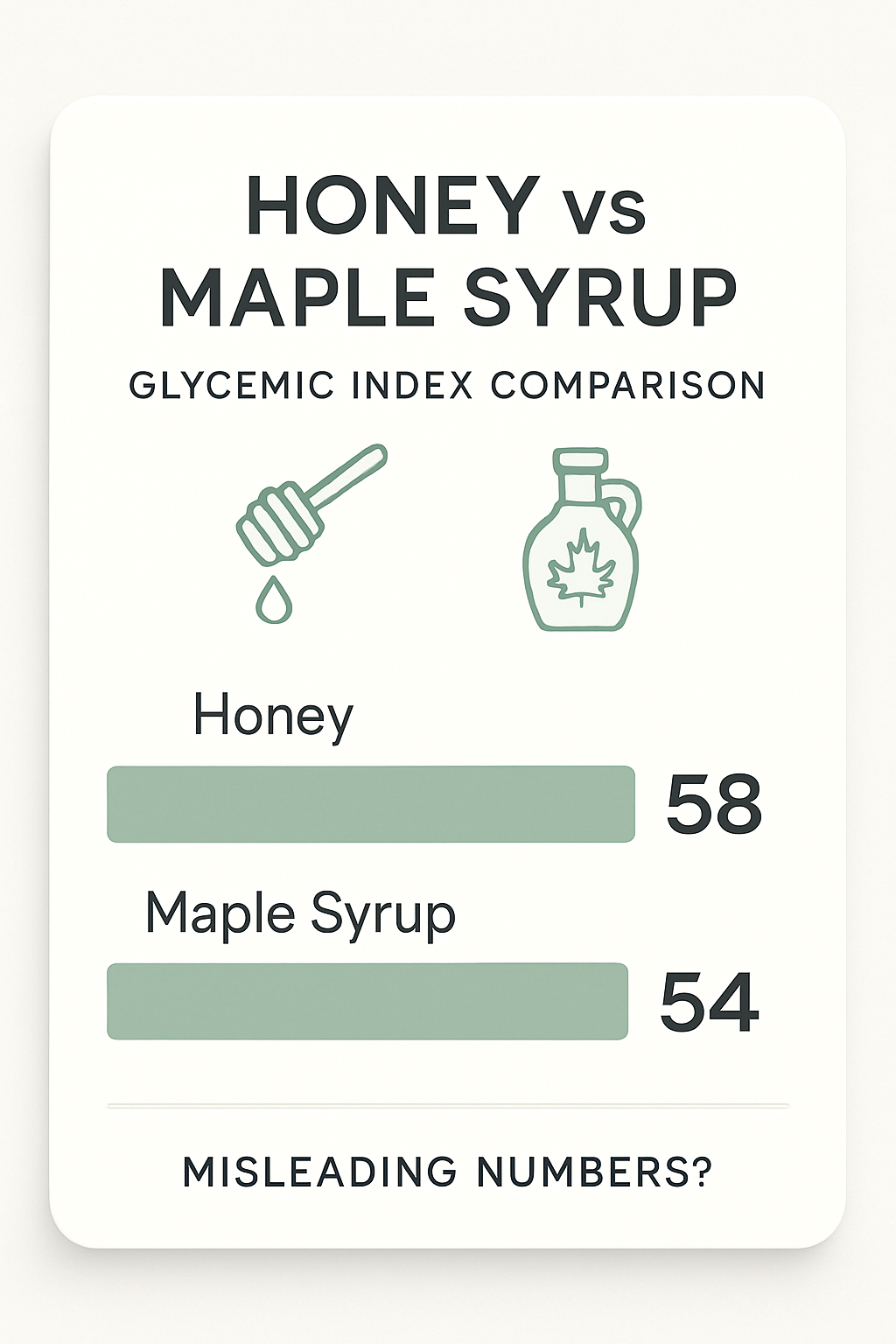
Glycemic index measures the blood-glucose response to a portion containing 50 g of available carbohydrate compared with a reference food. That is a laboratory protocol, not the usual teaspoon on toast. Reaching 50 g carbohydrate would require about 3 tablespoons of honey or nearly 4 tablespoons of maple syrup—far more than many people use at once.
Generic charts often list maple syrup around 54 and honey around 50 to 65. The honey number deserves caution. A human comparison of several U.S. honey varieties reported values around 69 to 74, demonstrating that a generic “low-GI honey” claim is unreliable. The underlying variety data are described in this honey glycemic-index study.
Glycemic load adjusts GI for the carbohydrate quantity actually eaten, so it is more useful for portion planning. Yet even GL omits the meal. A tablespoon of syrup on fiber-rich oats with walnuts and protein-rich milk generates a different curve from the same tablespoon dissolved in a sweet iced coffee on an empty stomach.
For diabetes, replace sugar rather than add “natural” sugar
Maple syrup is my preferred option for people with diabetes who want a small amount of real sweetener, largely because measured portions are lower in sugar per tablespoon and maple has fewer low-FODMAP complications. That does not establish maple syrup as a treatment for diabetes, nor does it mean honey is forbidden.
A 2024 double-blind crossover trial in 42 adults with mild cardiometabolic changes replaced 5% of energy from refined sugar with maple syrup for eight weeks. It reported improved oral-glucose-tolerance-test glucose AUC and small favorable changes in systolic pressure and android fat versus flavored sucrose syrup. The 2024 maple-syrup trial compared maple with sucrose, not maple with honey, and did not test adding syrup to an otherwise unchanged diet.
In clinical nutrition conversations, the more useful questions are: “How much did you use?”, “What food did it accompany?”, and “What does your glucose monitor show for your own repeated meal?” People taking insulin or sulfonylureas should keep carbohydrate doses consistent and discuss larger dietary changes with their prescribing clinician.
At 350°F, honey darkens before maple does
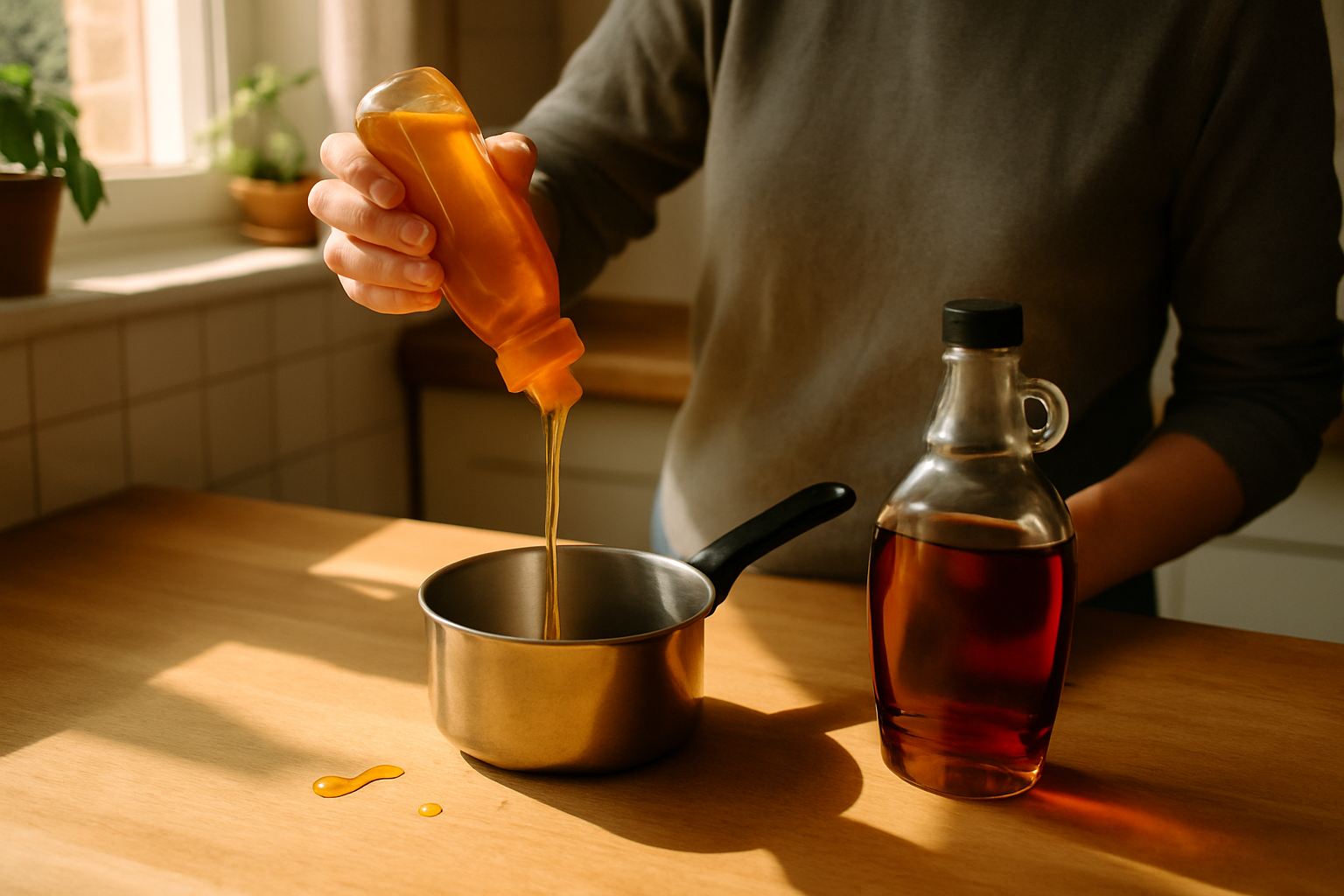
Honey browned faster in a 350°F oat-bar test because its free glucose and fructose are reducing sugars. By minute 14, the honey batch had a deeper amber rim and a toasted, almost butterscotch aroma; the maple batch stayed more evenly golden through minute 18. The named food-science principle is the Maillard reaction: reducing sugars react with amino groups from proteins, creating brown pigments and hundreds of aroma compounds.
Maple syrup is mostly sucrose, which must first split or thermally degrade before it contributes as strongly to Maillard browning. It still caramelizes and darkens, especially at concentrated hot spots, but it usually gives bakers a slightly wider visual margin. The maple bars tasted clean, woody, and rounded; the honey bars had a fuller floral top note and a stickier chew.
Honey’s higher viscosity creates a lacquered surface on roasted carrots and chicken thighs. Brush it on too early, and the glaze can blacken before the interior cooks. Maple syrup is thinner, so it spreads more easily in vinaigrettes and absorbs into oatmeal without leaving a dense sticky pocket at the bottom of the bowl.
The minute-two glaze mistake on a hot skillet
At a skillet surface temperature near 400°F, honey added directly to a pan sauce bubbled hard by minute two, turned bitter at the edges by minute four, and left a dark adhesive film by minute five. Maple syrup did the same eventually, but its change was slower and more even. Neither belongs in an empty, scorching pan.
- For a pan glaze: add either sweetener off heat.
- For roasting: brush on during final 8 minutes.
- For barbecue sauce: simmer below a hard boil.
- For tea: stir in after cooling slightly.
Raw honey’s enzyme activity declines with heating, but the practical reason to cool tea is flavor. Above roughly 140°F, delicate floral volatiles fade and honey can taste flatter. Maple is more forgiving in a hot drink, offering a mild caramel note rather than honey’s blossom-specific perfume.
Breakfast bowls expose the biggest taste difference
Honey tastes botanical. Clover honey is mild and candy-like; orange blossom honey can read citrusy; buckwheat honey is dark, malty, and faintly medicinal. That variation is exciting on ricotta toast or in plain yogurt, but it can clash with delicate fruit. A buckwheat honey drizzle overwhelmed strawberries in my tasting, while maple syrup let the berries remain the first flavor.
Maple syrup has a recognizable but narrower range: caramel, toasted wood, vanilla, and a faint mineral finish. Golden, delicate syrup is useful in coffee and lighter dressings. Amber, rich syrup works well with oats and pancakes. Dark, robust syrup stands up to rye bread, baked beans, and smoky sauces.
Maple syrup wins for breakfast consistency because it is less likely to compete with fruit, cinnamon, or coffee. Honey wins if the dish is intentionally built around its aroma—warm goat cheese, walnuts, and pear, for example. The trade-off is sensory, not a hidden nutritional superiority.
Maple syrup vs honey for baking without a collapsed cake
The difficult part of swapping maple for honey is not flavor; it is water. Pure maple syrup contains more water than honey, and honey is more hygroscopic, meaning it holds onto moisture from the surrounding food and air. A blind one-for-one swap can leave muffins looser, less glossy, and slightly less sweet.
Honey also tends to produce a softer, moister crumb over the next day. That is useful in gingerbread, granola bars, and chewy cookies. Maple gives a cleaner maple-caramel profile but may make a cake taste muted if the recipe has cocoa, coffee, or warm spices competing for attention.
Save this honey-to-maple substitution chart
These swaps assume pure maple syrup and standard liquid honey. Recipes with yeast, candy stages, or precise sugar crystallization need dedicated formulas rather than casual substitutions.
| Recipe need | Starting swap | Liquid adjustment | Kitchen note |
|---|---|---|---|
| Replace 1 tbsp honey | 1 tbsp maple | None | Milder sweetness |
| Replace ½ cup honey | ½ cup maple | Remove 1 tbsp | Check batter |
| Chewy granola bars | ¾ maple amount | None | Less binding |
| Cold salad dressing | Equal volume | None | Maple pours thinner |
| Roasted vegetables | ¾ maple amount | None | Add near finish |
For a tender quick bread, start with an equal-volume maple swap and remove one tablespoon of another liquid for every half cup of maple used. Taste the batter only if it contains no raw egg or flour; otherwise, bake a small test muffin. If sweetness feels low, increase maple by one tablespoon at a time rather than flooding the batter.
Four everyday goals and the better bottle for each
Choosing one sweetener for every scenario creates needless frustration. I still recommend maple as the household default, yet honey is the more effective ingredient in a few narrow applications. The table below is a decision tool, not a nutrition ranking.
| Kitchen goal | Better pick | Reason |
|---|---|---|
| Daily oatmeal | Maple syrup | Lower standard-pour sugar |
| Low-FODMAP dessert | Maple syrup | Usually better tolerated |
| Thick cheese glaze | Honey | Dense glossy coating |
| Warm lemon drink | Honey | Floral soothing taste |
For weight loss, neither ingredient is a metabolic shortcut. The winning move is reducing the pour while preserving satisfaction. Try maple’s strong dark grade in a measured teaspoon over Greek yogurt and berries, or use a fragrant honey that needs only a small drizzle. High-impact flavor can reduce the urge to keep adding sweetness.
Sweetened coffee is a frequent blind spot. A tablespoon of either sweetener disappears into a large latte with little sensory payoff. Start with one teaspoon, use cinnamon or vanilla for aroma, and drink it with a meal if an empty-stomach sweet coffee produces a noticeable energy crash.
Price, availability, and labels that reveal a fake
Honey is usually easier to buy in any supermarket, convenience store, or farmers’ market. Basic blended honey is often less expensive per ounce than pure maple syrup, while monofloral, local, and raw honeys can cost far more. Maple syrup generally costs more because sap must be collected and concentrated dramatically; a large volume of sap produces a small volume of syrup.
For a family using sweetener daily, price can favor honey—but only if the honey is actually used in small portions. Maple’s lighter viscosity makes it easier to overpour from a wide-mouthed bottle. A measured tablespoon or a narrow-pour spout prevents a costly “healthy breakfast” from turning into three tablespoons.
What to check in ten seconds at the shelf
- Maple ingredient line: it should say “pure maple syrup.”
- Pancake syrup warning: corn syrup may dominate.
- Honey ingredient line: it should say “honey” only.
- Flavor blends: check for added sugar syrups.
- Grade wording: Grade A describes quality.
- Crystals in honey: normal, not spoilage.
“Maple-flavored syrup” is a different food from pure maple syrup and commonly contains corn syrup, color, flavorings, and preservatives. “Raw” honey is not a regulated guarantee of superior nutrition, and cloudy honey is not automatically better. Crystallization simply occurs when glucose comes out of solution; set the jar in warm water, not boiling water, to reliquefy it without scorching the aroma.
Storage: maple can mold, honey usually crystallizes
Honey’s low water activity makes it exceptionally shelf-stable. Keep the lid tight in a cool, dry cupboard, use a clean dry spoon, and expect quality to remain good for years. Honey may darken, crystallize, or lose some aroma over time, but a granular texture is normal. Fermentation is more likely if water is introduced into the jar.
Pure maple syrup is more perishable after opening because it contains far more water. Refrigerate it promptly at about 40°F or below. A clean, refrigerated bottle is best used within roughly 6 to 12 months after opening; discard it if mold, fizzing, a sour smell, or unusual cloudiness develops. Freezing maple syrup in a sealed container extends storage without making it solid like ice.
Do not scrape visible mold off maple syrup and continue using it. Mold can grow beyond the spot you see. Honey does not need refrigeration, and refrigerator storage can speed crystallization.
Environmental impact is about production systems, not a simple badge
Maple syrup is plant-based and suitable for vegans. Its impact depends on forest management, fuel used to evaporate sap, packaging, and transport. Modern reverse-osmosis systems can reduce the energy needed before boiling, while direct wood-fired evaporation has a different emissions profile. Buying regional maple syrup may reduce transport distance for shoppers in maple-producing areas.
Honey production supports managed honeybee colonies, but “buy honey to save bees” oversimplifies ecology. Honeybees are livestock in many agricultural settings, and dense apiaries can compete with native pollinators for floral resources. Responsible beekeeping, local forage conditions, transport practices, and colony management matter more than a jar’s rustic label.
Choose maple for vegan requirements and predictable single-ingredient labeling. Choose honey from a transparent beekeeper if its flavor and origin matter to you, but do not frame either purchase as automatically environmentally harmless.
Infants, allergies, and condition-specific limits
Never give honey to infants under 12 months. Honey can contain spores of Clostridium botulinum; an infant’s immature gut can allow those spores to grow and produce toxin. Heating honey at home does not make this a safe workaround. Maple syrup does not share that specific botulism warning, though babies do not need added sweeteners in routine foods.
Adults with pollen allergy do not automatically need to avoid honey. Reactions are uncommon but possible, particularly in people sensitive to bee-related proteins or pollen residues. Stop using a product and seek urgent care for hives, wheezing, swelling, or other signs of a serious allergic reaction.
People with diabetes, fatty liver disease, elevated triglycerides, or active weight-management goals should treat both as measured added sugars. A teaspoon in a balanced meal is a different exposure from several tablespoons in a smoothie, homemade “energy” drink, or breakfast bowl.
Questions people ask before pouring honey or maple
Is maple syrup better than honey for diabetics?
Pure maple syrup is the better default because a tablespoon contains less sugar and fewer calories, but it still raises blood glucose. Honey does not have a reliably lower glycemic index across varieties. Use a measured amount, account for the meal’s total carbohydrate, and follow the plan made with your diabetes clinician.
Which has less sugar per tablespoon: honey or maple syrup?
Pure maple syrup has less: about 12.1 g per tablespoon compared with about 17.2 g for honey. That answer changes slightly in a sweetness-matched recipe because honey often requires a smaller portion for the same perceived sweetness.
Does raw honey become unhealthy after heating?
Heating reduces enzyme activity and softens fragile floral aromas, yet it does not turn honey into a fundamentally different sugar source. Use raw honey unheated if you value its distinctive flavor. For baked goods, select honey because you want its browning and moisture retention, not because you expect raw-food properties to survive the oven.
Can I substitute maple syrup for honey in baking?
Yes, for many muffins, sauces, dressings, and quick breads. Start with equal volume, then remove one tablespoon of another liquid per half cup of maple syrup because maple is thinner. Watch browning and sweetness; yeast breads, caramel, and candy recipes need more exact formula changes.
Can babies have maple syrup?
Maple syrup does not carry honey’s under-12-month botulism restriction, but it is still an added sugar with no nutritional need for infants. Keep baby foods unsweetened so preference development is not built around concentrated sweetness.
This content is based on culinary research, food chemistry, and clinical nutrition data. It is for informational purposes only and does not constitute medical advice. Consult a qualified healthcare professional before making significant changes to your diet.